MCQ
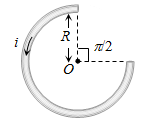
A current i ampere flows in a circular arc of wire whose radius is R, which subtend an angle 3π/2 radian at its centre. The magnetic induction B at the centre is
  • A
    $\frac{\mu_0 i}{R}$
  • B
    $\frac{\mu_0 \mathrm{i}}{2 R}$
  • C
    $\frac{2 \mu_0 \mathrm{i}}{R}$
  • $\frac{3 \mu_0 \mathrm{i}}{8 R}$

Answer

Correct option: D.
$\frac{3 \mu_0 \mathrm{i}}{8 R}$
(d) $\frac{3 \mu_0 \mathrm{i}}{8 R}$

Need a full question paper?

Generate a complete, print-ready paper with questions like this in minutes — across 16+ boards, with answer keys.

Start Generating Free

Similar questions

In Young's double slit experiment, one of the slit is wider than other, so that amplitude of the light from one slit is double of that from other slit. If $I_m$ be the maximum intensity, the resultant intensity $I$ when they interfere at phase difference $\phi$ is given by
Resistance of the wire is measured as $2\,\Omega$ and $3\,\Omega$ at $10^{\circ}C$ and $30^{\circ}C$ respectively. Temperature cocoefficient of resistance of the material of the wire is............$^{\circ}C ^{-1}$
A storage battery has e.m.f. 15 volts and internal resistance 0.05 ohm. Its terminal voltage when it is delivering 10 ampere is
A charge is brought from a point on the equatorial plane of a dipole to its mid-point. Which of the following quantities remains constant?
In the following, which one of the diodes reverse biased?
Half-life of a radioactive substance is 20 minutes. Difference between points of time when it is 33% disintegrated and 67% disintegrated is approximately
Assertion : In Young’s double slit experiment if wavelength of incident monochromatic light is just doubled, number of bright fringe on the screen will increase.

Reason : Maximum number of bright fringe on the screen is directly proportional to the wavelength of light used.

A galvanometer is used in laboratory for the null point in electrical experiments. If, on passing a current of $6 \,m A$ it produces a deflection of $2^{\circ},$ its figure of merit is close to :
The equivalent resistance between ends $A$ and $B$ is
Assertion : The force of repulsion between atomic nucleus and a-particle varies with distance according to inverse square law.
Reason : Rutherford did a-particle scattering experiment.