MCQ
The equivalent resistance between ends $A$ and $B$ is
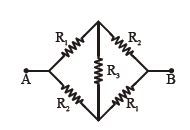
- AGreater than $\frac{{{R_{1\,}}\, + \,{R_2}}}{2}$
- BLess than $\frac{{2{R_1}{R_2}}}{{{R_{1\,}}\, + \,{R_2}}}$
- CEqual to $R_3$
- ✓Depends on $R_1, R_2$ and $R_3$
Also $\mathrm{R}_{\mathrm{AB}}$ depends upon $\mathrm{R}_{1}, \mathrm{R}_{2}$ and $\mathrm{R}_{3}$
Generate a complete, print-ready paper with questions like this in minutes — across 16+ boards, with answer keys.
Assertion $(A)$ and the other is labelled as Reason$(R)$
$Assertion$ $(A)$ : Work done by electric field on moving a positive charge on an equipotential surface is always zero.
$Reason$ $(R)$ : Electric lines of forces are always perpendicular to equipotential surfaces.
In the light of the above statements, choose the most appropriate answer from the options given below