Question
A current of 1.50A was passed through an electrolytic cell containing AgNO3 solution with inert electrodes. The weight of Ag deposited was 1.50g. How long did the current flow?

Answer

$\text{Ag}^++\text{e}^-\xrightarrow{ \ \ \ \ \ \ }\text{Ag}$
Quantity of charge required to deposit 108g of silver = 96500C
$\therefore$ Quantity of charge required to deposit 1.50g of silver $=\frac{96500}{108}\times1.50=1340.28\text{C}$
$\text{t}=\frac{\text{Q}}{\text{I}}$
$\therefore$ Time taken $=\frac{1340.28}{1.50}=893.52\text{s}$

Need a full question paper?

Generate a complete, print-ready paper with questions like this in minutes — across 16+ boards, with answer keys.
Start Generating Free

Similar questions

At 300K, 36g of glucose, C6H12O6 present per litre in its solution has an osmotic pressure of 4.98 bar. If the osmotic pressure of another glucose solution is 1.52 bar at the same temperature, calculate the concentration of the other solution.
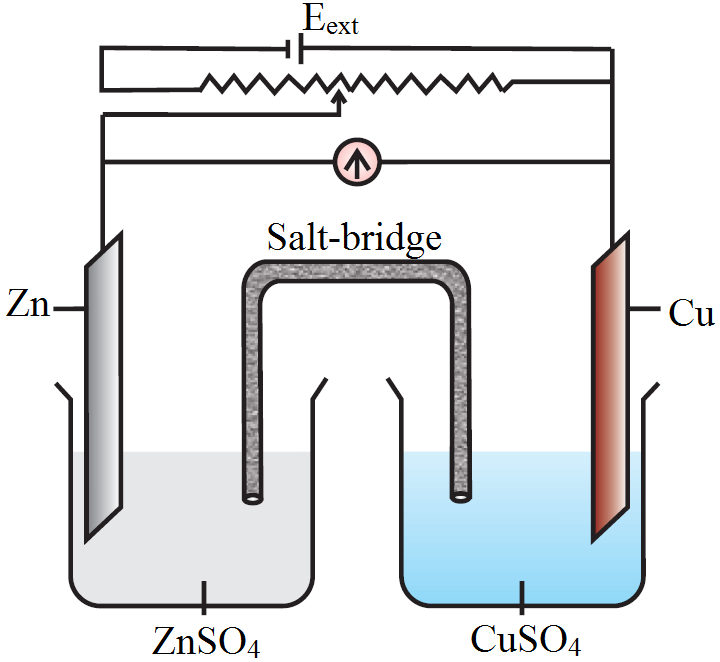
The electrochemical cell given alongside converts the chemical energy released during the redox reaction
$\text{Zn(s) + Cu}^{2+}\text{(aq)}\xrightarrow{ \ \ \ \ \ \ \ }\text{Zn}^{2+}(\text{aq) + Cu(s)}$
to electrical energy. It gives an electrical potential of 1.1V when concentration Zn2+ and Cu2+ ions is unity. State the direction of flow of current and also specify whether zinc and copper are deposited or dissolved at their respective electrodes when:
  1. An external opposite potential of less than 1.1V is applied.
  2. An external potential of 1.1V is applied.
  3. An external potential of greater than 1.1V is applied.

Explain dehydration of alcohols with chemical equations. And also give the order for relative ease of dehydration of alcohols.
  1. For the complex [Fe(CN)6]3–, write the hybridization type, magnetic character and spin nature of the complex.

(At. number: Fe=26).

  1. Draw one of the geometrical isomers of the complex [Pt(en)2Cl2]2+ which is optically active.
How many gram of Al metal will be obtained at the cathode by passing 0.1 Faraday electric current in $AlCl _3$ solution? (Atomic mass of Al $=27$ )
The rate constant for a first order reaction is 60 s-1 How much time will it take to reduce the concentration of the reactant to 1/10th of its initial value?
What happens when :
(i) Acetic acid reacts with chlorine in the presence of red phosphorus?
(ii) Silver acetate reacts with bromine in the presence of inert solvent $\left( CCl _4\right)$ ?
Define the term solution. How many types of solutions are formed? Write briefly about each type with an example.
Rate constant k for first order reaction has been found to be 2.54 × 10⁻³ s-1. Calculate its three-fourth life.
For the complex [Fe(en)2Cl2]Cl, (en = ethylene diamine), identify.
  1. The oxidation number of iron,
  2. The hybrid orbitals and the shape of the complex,
  3. The magnetic behaviour of the complex,
  4. The number of geometrical isomers,
  5. Whether there is an optical isomer also, And
  6. Name of the complex. (At. no. of Fe = 26).