MCQ
$A$ current of $(2.5 \pm 0.05)$ $A$ flows through a wire and develops a potential difference of $(10 \pm 0.1)$ $\mathrm{volt}.$ Resistance of the wire in $\mathrm{ohm},$ is
  • $4 \pm 0.12$
  • B
    $4 \pm 0.04$
  • C
    $4 \pm 0.08$
  • D
    $4 \pm 0.02$

Answer

Correct option: A.
$4 \pm 0.12$
a
$R=\frac{10}{2.5}=4 \pm \Delta R$

$\Delta R=0.03 \times 4=0.12$

Need a full question paper?

Generate a complete, print-ready paper with questions like this in minutes — across 16+ boards, with answer keys.

Start Generating Free

Similar questions

The mass density of a spherical galaxy varies as $\frac{ K }{ r }$ over a large distance $'r'$ from its centre. In that region, a small star is in a circular orbit of radius $R$. Then the period of revolution, $T$ depends on $R$ as
One end of a copper rod of uniform cross-section and of length $3.1$ m is kept in contact with ice and the other end with water at $100°C $ . At what point along it's length should a temperature of $200°C$ be maintained so that in steady state, the mass of ice melting be equal to that of the steam produced in the same interval of time. Assume that the whole system is insulated from the surroundings. Latent heat of fusion of ice and vaporisation of water are $80 cal/gm$ and $540$ cal/gm respectively
$1 \,\,kg$ of a gas does $20\,\, kJ$ of work and receives $16 \,\,kJ$ of heat when it is expanded between two states. $A$ second kind of expansion can be found between the initial and final state which requires a heat input of $9\,\, kJ$. The work done by the gas in the second expansion is  ....... $kJ$
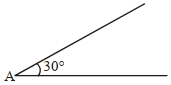
A sphere of mass $2\,kg$ and radius $0.5\, m$ is rolling with an initial speed of $1 \,ms ^{-1}$ goes up an inclined plane which makes an angle of $30^{\circ}$ with the horizontal plane, without slipping. How low will the sphere take to return to the starting point $A$ ? (in $second$)
A rod of legth l rotates with a uniform angular velocity $\omega$ about its perpendicular bisector. A uniform magnetic field B exists parallel to the axis of rotation. The potential difference between the two ends of the rod is:

  1. $\text{zero}$

  2. $\frac{1}{2}\text{Bl}\omega^2$

  3. $\text{Bl}\omega ^2$

  4. $2\text{B}\text{l}\omega^2$ 

A proton exerts a force on a proton which is:
  1. Gravitational.
  2. Electromagnetic.
  3. Nuclear.
  4. Weak.
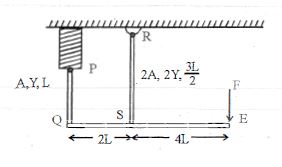
A rigid massless rod of length $6\ L$ is suspended horizontally by means of two elasticrods $PQ$ and $RS$ as given figure. Their area of cross section, young's modulus and lengths are mentioned in figure. Find deflection of end $S$ in equilibrium state. Free end of rigid rod is pushed down by a constant force . $A$ is area of cross section, $Y$ is young's modulus of elasticity
The velocity of a body depends on time according to the equation $v=\frac{t^2}{10}+20$. The body is undergoing
Energy of all molecules of a monoatomic gas having a volume $V$ and pressure $P$ is $\frac{3}{2}PV$. The total translational kinetic energy of all molecules of a diatomic gas as the same volume and pressure is
According to Reynolds, what will be the value of critical velocity?