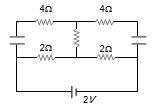
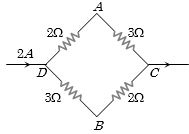
A current of $2\,A$ flows in a system of conductors as shown. The potential difference $({V_A} - {V_B})$ will be ............ $V$
Easy


Download our appand get started for free
Experience the future of education. Simply download our apps or reach out to us for more information. Let's shape the future of learning together!No signup needed.*
Similar Questions
- 1A steady current $i$ is flowing through a conductor of uniform cross-section. Any segment of the conductor hasView Solution
- 2Two electric bulbs ($60\,W$ and $100\,W$ respectively) are connected in series. The current passing through them isView Solution
- 3View SolutionA steel wire has a resistance twice that of an aluminium wire. Both of them are connected with a constant voltage supply. More heat will be dissipated in
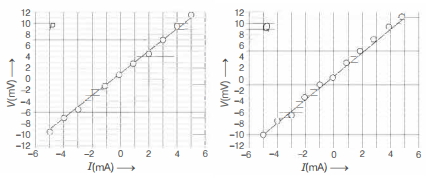
- 4Two students $P$ and $Q$ perform an experiment to verify Ohm's law for a conductor with resistance $R$. They use a current source and a voltmeter with least counts of $0.1 mA$ and $0.1 \,mV$, respectively. The plots of the variation of voltage drop $V$ across $R$ with current $I$ for both are shown below. The statement which is most likely to be correct?View Solution
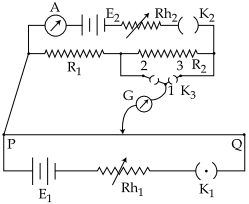
- 5A potentiometer $PQ$ is set up to compare two resistances as shown in the figure. The ameter $A$ in the circuit reads $1.0\, A$ when two way key $K_3$ is open. The balance point is at a length $l_1\, cm$ from $P$ when two way key $K_3$ is plugged in between $2$ and $1$ , while the balance point is at a length $l_2\, cm$ from $P$ when key $K_3$ is plugged in between $3$ and $1$ . The ratio of two resistances $\frac{{{R_1}}}{{{R_2}}}$ is found to beView Solution
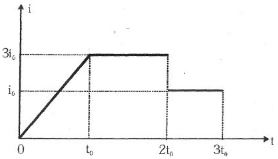
- 6A time varying current $i$ is passed through a resistance $R$ as shown in figure. The total heat generated in the resistance isView Solution
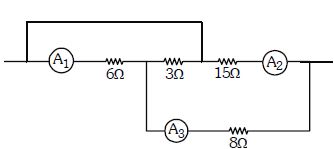
- 7A part of circuit is shown in figure. All the ammeters are ideal. If reading of ammeter $A_1$ is $1.0\ A$ , thenView Solution
- 8View SolutionThe example for non-ohmic resistance is
- 9An electric lamp is marked $60\, W$, $230\, V$. The cost of a $1\, kWh$ of energy is Rs. $1.25$. The cost of using this lamp $8$ hrs a day for $30$ day is Rs. ...............View Solution
- 10Find the power of the circuit ............ $W$View Solution