A current of $5\; {A}$ is passing through a non-linear magnesium wire of cross-section $0.04\; {m}^{2}$. At every point the direction of current density is at an angle of $60^{\circ}$ with the unit vector of area of cross-section. The magnitude of electric field at every point of the conductor is ....${V} / {m}$ (Resistivity of magnesium is $\rho=44 \times 10^{-8}\, \Omega m$)
JEE MAIN 2021, Diffcult
Download our app for free and get started
$I=\vec{J} \cdot \vec{A}=J A \cos (\theta)$
$5=J\left(\frac{4}{100}\right) \times \cos (60)$
$J=5 \times 50=250\, {A} / {m}^{2}$
Now, $\vec{E}=\rho \cdot \vec{J}$
$=44 \times 10^{-8} \times 250=11 \times 10^{-5}\, {V} / {m}$

Download our appand get started for free
Experience the future of education. Simply download our apps or reach out to us for more information. Let's shape the future of learning together!No signup needed.*
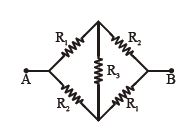
Similar Questions
- 1A thermocouple of negligible resistance produces an $e.m.f.$ of $40\,\mu V{/^o}C$ in the linear range of temperature. A galvanometer of resistance $10\; ohm$ whose sensitivity is $1\;\mu A/div$, is employed with the thermocouple. The smallest value of temperature difference that can be detected by the system will beView Solution
- 2In a Wheatstone’s bridge all the four arms have equal resistance $R$. If the resistance of the galvanometer arm is also $R$, the equivalent resistance of the combination as seen by the battery isView Solution
- 3Two wires $A$ and $B$ are made up of the same material and have the same mass. Wire A has radius of $2.0 \mathrm{~mm}$ and wire $B$ has radius of $4.0 \mathrm{~mm}$. The resistance of wire B is $2 \Omega$. The resistance of wire $\mathrm{A}$ is_______. $\Omega$.View Solution
- 4View SolutionIf a high power heater is connected to electric mains, then the bulbs in the house become dim, because there is a
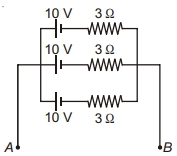
- 5Three identical cells are connected in parallel across $A B$. Net emf across $A B$ is .......... $V$View Solution
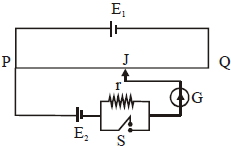
- 6A potentiometer wire $PQ$ of $1\,m$ length is connected to a standard cell $E _{1}$. Another cell $E _{2}$ of emf $1.02\, V$ is connected with a resistance $'r'$ and switch $S$ (as shown in figure). With switch $S$ open, the null position is obtained at a distance of $49\, cm$ from $Q$. The potential gradient in the potentiometer wire is.......$V/cm$View Solution
- 7If $400\; \Omega$ of resistance is made by adding four $100\; \Omega$ resistance of tolerance $5 \%$ then the tolerance of the combination is .....$\%$View Solution
- 8$10$ resistors, each of resistance $R$ are connected in series to a battery of $emf$ $E$ and negligible internal resistance. Then those are connected in parallel to the same battery, the current is increased $n$ times. The value of $n$ is :View Solution
- 9You are given a resistance wire of length $50\, cm$ and a battery of negligible resistance. In which of the following cases is largest amount of heat generatedView Solution
- 10The equivalent resistance between ends $A$ and $B$ isView Solution