Question
A cylindrical capacitor is constructed using two coaxial cylinders of the same length 10cm and of radii 2mm and 4mm:
  1. Calculate the capacitance.
  2. Another capacitor of the same length is constructed with cylinders of radii 4mm and 8mm. Calculate the capacitance.
Answer

  1. $\text{C}=\frac{2\in_0\text{L}}{\text{ln}\big(\frac{\text{R}_2}{\text{R}_1}\big)}=\frac{\text{e}\times3.14\times8.85\times10^{-2}\times10^{-1}}{\text{ln}2}$ $[\text{ln 2}=0.6932]$

$=80.17\times10^{-13}$

$\Rightarrow8\text{PF}$

  1. Same as $\frac{\text{R}_2}{\text{R}_1}$ will be same.

Need a full question paper?

Generate a complete, print-ready paper with questions like this in minutes — across 16+ boards, with answer keys.

Start Generating Free

Similar questions

According to Maxwell's theory of electrodynamics, an electron going in a circle should emit radiation of frequency equal to its frequency of revolution. What should be the wavelength of the radiation emitted by a hydrogen atom in ground state if this rule is followed?
Find the dimensions of Planck's constant h from the equation E = hv where E is the energy and v is the frequency.
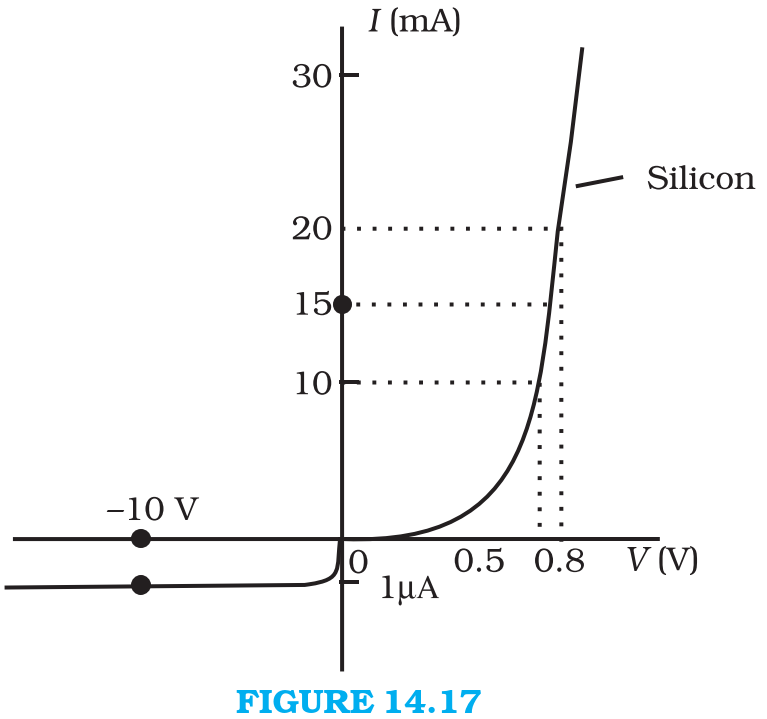
The $V-I$ characteristic of a silicon diode is shown in the Fig. 14.17. Calculate the resistance of the diode at (a) $I_D=15 mA$ and (b) $V_D=-10 V$.
Image
Arrange the following electromagnetic waves in the order of their increasing wavelength :
a. $\gamma$-rays
b. Microwaves
c. X-rays
d. Radio waves
How are infra-red waves produced? What role does infra-red radiation play in
i. maintaining the Earth's warmth and
ii. physical therapy?
A plane electromagnetic wave is propagating along Y -axis in vacuum. Write about the (i) ratio of magnitudes and (ii) directions of electric and magnetic fields.
A and B are two conducting spheres of equal radius, in which sphere $A$ is solid and sphere $B$ is hollow. Both are charged to the same potential. What will be the relation between the charges on both the spheres?
Find the maximum Coulomb force that can act on the electron due to the nucleus in a hydrogen atom.
A sphere of radius 5 cm has a charge of 31.41 µC. Calculate the surface density of charge.
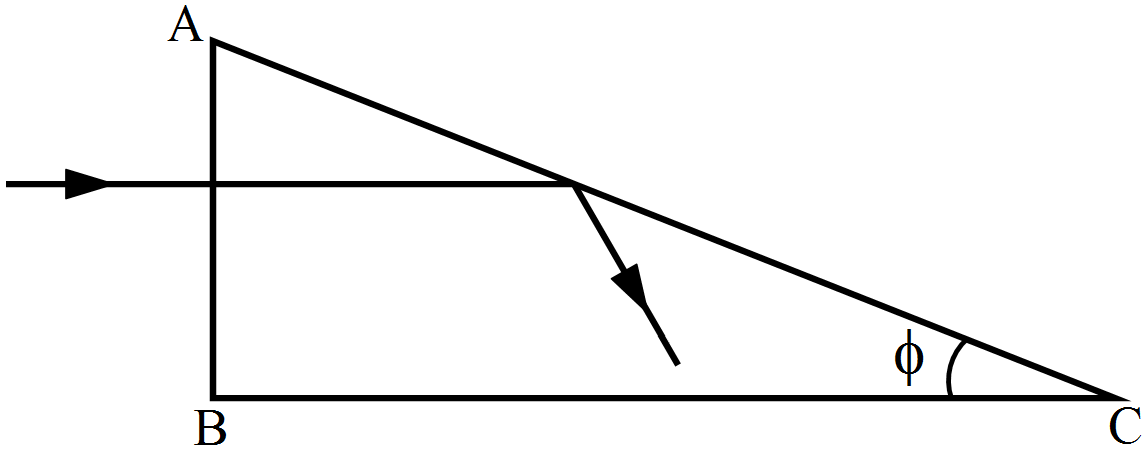
 A light ray is incident normally on the face AB of a right-angled prism ABC $(\mu=1.50)$ as shown in figure. What is the largest angle $\phi$ for which the light ray is totally reflected at the surface AC? 

Two transparent slabs having equal thickness but different refractive indices $\mu_1$ and $\mu_2$ are pasted side by side to form a composite slab. This slab is placed just after the double slit in a Young's experiment so that the light from one slit goes through one material and the light from the other slit goes through the other material. What should be the minimum thickness of the slab so that there is a minimum at the point P0 which is equidistant from the slits?