Question types

Capacitors question types

95 questions across 6 question groups — pick any mix to generate a Physics paper with step-by-step answer keys.

95
Questions
6
Question groups
5
Question types
Sample Questions

Capacitors questions

One sample from each question group in this chapter. Select any group above to see the full set with answer keys.

Q 1M.C.Q [1M]1 Mark
A capacitor of capacitance C is charged to a potential V. The flux of the electric field through a closed surface enclosing the capacitor is:
  1. $\frac{\text{CV}}{\in_0}$
  2. $\frac{\text{2CV}}{\in_0}$
  3. $\frac{\text{CV}}{2\in_0}$
  4. $\text{Zero}.$
View full solution
Q 2M.C.Q [1M]1 Mark
The capacitance of a capacitor does not depend on:
  1. The shape of the plates.
  2. The size of the plates.
  3. The charges on the plates.
  4. The separation between the plates.
View full solution
Q 3M.C.Q [1M]1 Mark
A dielectric slab is inserted between the plates of a capacitor. The charge on the capacitor is Q and the magnitude of the induced charge on each surface of the dielectric is Q':
  1. Q' may be larger than Q.
  2. Q' must be larger than Q.
  3. Q' must be equal to Q.
  4. Q' must be smaller than Q.
View full solution
Q 4M.C.Q [1M]1 Mark
Two metal spheres of capacitances C1 and C2 carry some charges. They are put in contact and then separated. The final charges Q1 and Q2 on them will satisfy:
  1. $\frac{\text{Q}_1}{\text{Q}_2}<\frac{\text{C}_1}{\text{C}_2}$
  2. $\frac{\text{Q}_1}{\text{Q}_2}=\frac{\text{C}_1}{\text{C}_2}$
  3. $\frac{\text{Q}_1}{\text{Q}_2}>\frac{\text{C}_1}{\text{C}_2}$
  4. $\frac{\text{Q}_1}{\text{Q}_2}=\frac{\text{C}_2}{\text{C}_1}$
View full solution
Q 5M.C.Q [1M]1 Mark
A parallel-plate capacitor has plates of unequal area. The larger plate is connected to the positive terminal of the battery and the smaller plate to its negative terminal. Let Q+ and Q- be the charges appearing on the positive and negative plates respectively:
  1. Q+ > Q-
  2. Q= Q-
  3. Q+ < Q-
  4. The information is not sufficient to decide the relation between Q+ and Q-.
View full solution
The plates of a parallel-plate capacitor are given equal positive charges. What will be the potential difference between the plates? What will be the charges on the facing surfaces and on the outer surfaces?
View full solution
Suppose a charge +Q1 is given to the positive plate and a charge -Q2 to the negative plate of a capacitor. What is the ''charge on the capacitor''?
View full solution
A capacitor has capacitance C. Is this information sufficient to know what maximum charge the capacitor can contain? If yes, what is this charges? If no, what other information is needed?
View full solution
A capacitor with stored energy 4.0J is connected with an identical capacitor with no electric field in between. Find the total energy stored in the two capacitors.
View full solution
Two conducting spheres of radii R1 and R2 are kept widely separated from each other. What are their individual capacitances? If the spheres are connected by a metal wire, what will be the capacitance of the combination? Think in terms of series-parallel connections.
View full solution
A cylindrical capacitor is constructed using two coaxial cylinders of the same length 10cm and of radii 2mm and 4mm:
  1. Calculate the capacitance.
  2. Another capacitor of the same length is constructed with cylinders of radii 4mm and 8mm. Calculate the capacitance.
View full solution
Q 173 Marks Question3 Marks
A charge of $20\mu\text{C}$ is placed on the positive plate of an isolated parallel-plate capacitor of capacitance $10\mu\text{F}.$ Calculate the potential difference developed between the plates.
View full solution
Q 183 Marks Question3 Marks
A charge of +2.0 × 10⁻⁸C is placed on the positive plate and a charge of -1.0 × 10⁻⁸C on the negative plate of a parallel-plate capacitor of capacitance $1.2\times10^{-3}\mu\text{F}.$ Calculate the potential difference developed between the plates.
View full solution
Q 193 Marks Question3 Marks
Suppose, one wishes to construct a 1.0 farad capacitor using circular discs. If the separation between the discs be kept at 1.0mm, what would be the radius of the discs?
View full solution
Q 203 Marks Question3 Marks
A large conducting plane has a surface charge density $1.0\times10^{-4}\text{Cm}^{-2}.$ Find the electrostatic energy stored in a cubical volume of edge 1.0cm in front of the plane.
View full solution
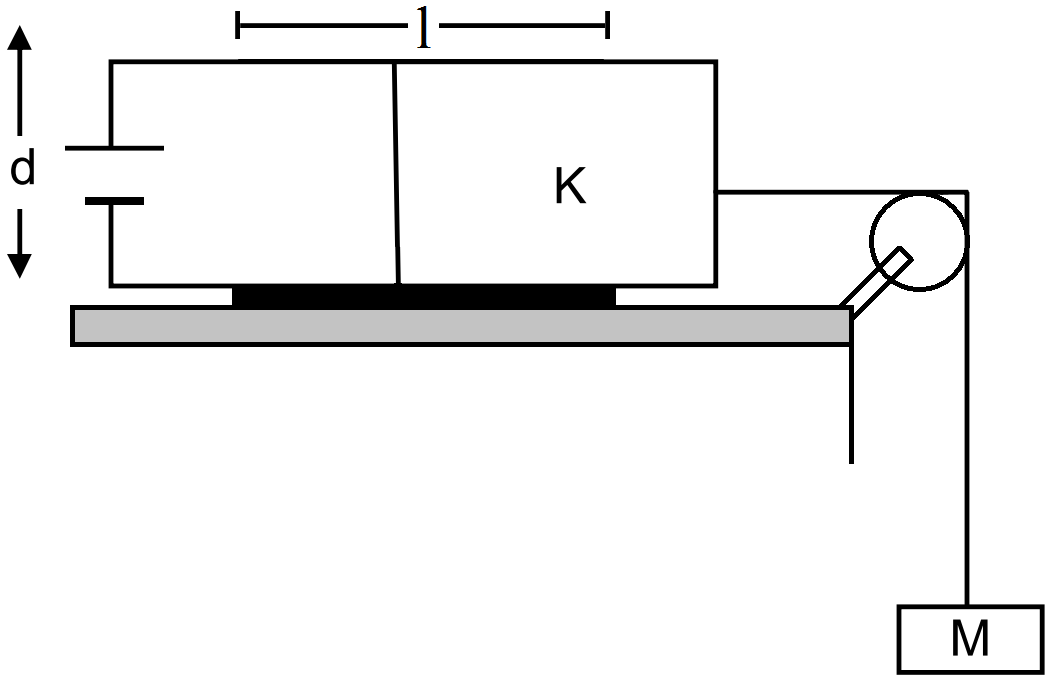
Consider the situation shown in figure. The width of each plate is b. The capacitor plates are rigidly clamped in the laboratory and connected to a battery of emf $\in.$ All surfaces are frictionless. Calculate the value of M for which the dielectric slab will stay in equilibrium.

View full solution
A $5.0\mu\text{F}$ capacitor is charged to 12V. The positive plate of this capacitor is now connected to the negative terminal of a 12V battery and vice versa. Calculate the heat developed in the connecting wires.
View full solution
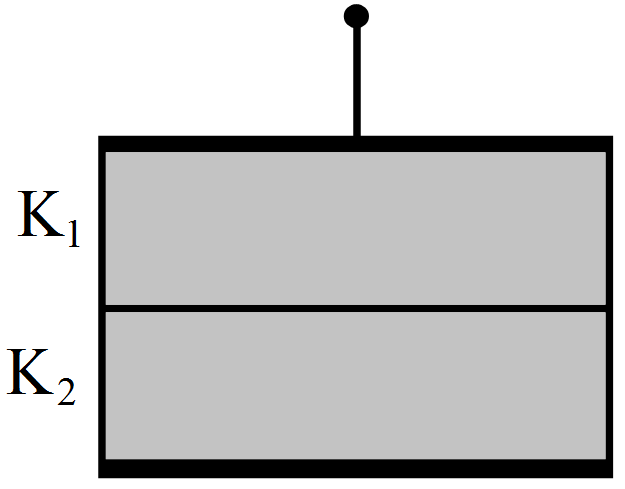
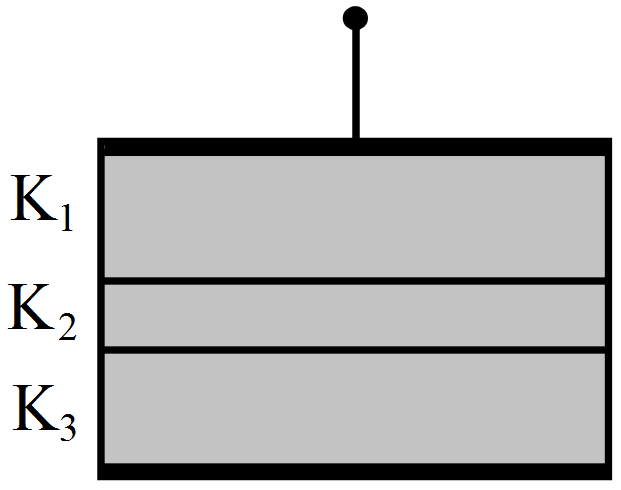
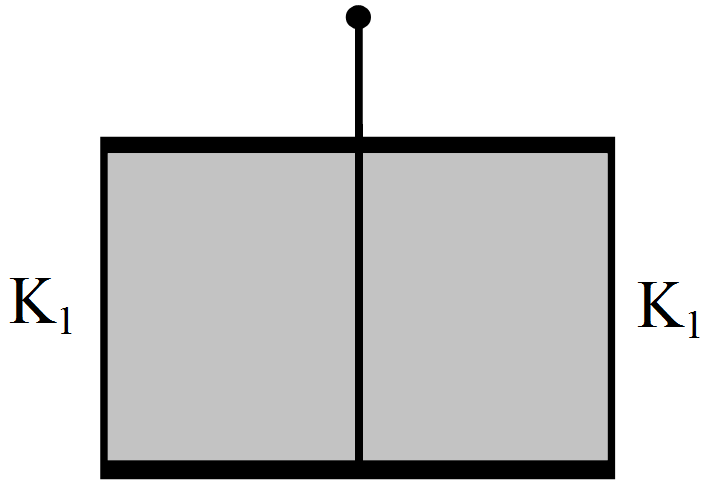
Find the capacitances of the capacitors shown in figure. The plate area is A and the separation between the plates is d. Different dielectric slabs in a particular part of the figure are of the same thickness and the entire gap between the plates is filled with the dielectric slabs.


View full solution

Generate a Capacitors paper free

Pick question groups from the list above, set marks and difficulty, and export a branded PDF with step-by-step answer keys. First 3 chapters free — no signup.

Download App