MCQ
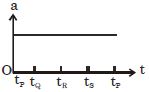
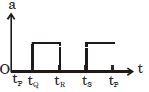
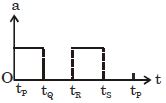
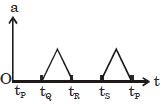
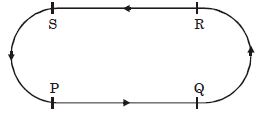
A dancer moves counterclockwise at constant speed around the path shown below. The path is such that the lengths of its segments, $PQ, QR, RS$, and $SP$, are equal. Arcs $QR$ and $SP$ are semicircles. Which of the following best represents the magnitude of the dancer’s acceleration as a function of time $t$ during one trip around the path, beginning at point $P$ ?
  • A


  • C

  • D

Answer

Correct option: B.

b
In the straight sections there is no acceleration, in the circular sections, there is a centripetal acceleration

Need a full question paper?

Generate a complete, print-ready paper with questions like this in minutes — across 16+ boards, with answer keys.

Start Generating Free

Similar questions

A thick rope of density $\rho$ and length $L$ is hung from a rigid support. The Young's modulus of the material of rope is $Y$. The increase in length of the rope due to its own weight is
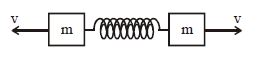
Two blocks each of mass $m$  are connected to a spring of spring constant $k.$  If both are given velocity $v$  in opposite directions, then the maximum elongation of the spring is
A litre of dry air at $STP$ expands adiabatically to a volume of $3$ litres. If $\gamma=1.40,$ the work done by air is$(3^{1.4}=4.6555)$ [Take air to be an ideal gas $]$
A monoatomic idea gas expands at constant pressure, with heat $Q$ supplied. The fraction of $Q$ which goes as work done by the gas is 
Two satellites $A$ and $B$ having masses in the ratio $4: 3$ are revolving in circular orbits of radii $3\,r$ and $4\,r$ respectively around the earth. The ratio of total mechanical energy of $A$ to $B$ is.
The potential energy, i.e., $U(x)$ can be assumed zero when:
The velocity of a particle moving on the $x-$ axis is given by $v = x^2 + x$ where $v$ is in $m/s$ and $x$ is in $m$ . Find its acceleration in $m/s^2$ when passing through the point $x = 2m$
When heat $Q$ is supplied to a diatomic gas of rigid molecules at constant volume its temperature increases by $\Delta T.$ The heat required to produce the same change in temperature, at constant pressure is
A particle moves along a circle if radius $\frac{{20}}{\pi }\;m$ with constant tangential acceleration. If the velocity of the particle is $80\;m/s$ at the end of the second revolution after motion has begun the tangential acceleration is
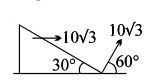
A particle is projected at angle $60^o$ with speed $10\sqrt 3 $, from the point $‘A’$ as shown in the figure. At the same time the wedge is made to move with speed $10\sqrt 3$ towards right as shown in the figure. Then the time after which particle will strike with wedge is  ........ $\sec$