MCQ
A circular loop carrying a current is replaced by an equivalent magnetic dipole. A point on the loop is in:
- AEnd-on position.
- BBroadside-on position.
- CBoth.
- DNone.
Explanation:
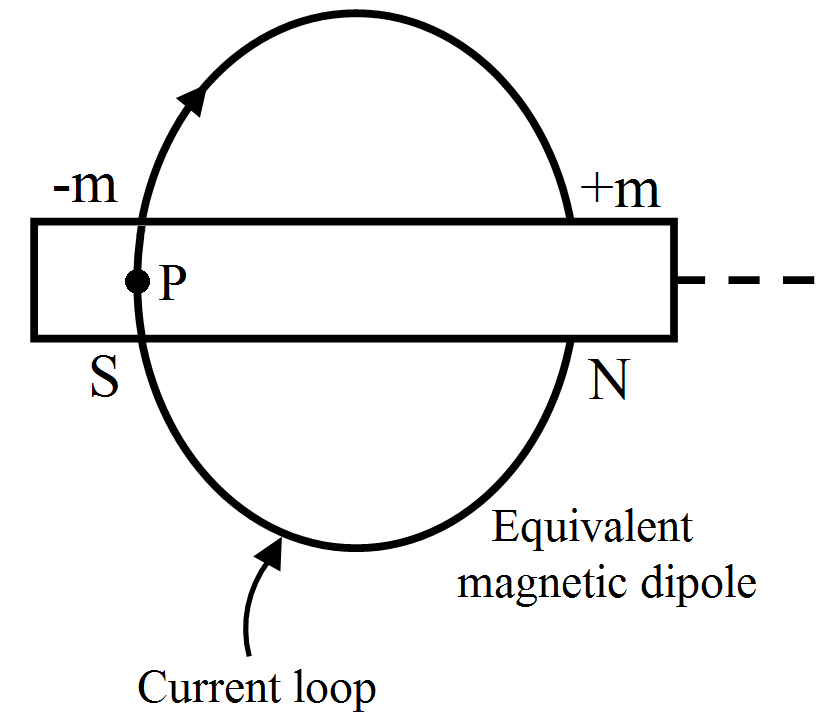
The position of the points lying on the equator of a magnetic dipole is called the broadside-on position. In our case, the point on the loop (after replacement of the circular loop with an equivalent magnetic dipole) lies on the equatorial position of the equivalent magnetic dipole. Hence, the point lies on the broadside-on position.
If P was the point on the loop, then it is clear from the figure that point P lies on the broadside-on position of the equivalent magnetic dipole.
Generate a complete, print-ready paper with questions like this in minutes — across 16+ boards, with answer keys.
Assertion : Mass of moving photon varies inversely as the wavelength.
Reason : Energy of the particle = Mass × 
|
(a) If both assertion and reason are true and the reason is the correct explanation of the assertion. |
|
(b) If both assertion and reason are true but reason is not the correct explanation of the assertion. |
|
(c) If assertion is true but reason is false. |
|
(d) If the assertion and reason both are false. |
A certain charge liberates 0.8 gm of  . The same charge will liberate how many gm of silver
|
(a) 108 gm |
(b) 10.8 gm |
(c) 0.8 gm |
(d) |
Assertion : The refractive index of diamond is  and that of liquid is
  . If the light travels from diamond to the liquid, it will totally reflected when the angle of incidence is 30o.
Reason : μ =  where m is the refractive index of diamond with respect to liquid.
|
(a) If both assertion and reason are true and the reason is the correct explanation of the assertion. |
|
(b) If both assertion and reason are true but reason is not the correct explanation of the assertion. |
|
(c) If assertion is true but reason is false. |
|
(d) If assertion is false but reason is true. |
If the mass number of an atom is A = 40 and its electron configuration is  , the number of neutrons and protons in its nucleus will be
| (a) 22, 18 | (b) 18, 22 |
(c) 20, 20 |
(d) 18, 18 |
The internal resistance of a cell depends on
|
(a) The distance between the plates |
(b) The area of the plates immersed |
|
(c) The concentration of the electrolyte |
(d) All the above |
A ray of light incident at an angle θ on a refracting face of a prism emerges from the other face normally. If the angle of the prism is 5º and the prism is made of a material of refractive index 1.5, the angle of incidence is:
