Questions · Page 1 of 5

M.C.Q (1 Marks)

🎯

Test yourself on this topic

50 questions · timed · auto-graded

MCQ 11 Mark
When the current through the electromagnet of a relay reaches a particular value:
  • A
    It breaks the circuit.
  • B
    It open the circuit by pulling in an iron contact.
  • C
    It closes the circuit by pulling in an iron contact.
  • D
    Both A or C.
Answer
  1. Both A or C.

Explanation:

They are ways of switching using a low current to use an electromagnet to close or open a spring steel contact.They are often used to isolate a user from a high voltage that needs to be switched, using low current, low voltage to operate the relay, rather than having a user come in direct proximity to the higher voltage that needs to be switched.When the current through the electromagnet of a relay reaches a particular value it either breaks the circuit by repllening or closes the circuit by pulling in an iron contact.
View full question & answer
MCQ 21 Mark
The magnetic compass is not useful for navigation near the magnetic poles, since:
  • A
    R = 0
  • B
    V = 0
  • C
    H = 0
  • D
    $\theta=0^\circ$
Answer
  1. H = 0
View full question & answer
MCQ 31 Mark
According to Lenz's law there is conversion of:
  • A
    Momentum.
  • B
    Collision.
  • C
    Voltage.
  • D
    Energy.
Answer
  1. Energy.

Explanation:

Lenz's law deals with conversion of mechanical energy into electromagnetic energy in case of electromagnetic induction. Hence Lenz's law is basically a conversion of energy from one form to another.

View full question & answer
MCQ 41 Mark
The magnetic susceptibility is negative for:
  • A
    Diamagnetic material only.
  • B
    Paramagnetic material only.
  • C
    Ferromagnetic material only.
  • D
    Paramagnetic and ferromagnetic materials.
Answer
  1. Diamagnetic material only.
View full question & answer
MCQ 51 Mark
The hysteresis cycle for the material of permanent magnet is:
  • A
    Short and wide.
  • B
    Tall and narrow
  • C
    Tall and wide.
  • D
    Short and narrow
Answer
  1. Tall and wide.
View full question & answer
MCQ 61 Mark
The upper limit temperature of a super conductor is:
  • A
    115K
  • B
    120K
  • C
    125K
  • D
    130K
Answer
  1. 125K

Explanation:

Superconductors are materials that conduct electricity with no resistance. This means that, unlike the more familiar conductors such as copper or steel, a superconductor can carry a current indefinitely without losing any energy.

The upper limit temperature of a superconductor is 125K

View full question & answer
MCQ 71 Mark
The substances which are attracted towards a magnet are called _______.
  • A
    Metals
  • B
    Ferro-magnetic materials
  • C
    Non-metals
  • D
    Dia-magnetic materials
Answer
  1. Ferro-magnetic materials

Explanation:

The substances which are attracted towards a magnet are called ferro-magnetic materials Materials that can be magnetized, which are also the ones that are strongly attracted to a magnet, are called ferromagnetic (or ferrimagnetic). These include iron, nickel, cobalt, some alloys of rare-earth metals, and some naturally occurring minerals such as lodestone.

View full question & answer
MCQ 81 Mark
Which of the following is the most suitable material for making permanent magnet?
  • A
    Steel.
  • B
    Soft iron.
  • C
    Copper.
  • D
    Nickel.
Answer
  1. Steel.
View full question & answer
MCQ 91 Mark
Permanent magnets should have:
  • A
    High retentivity and low coercivity.
  • B
    Low retentivity and high coercivity.
  • C
    High retentivity and high coercivity.
  • D
    Low retentivity and low coercivity.
Answer
  1. High retentivity and high coercivity.

Explanation:

Permanent magnets should have high retentivity so that a strong magnetic field persists on removal of magnetic field.

Permanent magnets should have high coercivity so that external magnetic field in opposite direction cannot easily demagnetize the magnet.

View full question & answer
MCQ 101 Mark
When does a magnetic dipole possess maximum potential energy inside a magnetic field?
  • A
    Magnetic moment and magnetic field are antiparallel.
  • B
    Magnetic moment and magnetic field are parallel.
  • C
    The magnetic moment is zero.
  • D
    The magnetic field is zero.
Answer
  1. Magnetic moment and magnetic field are antiparallel.

Explanation:

A magnetic dipole possess maximum potential energy when its magnetic moment and the magnetic field are antiparallel. When the magnetic dipole is aligned along the magnetic field, i.e. when $θ = 180^\circ,$ it is in unstable equilibrium having maximum potential energy.

View full question & answer
MCQ 111 Mark
The hysteresis cycle for the material of permanent magnet is:
  • A
    Short and wide.
  • B
    Tall and narrow.
  • C
    Tall and wide.
  • D
    Short and narrow.
Answer
  1. Tall and wide.

Explanation:

Permanent magnet should have large coercivity and large retentivity. Therefore, the hysteresis cycle of the material should be tall and wide.

View full question & answer
MCQ 121 Mark
The line of force in a magnetic field represents the direction at each point that a magnetic needle placed at the point takes up. Do they also represent the direction of the force on a moving charge at each point?
  • A
    Not possible.
  • B
    Represent circular motion.
  • C
    Represent tangential motion.
  • D
    Represents translatory motion.
Answer
  1. Not possible.

Explanation:

No. The force on a charge is perpendicular to the direction of the magnetic field at each point.

F = q (v × B).

It is inappropriate to call magnetic field lines as lines of force.

View full question & answer
MCQ 131 Mark
The value of Curie temperature for Ni is nearly:
  • A
    631K
  • B
    770K
  • C
    890K
  • D
    1100K
Answer
  1. 631K

Explanation:

Above 631K Ni behaves like paramagnetic material.

View full question & answer
MCQ 141 Mark
The inherent property of all materials is:
  • A
    Diamagnetism.
  • B
    Paramagnetism.
  • C
    Ferromagnetism.
  • D
    Both a and b.
Answer
  1. Diamagnetism.

Explanation:

Diamagnetism (where orbital motion of electrons creates tiny atomic current loops, which produce magnetic fields) is a property of all materials and opposes applied magnetic fields, but is very weak.

View full question & answer
MCQ 151 Mark
The permanent magnetic moment of the atoms of a material is zero. The material:
  • A
    Must be paramagnetic.
  • B
    Must be diamagnetic.
  • C
    Must be ferromagnetic.
  • D
    May be paramagnetic.
Answer
  1. Must be diamagnetic.

Explanation:

The permanent magnetic moment of the atoms of a material is zero. The material must be diamagnetic.

View full question & answer
MCQ 161 Mark
Lenz's law is a consequence of the law of conservation of:
  • A
    Energy.
  • B
    Momentum.
  • C
    Angular momentum.
  • D
    Charge and mass.
Answer
  1. Energy.

Explanation:

According to Lenz's law an induced electromotive force (emf) always gives rise to a current whose magnetic field opposes the original change in magnetic flux.

It is a common way of understanding how electromagnetic circuits obey newton's third law and the conservation of energy.

View full question & answer
MCQ 171 Mark
Magnetic field can be defined as the:
  • A
    Space surrounding the magnet in which magnetic force acts.
  • B
    Space surrounding the magnet in which electric force acts.
  • C
    Space surrounding the magnet in which no force acts.
  • D
    None.
Answer
  1. Space surrounding the magnet in which magnetic force acts.

Explanation:

A magnetic field is generated when electric charge carriers such as electrons move through space or within an electrical conductor. It is the space surrounding the magnet in which magnetic force acts. Its intensity is represented by magnetic lines of force.

View full question & answer
MCQ 181 Mark
In the hysteresis cycle, the value of H needed to make the intensity of magnetism zero is called:
  • A
    Retentivity.
  • B
    Coercive force.
  • C
    Lorentz force.
  • D
    None of the above.
Answer
  1. Coercive force.

Explanation:

The value of H needed to remove the residual magnetism is coercive force or coercivity.

View full question & answer
MCQ 191 Mark
The permanent magnetic moment of the atoms of a material is not zero. The material:
  • A
    Must be paramagnetic
  • B
    Must be diamagnetic
  • C
    Must be ferromagnetic
  • D
    May be paramagnetic
Answer
  1. Must be ferromagnetic

Explanation:

Unlike paramagnetic materials, the atomic moments in ferromagnetic materials exhibit very strong interactions. These interactions are produced by electronic exchange forces and result in a parallel or antiparallel alignment of atomic moments.

This results in permanent non-zero magnetic moment of atoms in these materials.

View full question & answer
MCQ 201 Mark
Which of the following statements can help you to determine the direction of induced current in Electromagnetic Induction?
  • A
    Induced current flows such that it increase the total value of current.
  • B
    Induced current flows such that it reduces the total value of current.
  • C
    Induced current flows such that direction of magnetic field produced from induced current opposes change in external magnetic field.
  • D
    Induced current flows such that direction of magnetic field produced from induced current opposes external magnetic field.
Answer
  1. Induced current flows such that direction of magnetic field produced from induced current opposes change in external magnetic field.

Explanation:

Lenz's Law states that the direction of an induced current is always such as to oppose the change in the circuit or the magnetic field that produces it. So according to this law, induced current flows to oppose the cause.

View full question & answer
MCQ 211 Mark
The magnetic force required to demagnetise the material is:
  • A
    Retentivity.
  • B
    Coercivity.
  • C
    Energy loss.
  • D
    Hysterisis.
Answer
  1. Coercivity.

Explanation:

Coercivity is the magnetic force required to demagnetise the material.

View full question & answer
MCQ 221 Mark
Demagnetisation of magnets can be done by:
  • A
    Rough handling.
  • B
    Heating.
  • C
    Magnetising in the opposite direction.
  • D
    All of the above.
Answer
  1. All of the above.
View full question & answer
MCQ 231 Mark
Consider the two idealized systems: (i) a parallel plate capacitor with large plates and small separation and (ii) a long solenoid of length L > > R, radius of cross-section. In (i) E is ideally treated as a constant between plates and zero outside. In (ii) magnetic field is constant inside the solenoid and zero outside. These idealised assumptions, however, contradict fundamental laws as below:
  • A
    Case (i) contradicts Gauss’s law for electrostatic fields.
  • B
    Case (ii) contradicts Gauss’s law for magnetic fields.
  • C
    Case (i) agrees with $\oint\text{E.dl=0.}$
  • D
    Case (ii) contradict $\oint\text{H.dl}=\text{I}_\text{en}$.
Answer
  1. Case (ii) contradicts Gauss’s law for magnetic fields.

Solution:

Key concept: The electrostatic field lines, do not form a continuous closed path (this follows from the conservative nature of electric field) while the magnetic field lines form the closed paths.

According to the Gauss' law, $\oint\text{E.ds}=\frac{\text{q}}{\in_0}$ for electronstatic field. It does not contradict foe eletrostatic fields as the elecric field lines do not form a continuous closed path.

According to Gauss' law in magnetism.

$\oint\text{B.ds}=0$

Which implies that number of magnetic field lines entering the Gaussian surface is equal to the number of magnetic field lines leaving it. Therefore case (ii) is not possible.

View full question & answer
MCQ 241 Mark
If $\mu_0$is absolute permeability of vacuum and $\mu\text{r}$ is relative magnetic permeability of another medium, then permeability $\mu$ of the medium is:
  • A
    $\mu\ \mu_\text{r}$
  • B
    $\frac{\mu}{\mu_\text{r}}$
  • C
    $\frac{\mu_\text{r}}{\mu}$
  • D
    $\frac{1}{\mu\ \mu_\text{r}}$
Answer
  1. $\mu\ \mu_\text{r}$
View full question & answer
MCQ 251 Mark
Which one of the following, when suspended freely, slowly sets itself parallel to the direction of the magnetic field?
  • A
    Ferromagnetic materials.
  • B
    Diamagnetic materials.
  • C
    Paramagnetic materials.
  • D
    Ferrimagnetic materials.
Answer
  1. Paramagnetic materials.

Explanation:

Paramagnetic materials are those when suspended freely inside the magnetic field, it slowly sets itself parallel to the direction of the magnetic field. When placed in a non-uniform magnetic field, it tends to move from weaker to a stronger magnetic field.

View full question & answer
MCQ 261 Mark
A magnetic field can be produced by:
  • A
    A moving charge.
  • B
    A changing electric field.
  • C
    None of these.
  • D
    Both of these.
Answer
  1. Both of these.

Explanation:

A moving charge and changing electric field both produces magnetic field.

View full question & answer
MCQ 271 Mark
The narrowest hysterisis loop is for:
  • A
    Cobalt steel
  • B
    Almico
  • C
    Soft magnetic material
  • D
    Stainless steel
Answer
  1. Soft magnetic material

Explanation:

A narrow hysteresis loop implies a small amount of dissipated energy. This occurs as a result of its small area and therefore more frequently repeated reversals of applied magnetising force. Soft magnetic are materials used in devices that require alternating magnetic fields have these narrow hysteresis shapes.

View full question & answer
MCQ 281 Mark
Permanent magnets are made from:
  • A
    Diamagnetic substances.
  • B
    Paramagnetic substance.
  • C
    Ferromagnetic substances.
  • D
    Wood.
Answer
  1. Ferromagnetic substances.

Explanation:

Ferromagnetic substance, Because they get magnetize in external magnetic field and don't lose their magnetic property.

View full question & answer
MCQ 291 Mark
Which of the following group is diamagnetic?
  • A
    Copper, hydrogen, silver.
  • B
    Copper, hydrogen, argon.
  • C
    Hydrogen, oxygen, argon.
  • D
    Copper, silver, oxygen.
Answer
  1. Copper, hydrogen, silver.

Explanation:

Diamagnetic substances are those which are freebly repelled by the magnetic field.

$\therefore$ Copper, Hydrogen, Silver are diamagnetic as their atoms have net magnetic dipole moment zero.

View full question & answer
MCQ 301 Mark
When a straight wire is moved up and down rapidly between two poles of a horseshoe magnet then _______ is produced in the wire.
  • A
    Magnetic field
  • B
    Magnetic current
  • C
    Electric current
  • D
    None
Answer
  1. Electric current

Explanation:

An electric current is produced in the wire. The production of electricity from magnetism is called electromagnetic induction.

View full question & answer
MCQ 311 Mark
A space or region around a magnet in which a force is experienced by magnetic pole is called.
  • A
    Magnetic field
  • B
    Magnetic force
  • C
    Magnetic moment
  • D
    Magnetic axis
Answer
  1. Magnetic field

Explanation:

A surrounding around a magnet in which source is felt is due to magnetic property of the magnet term as magnetic field.

View full question & answer
MCQ 321 Mark
The primary origin (s) of magnetism lies in:
  • A
    Atomic currents.
  • B
    Polar nature of molecules.
  • C
    Extrinsic spin of electron.
  • D
    None of these.
Answer
  1. Atomic currents.
View full question & answer
MCQ 331 Mark
The curie weiss law is obeyed by iron:
  • A
    At all temperatures.
  • B
    Above the curie temperature.
  • C
    Below the curie temperature.
  • D
    At the curie temperature.
Answer
  1. Above the curie temperature.

Explanation:

Curie - Wiess Law states that all ferromagnetic substances become paramagnteic above the curie temperature.

View full question & answer
MCQ 341 Mark
Find the false statement.
  • A
    Magnetic intensity is a vector quantity.
  • B
    Induced magnetization is a process where you can magnetize a non-magnetic material.
  • C
    Magnetic intensity and intensity of magnetization are the same.
  • D
    Total intensity is the measurement from the magnetometer after a model of the earth’s normal magnetic field is removed.
Answer
  1. Magnetic intensity and intensity of magnetization are the same.

Explanation:

The statement magnetic intensity and intensity of magnetization are the same is the false one. They are not the same. When a magnet is entering a magnetic field, then the poles of the magnet experiences certain forces. Magnetic intensity refers to the measure of these forces. But, the intensity of magnetization explains the change in the magnetic moment of a magnet as a function of volume. All the other statements are valid.

View full question & answer
MCQ 351 Mark
A magnetic needle of magnetic moment 6.7 × 10⁻² Am2 and moment of inertia 7.5 × 10⁻⁶kg m2 is performing simple harmonic oscillations in a magnetic field of 0.01 T. Time taken for 10 complete oscillations is:
  • A
    6.98 s.
  • B
    8.76 s.
  • C
    6.65 s.
  • D
    8.89 s.
Answer
  1. 6.65 s.
View full question & answer
MCQ 361 Mark
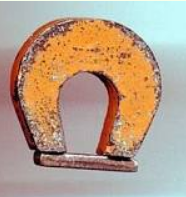
A horse-shoe magnet is an example of ________.
  • A
    Natural magnet.
  • B
    Artificial magnet.
  • C
    Neither natural nor artificial.
  • D
    None of these options.
Answer
  1. Artificial magnet.

Explanation:

Artificial magnets are man-made magnets. Magnets that are made from iron in different components shapes and sizes for different uses are called artificial magnets.

View full question & answer
MCQ 371 Mark
Which of the following is another term for magnetization?
  • A
    Magnetic neutrality.
  • B
    Magnetic polarization.
  • C
    Magnetic power.
  • D
    Magnetic moment.
Answer
  1. Magnetic polarization.

Explanation:

Magnetization is also termed as magnetic polarization. Magnetic polarization is basically a balance between the magnetic flux density in a space which is devoid of matter and the magnetic flux density in a space with matter, i.e. in a material.

View full question & answer
MCQ 381 Mark
A circular coil and a bar magnet moves with the same velocity. Then
  • A
    There will be no induced emf in the coil.
  • B
    There will be an induced emf in the coil.
  • C
    An emfwill be induced in the magnet.
  • D
    None ofthese.
Answer
  1. There will be no induced emf in the coil.

Explanation:

Since the coil and the magnet are moving with same velocity, so there will be no change in magnetic flux linked with the coil due to magnet. Hence no emf is induced in the coil.

View full question & answer
MCQ 391 Mark
Materials suitable for permanent magnet, must have which of the following properties?
  • A
    High retentivity, low coercivity and high permeability.
  • B
    Low retentivity, low coercivity and low permeability.
  • C
    Low retentivity, high coercivity and low permeability.
  • D
    High retentivity, high coercivity and high permeability.
Answer
  1. High retentivity, high coercivity and high permeability.
View full question & answer
MCQ 401 Mark
In an atom, electrons revolve around the nucleus. This gives rise to:
  • A
    Only electric field.
  • B
    Only magnetic field.
  • C
    Both electric and magnetic fields.
  • D
    None of the above.
Answer
  1. Both electric and magnetic fields.

Explanation:

When a charge electron starts to move, electric current generates and this electric current generates magnetic field, a charge at rest also can generate electric field.

View full question & answer
MCQ 411 Mark
Which of the following is the definition for magnetic meridian of Earth?
  • A
    Vertical plane passing through the axis of a freely suspended or pivoted magnet.
  • B
    Horizontal plane passing through the axis of a freely suspended or pivoted magnet.
  • C
    Vertical plane passing through the geographical North Pole and South Pole at a given place.
  • D
    Horizontal plane passing through the geographical North Pole and South Pole at a given place.
Answer
  1. Vertical plane passing through the axis of a freely suspended or pivoted magnet.

Explanation:

A vertical plane passing through the axis of a freely suspended or pivoted magnet is known as magnetic meridian of Earth. The vertical plane passing through the geographical North Pole and South Pole at a given place is known as the geographical meridian of that place.

View full question & answer
MCQ 421 Mark
ike magnetic force ______ each other.
  • A
    Repel
  • B
    Attract
  • C
    Strike
  • D
    All
Answer
  1. Repel

Explanation:

Like magnetic force repel each other whereas unlike magnetic poles attract each other.

View full question & answer
MCQ 431 Mark
When a ferromagnetic material goes through a hysteresis loop, the magnetic susceptibility:
  • A
    Has a fixed value.
  • B
    May be zero.
  • C
    May be infinity.
  • D
    May be negative.
Answer
  1. May be zero.
  2. May be infinity.
  3. May be negative.

Explanation:

When a ferromagnetic material goes through a Hysteresis loop, the Magnetic susceptibility may be zero, may be infinity or may be negative.

View full question & answer
MCQ 441 Mark
On cutting a solenoid in half, the field lines remain ...A... emerging from one face of the solenoid and entering into the other face.
Here, A refers to.
  • A
    Irregular.
  • B
    Discontinuous.
  • C
    Continuous.
  • D
    Alternate.
Answer
  1. Continuous.
View full question & answer
MCQ 451 Mark
A circular loop carrying a current is replaced by an equivalent magnetic dipole. A point on the axis of the loop is in:
  • A
    End-on position.
  • B
    Broadside-on position.
  • C
    Both.
  • D
    None of these.
Answer
  1. End-on position.
View full question & answer
MCQ 461 Mark
The value of resistivity of super conductor is:
  • A
    Zero
  • B
    Unity
  • C
    Infinity
  • D
    None of these
Answer
  1. Zero

Explanation:

In superconductors, the resistance drops abruptly to zero when the material is cooled below its critical temperature. Thus resistivity of superconductors is zero below its critical temperature.

View full question & answer
MCQ 471 Mark
Meena draws magnetic field lines of the field close to the axis of a current carrying circular loop. As she moves away from the center of the circular loop she observes that the lines keep ?
  • A
    on diverging.
  • B
    on converging.
  • C
    diappearing.
  • D
    none.
Answer
  1. on diverging.

Explanation:

Meena draws a magnetic field lines of field close to the axis of a current carrying circular loop.as she moves away from the centre of the circular loop she observes that the lines keep on diverging.Strength of the magnetic field falls as distance increases. This is indicated by the decrease in degree of closeness of the lines of field.

View full question & answer
MCQ 481 Mark
The desirable properties for making permanent magnets are:
  • A
    High retentivity and high coercive force.
  • B
    High retentivity and low coercive force.
  • C
    Low retentivity and high coercive force.
  • D
    Low retentivity and low coercive force.
Answer
  1. High retentivity and high coercive force.

Explanation:

Permanent magnetis are High retentivity and High coercive force.

View full question & answer
MCQ 491 Mark
A watch glass containing some powdered substance is placed between the pole pieces of a magnet. Deep concavity is observed at the centre. The substance in the watch glass is:
  • A
    Iron
  • B
    Chromium
  • C
    Carbon
  • D
    Wood
Answer
  1. Iron

Explanation:

Iron is a ferromagnetic substance the property which makes it attach to magnets. This causes the concavity. Chromium is anti-ferromagnetic, wood and carbon are not magnetic materials.

View full question & answer
MCQ 501 Mark
At Curie temperature the ferromagnetic materials get converted into.
  • A
    Non-magnetic material.
  • B
    Para magnetic material.
  • C
    Dia magnetic material.
  • D
    All of the above.
Answer
  1. Para magnetic material.

Explanation:

Above curie temperature ferromagnetic material behaves like paramganetic materials. There magnetic susceptibilty starts varying linearly with temperature. Their I becomes too small above curies temperature.

Therefore, nature of ferrromagnetic materials becomes paramagnetic.

View full question & answer