MCQ
A diamagnetic material in a magnetic field moves
  • A
    From weaker to the stronger parts of the field
  • B
    Perpendicular to the field
  • From stronger to the weaker parts of the field
  • D
    In none of the above directions

Answer

Correct option: C.
From stronger to the weaker parts of the field
c
(c) A diamagnetic material in a magnetic field moves from stronger to the weaker part of the field.

Need a full question paper?

Generate a complete, print-ready paper with questions like this in minutes — across 16+ boards, with answer keys.
Start Generating Free

Similar questions

In $NPN$ transistor the collector current is $20\, mA$. If $90\%$ of electrons emitted reach the collector, then
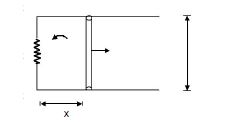
Two long parallel horizontal rails, a distance $l$ apart and each has a resistance $\lambda$ per  unit length are joined at one end by a resistance $R$. A perfectly conducting rod $MN$ of mass  $m$ is free to slide along the rails without friction. There is a uniform magnetic field of  induction $B$ normal to the plane of paper and directed into the paper. A variable force $F$ is applied to the rod $MN$ such that, as the rod moves, a constant current $i$ flows through $P$. The applied force $F$ as function of distance $x$ of the rod from $R$ is


One turn of insulated wire in the form of a planar square frame with side $l = 0.2\,m$ and resistance $1\,\Omega $ is placed in a uniform magnetic field perpendicular to the magnetic field lines. The current passing through the turn when magnetic field starts to decrease at a constant rate of $0.1\,T/ s$ is....$mA$
Ozone is found in
A particle moving with kinetic energy $E$ has de Broglie wavelength $\lambda$. If energy $\Delta \mathrm{E}$ is added to its energy, the wavelength become $\frac {\lambda}{2} .$ Value of $\Delta \mathrm{E},$ is 
A particle has a velocity $u$ towards east at $t = 0.$ Its acceleration is towards west and is constant. Let $\mathrm{x}_{\mathrm{A}} \text { and } \mathrm{x}_{\mathrm{B}}$ be the magnitude of displacements in the first $10$ seconds and the next $10$ seconds:
A  radiation of energy $'E'$ falls normally on a perfectly reflecting surface. The momentum transferred to the surface is $( C =$ Velocity of light $)$
The dual nature of light is exhibited by
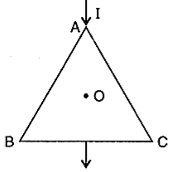
An equilateral triangle is made by uniform wires AB, BC, CA. A current I enteres at A and leaves from the midpoint of BC. If the lengths of each side of the triangle is L, the magnetic field B at the centroid O of the triangle is:
Image
In Young's double slit experiment, a glass plate is placed before a slit which absorbs half the intensity of light. Under this case