MCQ
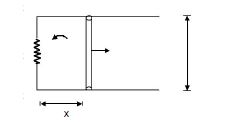
Two long parallel horizontal rails, a distance $l$ apart and each has a resistance $\lambda$ per  unit length are joined at one end by a resistance $R$. A perfectly conducting rod $MN$ of mass  $m$ is free to slide along the rails without friction. There is a uniform magnetic field of  induction $B$ normal to the plane of paper and directed into the paper. A variable force $F$ is applied to the rod $MN$ such that, as the rod moves, a constant current $i$ flows through $P$. The applied force $F$ as function of distance $x$ of the rod from $R$ is
 

  • A
    $i\,lB-\frac{2m \lambda i^2}{B^2 l^2}(R + 2 \lambda x)$
  • B
    $i\,lB+ \frac{4m \lambda i^2}{B^2 l^2}(R - 2 \lambda x)$
  • $i\,lB+ \frac{2m \lambda i^2}{B^2 l^2}(R + 2 \lambda x)$
  • D
    none of these

Answer

Correct option: C.
$i\,lB+ \frac{2m \lambda i^2}{B^2 l^2}(R + 2 \lambda x)$
c
$\mathrm{F}-\mathrm{i} \ell \mathrm{B}=\mathrm{ma}$            ........$(1)$

$\mathrm{B} \ell \mathrm{v}=\mathrm{i}(\mathrm{R}+2 \lambda \mathrm{x})$           ..........$(2)$

$\left(\frac{d V}{d x}\right)=\left(\frac{2 \lambda i}{B \ell}\right)$            ..........$(3)$

$a=V\left(\frac{d v}{d x}\right)=\left(\frac{2 \lambda i}{B \ell}\right)\left(\frac{i(R+2 \lambda x)}{B \ell}\right)$

$\mathrm{a}=\frac{2 \lambda \mathrm{i}^{2}}{\mathrm{B}^{2} \ell^{2}}(\mathrm{R}+2 \lambda \mathrm{x})$             ...........$(4)$

Need a full question paper?

Generate a complete, print-ready paper with questions like this in minutes — across 16+ boards, with answer keys.

Start Generating Free

Similar questions

A wire of length $L\, (=20\, cm)$, is bent into a semicircular arc. If the two equal halves of the arc were each to be uniformly charged with charges $ \pm Q\,,\,\left[ {\left| Q \right| = {{10}^3}{\varepsilon _0}} \right]$ Coulomb where $\varepsilon _0$ is the permittivity (in $SI\, units$) of free space] the net electric field at the centre $O$ of the semicircular arc would be
According to Joule's law, if the potential difference across a conductor having a material of specific resistance remains constant, then the heat produced in the conductor is directly proportional to
Radon (Ra) decays into Polonium $(p_{0})$ by emitting an α - particle with half-life of 4 days. A sample contains $6.4 \times 10^{10}$ atoms of Rn. After 12 days, the number of atoms of $R_n$ left in the sample will be
If a star can convert all the He nuclei completely into oxygen nuclei. The energy released per oxygen nuclei is $[$Mass of He nucleus is $4.0026$ amu and mass of Oxygen nucleus is $15.9994$ amu$]:$
If 3 charges are placed at the vertices of equilateral triangle of charge ‘q’ each. What is the net potential energy, if the side of equilateral ∆ is l cm
In a series resonant $LCR$ circuit, the voltage across $R$ is $100\,volts$ and $R = 1\, k\Omega $ with $C = 2\,\mu f$ .The resonant frequency $\omega $ is $200\,rad/s$. At resonance the voltage across $L$ is
The photo-electrons emitted from a surface of sodium metal are such that
Hydrogen atoms are excited from ground state of the principal quantum number 4. Then the number of spectral lines observed will be
Ten $60 \,W , 220 \,V$ bulbs are connected in series to $220 \,V$ supply. Power consumed in the circuit is ......... $W$
A particle of mass $m = 1.67 \times 10^{-27}\, kg$ and charge $q = 1.6 \times 10^{-19} \, C$ enters a region of uniform magnetic field of strength $1$ $tesla$ along the direction shown in the figure. The speed of the particle is $10^7\, m/s.$ The magnetic field is directed along the inward normal to the plane of the paper. The particle enters the field at $C$ and leaves at $D.$ Then the angle $\theta$ must be :-.........$^o$