Question
(a) Differentiate between
a. Nucleotide and Nucleoside
b. Amylose and Amylopectin
(b) Write a reaction which shows that all the carbon atoms in glucose are linked in a straight chain.
(c) Write two differences between DNA and RNA.
(d) Amino acids can be classified as $\alpha-, \beta-, \gamma-, \delta-$ and so on depending upon the relative position of the amino group with respect to the carboxyl group. Which type of amino acids forms a polypeptide chain in proteins?
(e) What are any two good sources of vitamin A?
(f) What is anomeric carbon?
(g) What is the difference between a glycosidic linkage and a peptide linkage?

Answer

Attempt any five of the following:
(i)
a. Nitrogeneous base linked with pentose sugar called as nucleoside while Nucleoside linked with phosphate group is called as nucleotide.
b. Amylose is water soluble while amylopectin is water insoluble.
(ii) On prolonged heating with HI, glucose gives n-hexane which suggest that all the six carbon atoms in glucose are linked linearly.
HOH_2 $HOH _2 C \underset{\text { Glu cose }}{( CHOH )_4 CHO }+ HI \xrightarrow{\Delta} CH _3\left( CH _2\right)_4 CH _3$
(iii) 
DNARNA
Double strandedSingle stranded
Thymine base is presentUracil base is present

Image
(v) Milk, carrot
(vi)An anomeric carbon can be identified as the carbonyl carbon (of the aldehyde or ketone functional group) in the open- chain form of the sugar. It can also be identified as the carbon bonded to the ring oxygen and a hydroxyl group in the cyclic form.
(vii) Glycosidic linkage: It is the linkage which joins two monosaccharides through oxygen atom. It is present in carbohydrates.
Peptide Linkage: It is the linkage which joins two amino acids through - CO-NH- bond. It is present in proteins.

Need a full question paper?

Generate a complete, print-ready paper with questions like this in minutes — across 16+ boards, with answer keys.

Start Generating Free

Similar questions

Rate constant for a first order reaction has been found to be $2.54 \times 10^{-3}s^{-1}.$ Calculate its three$-$fourth life.
Answer the following questions:
Give chemical reactions for the following observations:
  1. Potassium permanganate is a good oxidising agent in basic medium.
  2. Inter convertibility of chromate ion and dichromate ion in aqueous solution depends upon pH of the solution.
  3. Potassium permanganate is thermally unstable at 513K.
What is polymerisation? Define the terms 'addition polymerisation' and Give one example.
  1. Account for the following:
  1. Write the preparation of potassium permanganate from pyrolusite ore $\ce{(MnO_2)}.$
  2. $\ce{Mn_2O_7}$ is acidic whereas $\ce{MnO }$ is basic.
  3. Though copper has completely filled $d-$orbital $(d^{10})$ yet it is considered as a transition metal.
  4. Actinoids show wide range of oxidation states.
Prove that the relative depression of vapour pressure is equal to the mole fraction of solute.

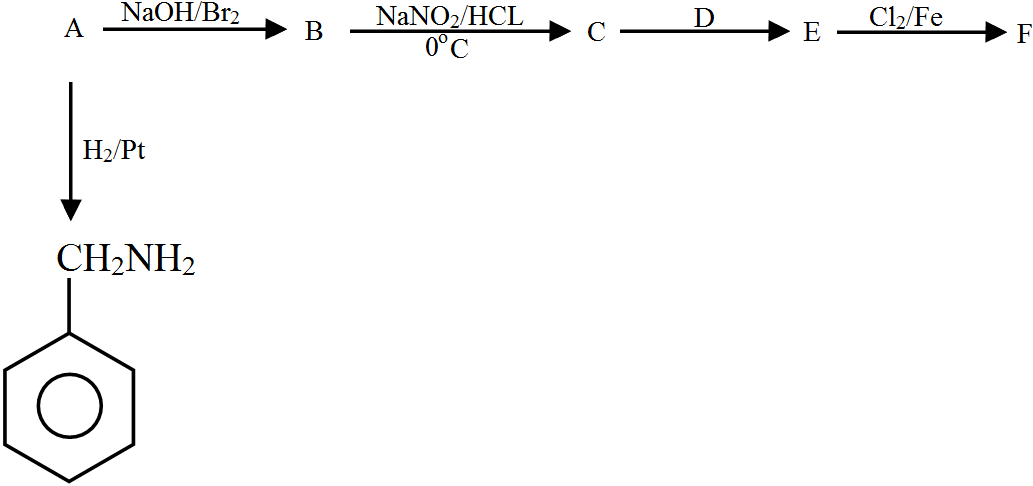
Write the structures of reagents/ organic compounds (A to F) in the following sequence of reactions:
Draw all the isomers of: (geometrical and optical)
i. $\left[ CoCl _2( en )_2\right]^{+}$
ii. $\left[ Co \left( NH _3\right) Cl ( en )^2\right]^{2+}$
iii. $\left[ Co \left( NH _3\right)_2 Cl _2( en )\right]^{+}$
A colorless substance ' $A$ ' $\left( C _6 H _7 N\right)$ is sparingly soluble in water and gives a water-soluble compound ' B ' on treating with a mineral acid. On reacting with CHCl 3 and alcoholic potash ' A ' produces an obnoxious smell due to the formation of compound ' C '. The reaction of ' A ' with benzene sulphonyl chloride gives compound ' D ' which is soluble in alkali. With $NaNO _2$ and HCl , ' A ' forms compound ' E ' which reacts with phenol in alkaline medium to give an orange dye ' $F$ '. Identify compounds ' $A$ ' to ' $F$ '.
Match the property given in Column $I$ with the element given in Column $II.$
 
Column $I ($Property$)$
 
Column $II ($Element$)$
$(i)$
Lanthanoid which shows $+4$ oxidation state
$(a)$ $Pm$
$(ii)$
Lanthanoid which can show $+2$ oxidation state
$(b)$ $Ce$
$(iii)$
Radioactive lanthanoid
$(c)$ $Lu$
$(iv)$
Lanthanoid which has $4f^7$ electronic configuration in $+3$ oxidation state
$(d)$ $Eu$
$(v)$
 Lanthanoid which has $4f^{14}$ electronic configuration in $+3$ oxidation state
$(e)$ $Gd$
 
 
$(f)$ $Dy$
  1. A $10\%$ solution $($by mass$)$ of sucrose in water has a freezing point of $269.15 K$. Calculate the freezing point of $10\%$ glucose in water if the freezing point of pure water is $273.15 K.$ Given:
$($Molar mass of sucrose $= 342\ g\ mol^{-1})$
$($Molar mass of glucose $= 180\ g\ mol^{-1})$
  1. Define the following terms:
  1. Molality $(m)$
  2. Abnormal molar mass