Question
Match the property given in Column $I$ with the element given in Column $II.$
 
Column $I ($Property$)$
 
Column $II ($Element$)$
$(i)$
Lanthanoid which shows $+4$ oxidation state
$(a)$ $Pm$
$(ii)$
Lanthanoid which can show $+2$ oxidation state
$(b)$ $Ce$
$(iii)$
Radioactive lanthanoid
$(c)$ $Lu$
$(iv)$
Lanthanoid which has $4f^7$ electronic configuration in $+3$ oxidation state
$(d)$ $Eu$
$(v)$
 Lanthanoid which has $4f^{14}$ electronic configuration in $+3$ oxidation state
$(e)$ $Gd$
 
 
$(f)$ $Dy$

Answer

  1. Lanthanoid shows $+4$ oxidation state$-$ Cerium $(Ce)$
  2. Lanthanoid shows $+2$ oxidation state$-$ Europium $(Eu)$
  3. Radioactive lanthanoid $-$ Promethium $(Pm)$
  4. Lanthanoid having $4f^7$ configuration in $+3$ states $-$ Gadolinium $(Gd)$
  5. Lanthanoid having $4f^{14}$ configuration in $+3$ states $-$ Lutetium $(Lu)$

Need a full question paper?

Generate a complete, print-ready paper with questions like this in minutes — across 16+ boards, with answer keys.

Start Generating Free

Similar questions

Explain the following phenomena with the help of Henry’s law.
  1. Painful condition known as bends.
  2. Feeling of weakness and discomfort in breathing at high altitude.
In a reaction between A and B, the inital rate of reaction (ro) was measured for different initial concentrations of A and B as given below :
$A / mol ^{-1}$0.200.200.40
$B / mol L ^{-1}$0.300.100.05
$r _0 / mol L ^{-1} s^{-1}$$5.07 \times 10^{-5}$$5.07 \times 10^{-5}$$1.43 \times 10^{-4}$
What is the order of the reaction with respect to A and B?
i. Write the structure of main products when aniline reacts with the following reagents :
a. $Br _2$ water
b. HCl
c. $\left( CH _3 CO \right)_2 O /$ pyridine
ii. Arrange the following in the increasing order of their boiling point:$C _2 H _5 NH _2, C _2 H _5 OH ,\left( CH _3\right)_3 N$
iii. Give a simple chemical test to distinguish between the following pair of compounds : $\left( CH _3\right)_2 NH$ and $\left( CH _3\right)_3 N$.
What is the difference between order of a reaction and its molecularity?
(i) Define the order of a reaction.
(ii) Explain the effect of concentration of reactant on the rate constant.
(iii) For a first order reaction, if the rate constant at 500 K and 600 K are $0.03 s^{-1}$ and $0.06 s^{-1}$ respectively, then calculate the activation energy.
$
\left[R=8.314 JK^{-1} mol^{-1}, \log 2=0.3010\right]
$
Primary alkyl halide $C _4 H _9 Br$ (a) reacted with alcoholic ROH to give compound (b). Compound (b) is reacted with HBr to give (c) which is an isomer of (a). When (a) is treated with sodium metal it gives compound (d), $C _8 H _{18}$ which is different from the compound formed when $n$-butyl bromide is reacted with sodium. Give the structural formula of (a) and write the equations for all the reactions.
A voltaic cell is set up at $25^\circ C$ with the following half$-$cells $Al^{3+} (0.001M)$ and $Ni^{2+} (0.50M).$ Write an equation for the reaction that occurs when the cell generates an electric current and determine the cell potential.
$(\text{Given:}\text{ E}^{\circ}_{\text{Ni}^{2+}/\text{Ni}}=-0.25\text{V,E}^{\circ}_{\text{Al}^{3+}/\text{Al}}=-1.66\text{V})$
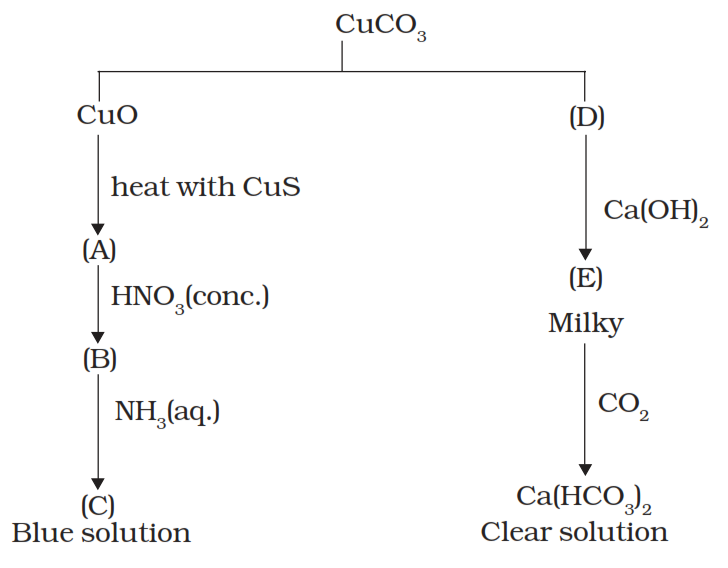
Identify $A$ to $E$ and also explain the reactions involved.
Attempt any five of the following:
$(a)$ Deficiency of which vitamin causes night-blindness.
$(b)$ Give two examples of reducing sugars.
$(c)$ Define the following terms:
$i.$ Glycosidic linkage
$ii.$ Native protein
$(d)$ Write function of carbohydrates in plants.
$(e)$ Differentiate between:
$i.$ Peptide linkage and Glycosidic linkage
$ii.$ Nucleoside and Nucleotide
$(f)$ What type of linkage holds together the monomers of $\text{DNA}$?
$(g)$ Write the product obtained when $D-$glucose reacts with $H_2N-OH.$
Describe the dispersion methods for preparation of colloidal solution.