MCQ
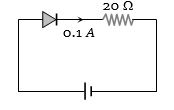
A diode having potential difference $0.5\, V$ across its junction which does not depend on current, is connected in series with resistance of $20$ $\Omega$ across source. If $0.1\, A$ passes through resistance then what is the voltage of the source.....$V$
  • A
    $1.5$
  • B
    $2$
  • $2.5$
  • D
    $5$

Answer

Correct option: C.
$2.5$
c
(c)$V' = V + IR$
$= 0.5 + 0.1 + 20$
$= 2.5\, V$

Need a full question paper?

Generate a complete, print-ready paper with questions like this in minutes — across 16+ boards, with answer keys.

Start Generating Free

Similar questions

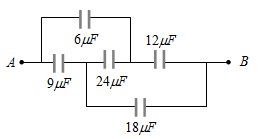
In the connections shown in the adjoining figure, the equivalent capacity between A and B will be
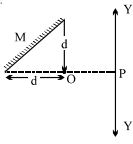
As shown in the figure a particle is placed at $O$ in front of a plane mirror $M$. $A$ man at $P$ can move along path $PY$ and $PY'$ then which of the following is true
Reactance of a capacitor of capacitance $C\mu F$ for $ac$ frequency $\frac{{400}}{\pi }$ $Hz$ is $25\Omega $. The value $C$ is.....$\mu F$
A tangent galvanometer has a coil of $25$ $turns$ and a radius of $15\, cm$. The horizontal component of the earth’s magnetic field is $3\times10^{-5}\, T$. The current required to produce a deflection of $45^o$ in it is....$A$
Consider the following statements :

$A.$ Atoms of each element emit characterstics spectrum.

$B.$ According to Bohr's Postulate, an electron in a hydrogen atom, revolves in a certain stationary orbit.

$C.$ The density of nuclear matter depends on the size of the nucleus.

$D.$ A free neutron is stable but a free proton decay is possible.

$E.$ Radioactivity is an indication of the instability of nuclei.

Choose the correct answer from the options given below 

What will be the focal length of a convex lens whose power is +2.5 D ?
There are two charges $+1$ microcoulombs and $+5$ microcoulombs. The ratio of the forces acting on them will be
When a beam of light is incident on a plane mirtor, it is found that a real image is formed. The incident beam must be
Curie temperature is the temperature above which:
When radiation of wavelength $\lambda$ is incident on a metallic surface, the stopping potential is 4.8 volts. If the same surface is illuminated with radiation of double the wavelength, then the stopping potential becomes 1.6 volts. Then the threshold wavelength for the surface is