A disc of radius $R$ and mass $M$ is pivoted at the rim and is set for small oscillations. If simple pendulum has to have the same period as that of the disc, the length of the simple pendulum should be
Diffcult
Download our app for free and get started
(d) Time period of a physical pendulum
$T = 2\pi \sqrt {\frac{{{I_0}}}{{mgd}}} = 2\pi \sqrt {\frac{{\left( {\frac{1}{2}m{R^2} + m{R^2}} \right)}}{{mgR}}} $
$ = 2\pi \sqrt {\frac{{3R}}{{2g}}} $…..$(i)$
${T_{simple\;pendulum}} = 2\pi \sqrt {\frac{l}{g}} $…..$(ii)$
Equating $(i)$ and $(ii),$
$T = 2\pi \sqrt {\frac{{{I_0}}}{{mgd}}} = 2\pi \sqrt {\frac{{\left( {\frac{1}{2}m{R^2} + m{R^2}} \right)}}{{mgR}}} $
$ = 2\pi \sqrt {\frac{{3R}}{{2g}}} $…..$(i)$
${T_{simple\;pendulum}} = 2\pi \sqrt {\frac{l}{g}} $…..$(ii)$
Equating $(i)$ and $(ii),$
$l = \frac{3}{2}R.$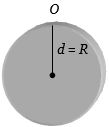

Download our appand get started for free
Experience the future of education. Simply download our apps or reach out to us for more information. Let's shape the future of learning together!No signup needed.*
Similar Questions
- 1A loaded vertical spring executes $S.H.M.$ with a time period of $4\; sec$. The difference between the kinetic energy and potential energy of this system varies with a period of ........$sec$View Solution
- 2A particle excutes $SHM$ on a straight line path. The amplitude of oscillation is $2\,cm$. When the displacement of the particle from the mean position is $1\,cm$, the numerical value of magnitude of acceleration is equal to the numerical value of magnitude of velocity. The frequency of $SHM$ is (in $second^{-1}$)View Solution
- 3The oscillation of a body on a smooth horizontal surface is represented by the equation $x= Acos$$\omega t$View Solution
where $x=$ displacement at time $t$
$\omega =$ frequency of oscillation
Which one of the following graphs shows correctly the variation $a$ with $t$ ?
Here $a=$ acceleration at time $t$
$T=$ time period
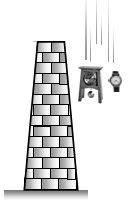
- 4A man having a wrist watch and a pendulum clock rises on a $TV$ tower. The wrist watch and pendulum clock per chance fall from the top of the tower. ThenView Solution
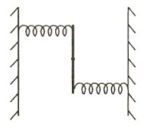
- 5A uniform rod of length $L$ and mass $M$ is pivoted at the centre. Its two ends are attached to two springs of equal spring constants $k$. The springs are fixed to rigid supports as shown in the figure, and the rod is free to oscillate in the horizontal plane. The rod is gently pushed through a small angle $\theta$ in one direction and released. The frequency of oscillation isView Solution
- 6Two pendulums have time periods $T$ and $5T/4.$ They start $SHM$ at the same time from the mean position. After how many oscillations of the smaller pendulum they will be again in the same phase :View Solution
- 7Two masses $M_{A}$ and $M_{B}$ are hung from two strings of length $l_{A}$ and $l_{B}$ respectively. They are executing SHM with frequency relation $f_{A}=2 f_{B}$, then relationView Solution
- 8A particle moves such that its acceleration $a$ is given by $a = - bx$, where $x$ is the displacement from equilibrium position and b is a constant. The period of oscillation isView Solution
- 9View SolutionWhich of the diagrams shown in figure represents variation of total mechanical energy of a pendulum oscillating in water as function of time ?
- 10Velocity at mean position of a particle executing $S.H.M.$ is $v$, they velocity of the particle at a distance equal to half of the amplitudeView Solution