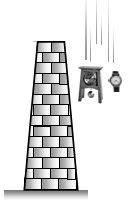
A man having a wrist watch and a pendulum clock rises on a $TV$ tower. The wrist watch and pendulum clock per chance fall from the top of the tower. Then
Easy
Download our app for free and get started
(d) Function of wrist watch depends upon spring action so it is not effected by gravity but pendulum clock has time period, $T = 2\pi \sqrt {\frac{l}{g}} $. During free fall effective acceleration becomes zero, so time period comes out to be infinity i.e. the clock stops.

Download our appand get started for free
Experience the future of education. Simply download our apps or reach out to us for more information. Let's shape the future of learning together!No signup needed.*
Similar Questions
- 1Amplitude of a wave is represented by $A = \frac{c}{{a + b - c}}$ Then resonance will occur whenView Solution
- 2An ideal gas enclosed in a vertical cylindrical container supports a freely moving piston of mass $M$. The piston and the cylinder have equal cross sectional area $A$. When the piston is in equilibrium, the volume of the gas is $V_0$ and its pressure is $P_ 0$. The piston is slightly displaced from the equilibrium position and released. Assuming that the system is completely isolated from its surrounding, the piston executes a simple harmonic motion with frequencyView Solution
- 3$A$ particle of mass m is constrained to move on $x$ -axis. $A$ force $F$ acts on the particle. $F$ always points toward the position labeled $E$. For example, when the particle is to the left of $E, F$ points to the right. The magnitude of $F$ is a constant $F$ except at point $E$ where it is zero. The system is horizontal. $F$ is the net force acting on the particle. The particle is displaced a distance $A$ towards left from the equilibrium position $E$ and released from rest at $t = 0.$ Find minimum time it will take to reach from $x = - \frac{A}{2}$ to $0$.View Solution
- 4A particle performs $SHM$ on $x-$ axis with time period of $0.5\,sec,$ such that it's velocity is zero at $x = -3\,cm$ and at $x = 9\,cm$. It was located at $x = 0$ and moving in negative $'x'$ at $t = 0$. The equation of $SHM$ of the particle isView Solution
- 5A simple pendulum has time period $T_1$. The point of suspension is now moved upward according to equation $y = k{t^2}$ where $k = 1\,m/se{c^2}$. If new time period is $T_2$ then ratio $\frac{{T_1^2}}{{T_2^2}}$ will beView Solution
- 6The kinetic energy and the potential energy of a particle executing $S.H.M.$ are equal. The ratio of its displacement and amplitude will beView Solution
- 7A particle free to move along the $x-$axis has potential energy given by $U(x) = k[1 - \exp {( - x)^2}]$ for $ - \infty \le x \le + \infty $, where k is a positive constant of appropriate dimensions. ThenView Solution
- 8Equations ${y_1} = A\sin \omega t$ and ${y_2} = \frac{A}{2}\sin \omega t + \frac{A}{2}\cos \omega t$ represent $S.H.M.$ The ratio of the amplitudes of the two motions isView Solution
- 9The angular frequency of motion whose equation is $4\frac{{{d^2}y}}{{d{t^2}}} + 9y = 0$ is ($y =$ displacement and $t =$ time)View Solution
- 10The position co-ordinates of a particle moving in a $3-D$ coordinates system is given by $x = a\,cos\,\omega t$ , $y = a\,sin\,\omega t$ and $z = a\omega t$ The speed of the particle isView Solution