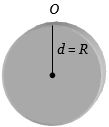
A disc of radius $R$ and mass $M$ is pivoted at the rim and is set for small oscillations. If simple pendulum has to have the same period as that of the disc, the length of the simple pendulum should be
Diffcult


Download our appand get started for free
Experience the future of education. Simply download our apps or reach out to us for more information. Let's shape the future of learning together!No signup needed.*
Similar Questions
- 1A large horizontal surface moves up and down in $SHM$ with an amplitude of $1 \,cm$. If a mass of $10\, kg$ (which is placed on the surface) is to remain continually in contact with it, the maximum frequency of $S.H.M.$ will be ... $Hz$View Solution
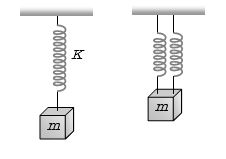
- 2A mass m performs oscillations of period $T$ when hanged by spring of force constant $K$. If spring is cut in two parts and arranged in parallel and same mass is oscillated by them, then the new time period will beView Solution
- 3The displacement of simple harmonic oscillator after $3$ seconds starting from its mean position is equal to half of its amplitude. The time period of harmonic motion is $\dots \; s$View Solution
- 4The velocity of a particle in simple harmonic motion at displacement $y$ from mean position isView Solution
- 5The displacement time equation of a particle executing $SHM$ is : $x = A \,sin\,(\omega t + \phi )$. At time $t = 0$ position of the particle is $x = A/2$ and it is moving along negative $x-$ direction. Then the angle $\phi $ can beView Solution
- 6View SolutionA particle is moving with constant angular velocity along the circumference of a circle. Which of the following statements is true
- 7A body performs $S.H.M.$ Its kinetic energy $K$ varies with time $t$ as indicated by graphView Solution
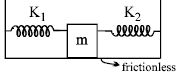
- 8Two springs with negligible masses and force constant of $K_1 = 200\, Nm^{-1}$ and $K_2 = 160\, Nm^{-1}$ are attached to the block of mass $m = 10\, kg$ as shown in the figure. Initially the block is at rest, at the equilibrium position in which both springs are neither stretched nor compressed. At time $t = 0,$ a sharp impulse of $50\, Ns$ is given to the block with a hammer.View Solution
- 9$Assertion :$ In simple harmonic motion, the velocity is maximum when the acceleration is minimum.View Solution
$Reason :$ Displacement and velocity of $S.H.M.$ differ in phase by $\frac{\pi }{2}$ - 10For a particle executing simple harmonic motion, the kinetic energy $K$ is given by $K = {K_o}{\cos ^2}\omega t$. The maximum value of potential energy isView Solution