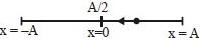
The displacement time equation of a particle executing $SHM$ is : $x = A \,sin\,(\omega t + \phi )$. At time $t = 0$ position of the particle is $x = A/2$ and it is moving along negative $x-$ direction. Then the angle $\phi $ can be
Medium


Download our appand get started for free
Experience the future of education. Simply download our apps or reach out to us for more information. Let's shape the future of learning together!No signup needed.*
Similar Questions
- 1View SolutionA pendulum is swinging in an elevator. Its period will be greatest when the elevator is
- 2A bead of mass $m$ is attached to the mid-point of a tant, weightless string of length $l$ and placed on a frictionless horizontal table.Under a small transverse displacement $x$, as shown in above figure. If the tension in the string is $T$, then the frequency of oscillation isView Solution
- 3A block of mass $200\, g$ executing $SHM$ under the influence of a spring of spring constant $K=90\, N\,m^{-1}$ and a damping constant $b=40\, g\,s^{-1}$. The time elapsed for its amplitude to drop to half of its initial value is ...... $s$ (Given $ln\,\frac{1}{2} = -0.693$)View Solution
- 4A mass $0.9\,kg$, attached to a horizontal spring, executes $SHM$ with an amplitude $A _{1}$. When this mass passes through its mean position, then a smaller mass of $124\,g$ is placed over it and both masses move together with amplitude $A _{2}$. If the ratio $\frac{ A _{1}}{ A _{2}}$ is $\frac{\alpha}{\alpha-1}$, then the value of $\alpha$ will be$......$View Solution
- 5Which of the following quantities are always negative in a $SHM$View Solution
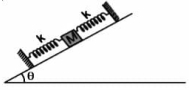
- 6View SolutionIn the adjacent figure, if the incline plane is smooth and the springs are identical, then the period of oscillation of this body is
- 7View SolutionWhich one of the following is a simple harmonic motion
- 8The displacement of a particle along the $x-$ axis is given by $x=asin^2$$\omega t$ . The motion of the particle corresponds toView Solution
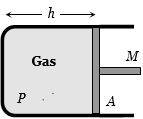
- 9A cylindrical piston of mass $M$ slides smoothly inside a long cylinder closed at one end, enclosing a certain mass of gas. The cylinder is kept with its axis horizontal. If the piston is disturbed from its equilibrium position, it oscillates simple harmonically. The period of oscillation will beView Solution
- 10When the potential energy of a particle executing simple harmonic motion is one-fourth of its maximum value during the oscillation, the displacement of the particle from the equilibrium position in terms of its amplitude $a$ isView Solution