MCQ
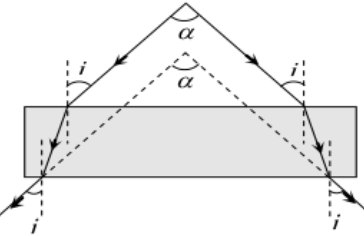
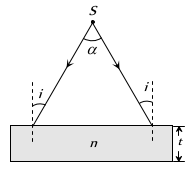
A diverging beam of light from a point source $S$ having divergence angle $\alpha$, falls symmetrically on a glass slab as shown. The angles of incidence of the two extreme rays are equal. If the thickness of the glass slab is $t$ and the refractive index $n$, then the divergence angle of the emergent beam is
  • A
    Zero
  • $\alpha$
  • C
    $\sin ^{-1}(1 / n)$
  • D
    $2 \sin ^{-1}(1 / n)$

Answer

Correct option: B.
$\alpha$

Since rays after passing through the glass slab just suffer lateral
displacement hence we have angle between the emergent rays as $\alpha$.

Need a full question paper?

Generate a complete, print-ready paper with questions like this in minutes — across 16+ boards, with answer keys.

Start Generating Free

Similar questions

Helium at $27^{\circ} \mathrm{C}$ has a volume of 8 litres. It is suddenly compressed to a volume of 1 litre. The temperature of the gas will be $[\gamma=5 / 3]$
Two wires of the same material are given. The first wire is twice as long as the second and has twice the diameter of the second. The resistance of the first will be
The equivalent resistance between the points $P$ and $Q$ in the network given here is equal to (given $r=\frac{3}{2} \Omega$ )

Image

In changing the state of thermodynamics from $A$ to $B$ state, the heat required is $Q$ and the work done by the system is $\mathrm{W}$. The change in its internal energy is
A torch battery consisting of two cells of 1.45 volts and an internal resistance $0.15 \Omega$, each cell sending currents through the filament of the lamps having resistance $1.5 \mathrm{ohms}$. The value of current will be
Which of the following is quantised according to Bohr's theory of hydrogen atom
If a cyclist moving with a speed of $4.9 m / s$ on a level road can take a sharp circular turn of radius $4 m$, then coefficient of friction between the cycle tyres and road is
There is a current of 40 ampere in a wire of $10^{-6} \mathrm{~m}^2$ area of cross-section. If the number of free electron per $\mathrm{m}^3$ is $10^{29}$, then the drift velocity will be
A circular coil of radius $5 \mathrm{~cm}$ has $500$ turns of a wire. The approximate value of the coefficient of self induction of the coil will be
As per given figure to complete the circular loop what should be the radius if initial height is $5 m$
Image