MCQ
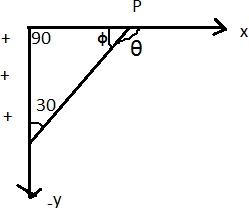
A field line shown in the figure. This field line cannot represent
  • A
    magnetic field
  • electrostatic field
  • C
    induced electric field
  • D
    All of above

Answer

Correct option: B.
electrostatic field
b

Need a full question paper?

Generate a complete, print-ready paper with questions like this in minutes — across 16+ boards, with answer keys.
Start Generating Free

Similar questions

If force on a rocket having exhaust velocity of $300 \,m/sec$ is $210\, N$, then rate of combustion of the fuel is ........... $kg/s$
Image
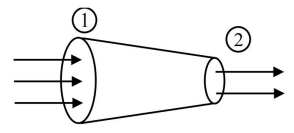
The tube of length L is shown in the figure. The radius of cross section at the point (1) is 2 cm and at the point (2) is 1 cm, respectively. If the velocity of water entering at point (1) is $2 m / s$, then velocity of water leaving the point (2) will be :
Three identical particle $A , B$ and $C$ of mass $100\, kg$ each are placed in a straight line with $AB = BC =13 \,m$. The gravitational force on a fourth particle $P$ of the same mass is $F$, when placed at a distance $13 \,m$ from the particle $B$ on the perpendicular bisector of the line $AC$. The value of $F$ will be approximately$....G$
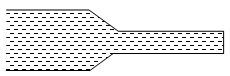
Water flows through a frictionless duct with a cross-section varying as shown in fig. Pressure $p$  at points along the axis is represented by
Assume the aerodynamic drag force on $a$ car is proportional to its speed. If the power output from the engine is doubled, then the maximum speed of the car.
Two identical charged spheres are suspended by strings of equal lengths. The strings make an angle $\theta$ with each other. When suspended in water the angle remains the same. If density of the material of the sphere is $1.5 \mathrm{~g} / \mathrm{cc}$, the dielectric constant of water will be

(Take density of water $=1 \mathrm{~g} / \mathrm{cc}$ )
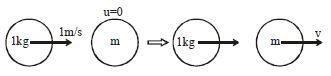
A particle of mass $1\, kg$ moving with velocity $1\, m/s$, collides elastically with another particle of mass $m$. In the collision particle of mass $1\, kg$ loses $\frac{3}{4}$of its $K.E.$ The value of $m$ is :
The direction $(\theta ) $ of $\vec E$ at point $P$ due to uniformly charged finite rod will be
A spherical drop of liquid splits into $1000$ identical spherical drops. If $u _{ i }$ is the surface energy of the original drop and $u_f$ is the total surface energy of the resulting drops, the (ignoring evaporation). $\frac{u_f}{u_i}=\left(\frac{10}{x}\right)$. Then value of $x$ is $......$
A circular hole of diameter $R$ is cut from a disc of mass $M$ and radius $R ;$ the circumference of the cut passes through the centre of the disc . The moment of inertia of the remaining portion of the disc about an axis perpendicular to the disc and passing through its centre is