A flat horizontal board moves up and down in $SHM$ of amplitude $\alpha$. Then the shortest permissible time period of the vibration such that an object placed on the board may not lose contact with the board is
Medium
Download our app for free and get started
$\mathrm{m} \alpha \omega^{2}=\mathrm{mg}$
$\omega=\sqrt{\frac{g}{\alpha}}$
$\frac{2 \pi}{\mathrm{T}}=\sqrt{\frac{\mathrm{g}}{\alpha}} \quad \text { or } \quad \mathrm{T}=2 \pi \sqrt{\frac{\alpha}{\mathrm{g}}}$

Download our appand get started for free
Experience the future of education. Simply download our apps or reach out to us for more information. Let's shape the future of learning together!No signup needed.*
Similar Questions
- 1A spring is stretched by $0.20\, m$, when a mass of $0.50\, kg$ is suspended. When a mass of $0.25\, kg$ is suspended, then its period of oscillation will be .... $\sec$ $(g = 10\,m/{s^2})$View Solution
- 2The mass of a particle is $1\,\,kg$ and it is moving along $x-$ axis. The period of its small oscillation is $\frac {\pi }{2}$ . Its potential energy may beView Solution
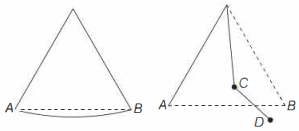
- 3A simple pendulum oscillates freely between points $A$ and $B$. We now put a peg (nail) at the point $C$ as shown in above figure. As the pendulum moves from $A$ to the right, the string will bend at $C$ and the pendulum will go to its extreme point $D$. Ignoring friction, the point $D$View Solution
- 4The bob of a pendulum was released from a horizontal position. The length of the pendulum is $10 \mathrm{~m}$. If it dissipates $10 \%$ of its initial energy against air resistance, the speed with which the bob arrives at the lowest point is : [Use, $\mathrm{g}: 10 \mathrm{~ms}^{-2}$ ]View Solution
- 5A particle executes $SHM$ of period $1.2\, sec$ and amplitude $8\, cm.$ Find the time it takes to travel $3\,cm$ from the positive extremity of its oscillation. ..... $\sec$View Solution
- 6View SolutionFor a particle executing simple harmonic motion, which of the following statements is not correct
- 7View SolutionThe total energy of a particle, executing simple harmonic motion is
- 8The phase of a particle executing simple harmonic motion is $\frac{\pi }{2}$ when it hasView Solution
- 9Two simple harmonic motions of angular frequency $100$ and $1000\,\,rad\,s^{-1}$ have the same displacement amplitude. The ratio of their maximum acceleration isView Solution
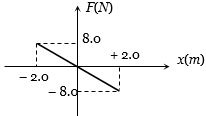
- 10A body of mass $0.01 kg$ executes simple harmonic motion $(S.H.M.)$ about $x = 0$ under the influence of a force shown below : The period of the $S.H.M.$ is .... $s$View Solution