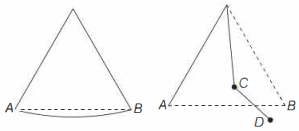
A simple pendulum oscillates freely between points $A$ and $B$. We now put a peg (nail) at the point $C$ as shown in above figure. As the pendulum moves from $A$ to the right, the string will bend at $C$ and the pendulum will go to its extreme point $D$. Ignoring friction, the point $D$
KVPY 2011, Advanced
Download our app for free and get started
(a)
Total length of a pendulum remains same, so extreme point $D$ lies on the line $A B$, as shown below.
This can be proved by applying energy conservation between extreme positions $A$ and $D$ (its given friction is abscent),
$K_A+U_A=K_B+U_B=K_D+U_D$
$\Rightarrow 0+U_A=0+U_B=0+U_D$
$\Rightarrow U_A=U_B=U_D \Rightarrow h_A=h_B=h_D$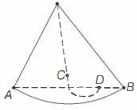

Download our appand get started for free
Experience the future of education. Simply download our apps or reach out to us for more information. Let's shape the future of learning together!No signup needed.*
Similar Questions
- 1$x$ and $y$ displacements of a particle are given as $x(t) = a\,sin\,\omega t$ and $y(t) = a\,sin\,2\omega t.$ Its trajectory will look likeView Solution
- 2The equation of a particle executing simple harmonic motion is given by $x =\sin \pi\left( t +\frac{1}{3}\right) m$. At $t =1 \,s$, the speed of particle will be .......... $cm s ^{-1}$ (Given : $\pi=3.14$ )View Solution
- 3A lift is descending with acceleration $g/3$ . What will be the time period of a simple pendulum suspended from its ceiling if its time period in staionary life is $'T'$ ?View Solution
- 4A pendulum suspended from the ceiling of a train has a period $T$, when the train is at rest. When the train is accelerating with a uniform acceleration a, the period of oscillation willView Solution
- 5The ratio of maximum acceleration to maximum velocity in a simple harmonic motion is $10\,s^{-1}$. At, $t = 0$ the displacement is $5\, m$. What is the maximum acceleration ? The initial phase is $\frac{\pi }{4}$View Solution
- 6A particle is executing simple harmonic motion with a period of $T$ seconds and amplitude a metre. The shortest time it takes to reach a point $\frac{a}{{\sqrt 2 }}\,m$ from its mean position in seconds isView Solution
- 7View SolutionThe time period of a simple pendulum when it is made to oscillate on the surface of moon
- 8A particle executing simple harmonic motion with amplitude of $0.1 \,m$. At a certain instant when its displacement is $0.02 \,m$, its acceleration is $0.5 \,m/s^2$. The maximum velocity of the particle is (in $m/s$)View Solution
- 9The phase (at a time $t$) of a particle in simple harmonic motion tellsView Solution
- 10When a particle executes $SHM$ the nature of graphical representation of velocity as a function of displacement is :View Solution