A flow of $10^{7}$ electrons per second in a conducting wire constitutes a current of
AIPMT 1994, Easy
Download our app for free and get started
Flow of electrons, $\frac{n}{t}=10^{7} / sec .$
$(I)=\frac{q}{t}=\frac{n e}{t}=\frac{n}{t} \times e$
$=10^{7} \times\left(1.6 \times 10^{-19}\right)=1.6 \times 10^{-12}\; A$

Download our appand get started for free
Experience the future of education. Simply download our apps or reach out to us for more information. Let's shape the future of learning together!No signup needed.*
Similar Questions
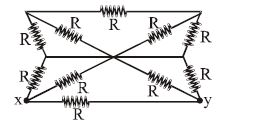
- 1What will be equivalent resistance of circuit between $x$ and $y$View Solution
- 2Two identical cells each of emf $1.5\,V$ are connected in series across a $10\,\Omega$ resistance. An ideal voltmeter connected across $10\,\Omega$ resistance reads $1.5\,V$. The internal resistance of each cell is $......\Omega$.View Solution
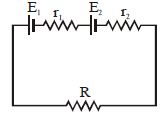
- 3Under what conditions current passing through a resistance $R$ can be increased by short circuiting the battery of emf $E_2$. The internal resistances of the two batteries are $r_1$ and $r_2$ respectivelyView Solution
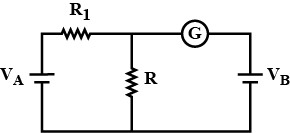
- 4In the circuit shown the cells $A$ and $B$ have negligible resistance. For $V _{ A }=12\; V , R _{1}=500\; \Omega$ and $R =100\; \Omega$ the galvanometer $(G)$ shows no deflection. The value of $V_{B}$ is .... $V$View Solution
- 5A current of $2\, mA$ was passed through an unknown resistor which dissipated a power of $4.4\, W$. Dissipated power when an ideal power supply of $11\, V$ is connected across it isView Solution
- 6The resistance of hot tungsten filament is about $10$ times the cold resistance. What will be the resistance of $100\, W$ and $200\, V$ lamp when not in use ............. $\Omega $View Solution
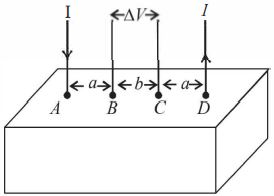
- 7Consider a block of conducting material ofresistivity '$\rho$' shown in the figure. Current '$I$' enters at '$A$' and leaves from '$D$'. We apply superp osition principle to find voltage '$\Delta V$ ' developed between '$B$' and '$C$'. The calculation is done in the following steps:View Solution
$(i)$ Take current '$I$' entering from '$A$' and assume it to spread over a hemispherical surface in the block.
$(ii)$ Calculatefield $E(r)$ at distance '$r$' from $A$ by using Ohm's law $E = \rho j$, where j is the current per unit area at '$r$'.
(iii) From the '$r$' dependence of $E(r)$, obtain the potential $V(r)$ at $r$.
(iv) Repeat $(i), (ii)$ and $(iii)$ for current '$I$' leaving '$D$' and superpose results for '$A$' and '$D$'.$\Delta V$ measured between $B$ and $C$ is
- 8$50\,\Omega $ and $100\,\Omega $ resistors are connected in series. This connection is connected with a battery of $2.4\, volts$. When a voltmeter of $100\,\Omega $ resistance is connected across $100\,\Omega $ resistor, then the reading of the voltmeter will be ............. $V$View Solution
- 9A new flashlight cell of $e.m.f.$ $1.5\, volts$ gives a current of $15\, amps$, when connected directly to an ammeter of resistance $0.04\,\Omega $. The internal resistance of cell is ........... $\Omega$View Solution
- 10There is a current of $20$ amperes in a copper wire of ${10^{ - 6}}$ square meter area of cross-section. If the number of free electrons per cubic meter is ${10^{29}}$, then the drift velocity isView Solution