Consider a block of conducting material ofresistivity '$\rho$' shown in the figure. Current '$I$' enters at '$A$' and leaves from '$D$'. We apply superp osition principle to find voltage '$\Delta V$ ' developed between '$B$' and '$C$'. The calculation is done in the following steps:
$(i)$ Take current '$I$' entering from '$A$' and assume it to spread over a hemispherical surface in the block.
$(ii)$ Calculatefield $E(r)$ at distance '$r$' from $A$ by using Ohm's law $E = \rho j$, where j is the current per unit area at '$r$'.
(iii) From the '$r$' dependence of $E(r)$, obtain the potential $V(r)$ at $r$.
(iv) Repeat $(i), (ii)$ and $(iii)$ for current '$I$' leaving '$D$' and superpose results for '$A$' and '$D$'.
$(i)$ Take current '$I$' entering from '$A$' and assume it to spread over a hemispherical surface in the block.
$(ii)$ Calculatefield $E(r)$ at distance '$r$' from $A$ by using Ohm's law $E = \rho j$, where j is the current per unit area at '$r$'.
(iii) From the '$r$' dependence of $E(r)$, obtain the potential $V(r)$ at $r$.
(iv) Repeat $(i), (ii)$ and $(iii)$ for current '$I$' leaving '$D$' and superpose results for '$A$' and '$D$'.
$\Delta V$ measured between $B$ and $C$ is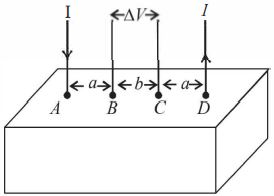
AIEEE 2008, Diffcult
Download our app for free and get started
Let $j$ be the current density.
Then $j \times 2 \pi r^{2}=I \Rightarrow j=\frac{I}{2 \pi r^{2}} \therefore E=\rho j=\frac{\rho I}{2 \pi r^{2}}$
Now, $\Delta V_{BC}^\prime = - \int\limits_{a + b}^a {\vec E} .\overline {dr} = - \int\limits_{a + b}^a {\frac{{\rho I}}{{2\pi {r^2}}}dr} $
$=-\frac{\rho I}{2 \pi}\left[-\frac{1}{r}\right]_{a+b}^{a}=\frac{\rho I}{2 \pi a}-\frac{\rho I}{2 \pi(a+b)}$
On applying superposition as mentioned we get
$\Delta V_{B C}=2 \times \Delta V_{B C}^{\prime}=\frac{\rho I}{\pi a}-\frac{\rho I}{\pi(a+b)}$

Download our appand get started for free
Experience the future of education. Simply download our apps or reach out to us for more information. Let's shape the future of learning together!No signup needed.*
Similar Questions
- 1View SolutionThe resistivity of a wire
- 2The potential difference between $A$ and $B$ in the Figure is ................... $\mathrm{V}$View Solution

- 3A certain piece of silver of given mass is to be made like a wire. Which of the following combination of length $(L)$ and the area of cross-sectional $(A) $ will lead to the smallest resistanceView Solution
- 4Drift velocity ${v_d}$ varies with the intensity of electric field as per the relationView Solution
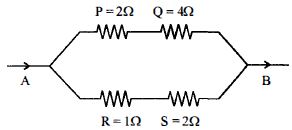
- 5Which of the four resistances $P, Q, R$ and $S$ generate the greatest amount of heat when a current flows from $A$ to $B$ ?View Solution
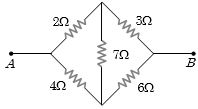
- 6Five resistances are connected as shown in the figure. The effective resistance between the points $A$ and $B$ isView Solution
- 7View SolutionThe material of wire of potentiometer is
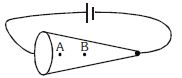
- 8View SolutionSuppose a current carrying wire has a cross-sectional area that, gradually become smaller along the wire, has the shape of a very long cone as shown in figure. Choose the correct statement
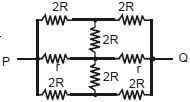
- 9The effective resistance between points $P$ and $Q$ of the electrical circuit shown in the figure isView Solution
- 10Two long coaxial and conducting cylinders of radius $a$ and $b$ are separated by a material of conductivity $\sigma$ and a constant potential difference $V$ is maintained between them, by a battery. Then the current, per unit length of the cylinder flowing from one cylinder to the other is -View Solution