MCQ
A flywheel rotates with a uniform angular acceleration. Its angular velocity increases from $20\pi \, rad/s$ to $40\pi \,rad/s\,m\,10\,sec$ . How many rotations did it made in this period
  • A
    $50$
  • $150$
  • C
    $100$
  • D
    $250$

Answer

Correct option: B.
$150$
b
$\omega_{0}=20 \pi, \omega=40 \pi, \tau=10 \mathrm{s}$

$\omega=\omega_{0}+\alpha t$

$20 \pi=\alpha(10) \Rightarrow \alpha=2 \pi \mathrm{rad} / \mathrm{s}^{2}$

$\theta=20 \pi(10)+\frac{1}{2}(2 \pi)(10)^{2}$

$\theta=200 \pi+100 \pi$

$\theta=300 \pi$

$2 \mathrm{n} \pi=300 \pi$

$\mathrm{n}=150$ rounds

Need a full question paper?

Generate a complete, print-ready paper with questions like this in minutes — across 16+ boards, with answer keys.
Start Generating Free

Similar questions

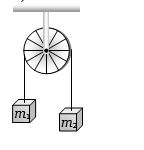
Two masses ${m_1}$ and ${m_2}$ are attached to a string which passes over a frictionless smooth pulley. When ${m_1} = 10kg,$ ${m_2} = 6kg,\,$the acceleration of masses is  .......... $m/s^{2}$
In a thermodynamic process, pressure of a fixed mass of a gas is changed in such a manner that the gas molecules gives out $20 J$ of heat and $10 J$ of work is done on the gas. If the initial internal energy of the gas was $40 J,$ then the final internal energy will be ........ $J$
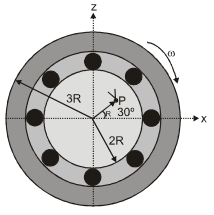
The figure shows a system consisting of $(i)$ a ring of outer radius $3 \ R$ rolling clockwise without slipping on a horizontal surface with angular speed $\omega$ and $(ii)$ an inner disc of radius $2 \ R$ rotating anti-clockwise with angular speed $\omega / 2$. The ring and disc are separated $b$ frictionaless ball bearings. The system is in the $x-z$ plane. The point $P$ on the inner disc is at distance $R$ from the origin, where $OP$ makes an angle of $30^{\circ}$ with the horizontal. Then with respect to the horizontal surface, $Image$

$(A)$ the point $O$ has linear velocity $3 R \omega \hat{ i }$.

$(B)$ the point $P$ has a linear velocity $\frac{11}{4} R \omega \hat{ i }+\frac{\sqrt{3}}{4} R \omega \hat{ k }$

$(C)$ the point $P$ has linear velocity $\frac{13}{4} R w \hat{ i }-\frac{\sqrt{3}}{4} R \omega \hat{k}$

$(D)$ The point $P$ has a linear velocity $\left(3-\frac{\sqrt{3}}{4}\right) R w_{\hat{ i }}+\frac{1}{4} R w_{\hat{k}}$.
A small bar magnet A oscillates in a horizontal plane with a period $T$ at a place where the angle of dip is $60^o$. When the same needle is made to oscillate in a vertical plane coinciding with the magnetic meridian, its period will be
A sphere, a cube and a thin circular plate, all made of the same material and having the same mass are initially heated to a temperature of $1000°C$ . Which one of these will cool first
A string is fixed at both ends vibrates in a resonant mode with a separation $2.0 \,\,cm$ between the consecutive nodes. For the next higher resonant frequency, this separation is reduced to $1.6\,\, cm$. The length of the string is .... $cm$
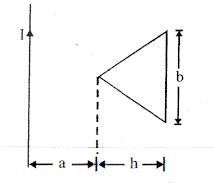
A very long straight conductor and isosceles triangular conductor lie in a plane and are separated from each other as shown in the figure. If $a = 10\ cm , b = 20\ cm$ and $h = 10\ cm$ , find the coefficient of mutuaI induction
The Rydberg constant $R$ for hydrogen is
The curve between the activity $A$ of a radioactive sample and the number of active atoms $N$ is
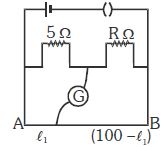
The resistance in the two arms of a meter bridge are $5\,\Omega $ and $R\,\Omega $, respectively. When the resistance $R$ is shunted with an equal resistance, the new balance point is at $1.6\, l_1$. The resistance $‘R’$ is ................. $\Omega$