- A$\frac{3}{2}{\text{I}}\,{\text{u}}$
- ✓$\frac{1}{2}{\text{I}}\,{\text{u}}$
- C$I \,u$
- D$2\, I\, u$
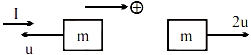
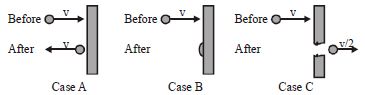
$\mathrm{I}=2 \mathrm{mu}-(-\mathrm{mu})$
$\mathrm{I}=3 \mathrm{mu} \ldots(\mathrm{i})$
According to work energy theorem
$\mathrm{W}=\Delta \mathrm{T}$
$\mathrm{W}=\mathrm{T}_{\mathrm{f}}-\mathrm{T}_{\mathrm{i}}$
$\mathrm{W}=\frac{1}{2} \mathrm{m}(2 \mathrm{u})^{2}-\frac{1}{2} \mathrm{m}(-\mathrm{u})^{2}$
$\mathrm{W}=\frac{1}{2} \mathrm{m}\left(4 \mathrm{u}^{2}\right)-\frac{1}{2} \mathrm{mu}^{2}$
$\mathrm{w}=\frac{3 \mathrm{mu}^{2}}{2}$ $...(ii)$
From equation $(i)$ and $(ii)$
$\mathrm{W}=\frac{1}{2} \mathrm{Iu}$
Generate a complete, print-ready paper with questions like this in minutes — across 16+ boards, with answer keys.

Place the impulse exerted by the wall on the projectile in each of these three cases in the correct order.
Assertion $A$ : If $dQ$ and $dW$ represent the heat supplied to the system and the work done on the system respectively. Then according to the first law of thermodynamics $d Q=d U-d W$.
Reason $R :$ First law of thermodynamics is based on law of conservation of energy.
In the light of the above statements, choose the correct answer from the option given below :