Question
A galvanometer can be converted into voltmeter of given range by connecting a suitable resistance R, in series with the galvanometer, whose value is given by,
$\text{R}_\text{s}=\frac{\text{V}}{\text{I}_\text{g}}-\text{G}$
where Vis the voltage to be measured, lg is the current for full scale deflection of galvanometer and G is the resistance of galvanometer.
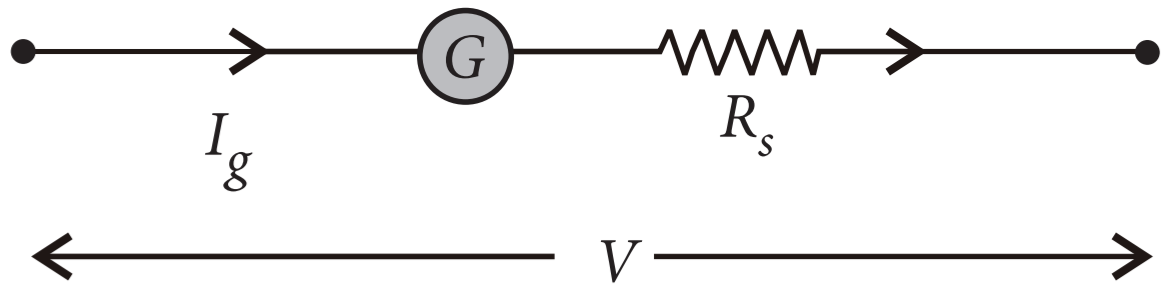
Series resistor(R,) increases range of voltmeter and the effective resistance of galvanometer. It also protects the galvanometer from damage due to large current. Voltmeter is a high resistance instrument and it is always connected in parallel with the circuit element across which potential difference is to be measured. An ideal voltmeter has infinite resistance. In order to increase the range of voltmeter n times the value of resistance to be connected in series with galvanometer is Rs = (n - 1)G.
  1. 10mA current can pass through a galvanometer of resistance $25\Omega$ What resistance in series should be connected through it, so that it is converted into a voltmeter of 100V?
  1. $0.975\Omega$
  2. $99.75\Omega$
  3. $975\Omega$
  4. $9975\Omega$
  1. There are 3 voltmeter A, B, C having the same range but their resistance are $15000\Omega,10000\Omega$, and $5000\Omega$ respectively. 'Tile best voltmeter amongst them is the one whose resistance is
  1. $5000\Omega$
  2. $10000\Omega$
  3. $15000\Omega$
  4. all are equally good.
  1. A milliammeter of range 0 to 25mA and resistance of $10\Omega$ is to be converted into a voltmeter with a range of 0 to 25V. 'Tile resistance that should be connected in series will be:
  1. $930\Omega$
  2. $960\Omega$
  3. $990\Omega$
  4. $1010\Omega$
  1. To convert a moving coil galvanometer (MCG) into a voltmeter:
  1. A high resistance R is connected in parallel with MCG.
  2. A low resistance R is connected in parallel with MCG.
  3. A low resistance R is connected in series with MCG.
  4. A high resistance R is connected in series with MCG.
  1. To increase the current sensitivity of a moving coil galvanometer, we should decrease:
  1. Zero.
  2. Low.
  3. High.
  4. Infinity.

Answer

  1. (d) $9975\Omega$

Explanation:

A galvanometer can be converted into a voltmeter of given range by connecting a suitable high resistance R in series of galvanometer, which is given by,

$\text{R}=\frac{\text{V}}{\text{I}_\text{g}}-\text{G}=\frac{100}{10\times10^{-3}}-25=10000-25=9975\Omega$

  1. (c) $15000\Omega$

Explanation:

An ideal voltmeter should have a very high resistance.

  1. (c) $990\Omega$

Explanation:

Resistance of voltmeter $=\frac{25}{25\times10^{-3}}=1000\Omega$

$\therefore\text{X}=1000-10=990\Omega$

  1. (d) A high resistance R is connected in series with MCG.

Explanation:

To convert a moving coil galvanometer into a voltmeter, it is connected with a high resistance in series. The voltmeter is connected in parallel to measure the potential difference. As the resistance is high, the voltmeter itself does not consume current.

  1. (d) Infinity.

Explanation:

The resistance of an ideal voltmeter is infinity.

Need a full question paper?

Generate a complete, print-ready paper with questions like this in minutes — across 16+ boards, with answer keys.

Start Generating Free

Similar questions

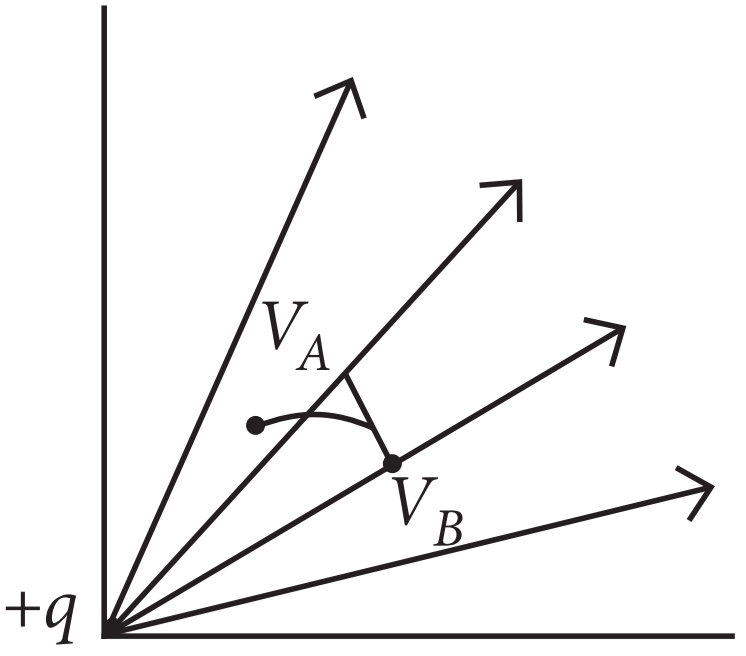
Electrostatic potential energy of a system of point charges is defined as the total amount of work done in bringing the different charges to their respective positions from infinitely charge mutual separations. The work is stored in the system of two point charges in the form of electrostatic potential energy U of the system. Electric potential difference between any points A and B in an electric field is the amount of work done in moving a unit positive test charge from A to B along any path agents the electrostatic force $\text{V}_\text{B}-\text{V}_\text{A}=\frac{\text{W}_\text{AB}}{\text{q}_\text{o}}=\int\vec{\text{E}}.\text{dl}.$

  1. A test charge is moved from lower potential point to a higher potential point. The potential energy of test charge wiII.
  1. Remain the same.
  2. Increase.
  3. Decrease.
  4. Become zero.
  1. Which of the following statement is not true?
  1. Electrostatic force is a conservative force.
  2. Potential energy of charge q at a point is the work done per unit charge in bringing a charge from any point to infinity.
  3. Spring force and gravitational force are conservative force.
  4. Both (a) and (c).
  1. Work done in moving a charge from one point to another inside a uniformly charged conducting sphere is:
  1. Always zero.
  2. Non-zero.
  3. May be zero.
  4. None of these.
  1. The work done in bringing a unit positive charge from infinite distance to a point at distance x from a positive charge Q is W. Then the potential $\phi$ at that point is:
  1. $\frac{\text{WQ}}{\text{x}}$

  2. W

  3. $\frac{\text{W}}{\text{x}}$

  4. WQ

  1. If $1\mu\text{C}$ charge is shifted from A to B and it is found that work done by an external force is $40\mu\text{J}.$ ln doing so against electrostatics force, the potential difference VA - VB is:
  1. 40V
  2. -40V
  3. 20V
  4. -60V
  1. A point-object is placed on the principal axis of a convex spherical surface of radius of curvature R, which separates the two media of refractive indices n 1 and n 2 (n 2 > n 1). Draw the ray diagram and deduce the relation between the distance of the object (u),distance of the image (v) and the radius of curvature (R) for refraction to take place at the convex spherical surface from rarer to denser medium.
  2. Use the above relation to obtain the condition on the position of the object and the radius of curvature in terms of n1 and n2 when the real image is formed.
Motion of Charge in Magnetic Field
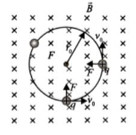
An electron with speed $V_0$ << c moves in a circle of radius $r _{\circ}$ in a uniform magnetic field. This electron is able to traverse a circular path as the magnetic force acting on the electron is perpendicular to both $V_0$ and B ,as shown in the figure. This force continuously deflects the particle sideways without changing its speed and the particle will move along a circle perpendicular to the field. The time required for one revolution of the electron is $T _{ o }$.

Image

(i) If the speed of the electron is now doubled to 2vo. The radius of the circle will change to
(A) $4 r_0$ (B) $2 r_0$ (C) $r _{ o }$ (D) $r _0 / 2$

(ii) If v = 2vo, then the time required for one revolution of the electron (To ) will change to
(A) $4 T_0$ (B) $2 T_{ O }$ (C) $T _{ o }$ (D) $T _{ d } / 2$
(iii) A charged particles is projected in a magnetic field . The acceleration of the particle is found to be. Find the value of x.
(A) $4 ms^{-2}$ (B) $-4 ms^{-2}$ (C) $-2 ms^{-2}$ (D) $2 ms^{-2}$

(iv) If the given electron has a velocity not perpendicular to B, then trajectory of the electron is
(A) straight line (B) circular (C) helical (D) zig-zag

OR

If this electron of charge (e) is moving parallel to uniform magnetic field with constant velocity v, the force acting on the electron is
(A) Bev (B) Be/v (C) B/ev (D) Zero

According to Einstein, when a photonoflight offrequencyu or wavelength $\lambda$ is incident on a photosensitive metal surface of work function $\phi_0$, where $\phi_0<\text{h}\upsilon$ (here, h is Planck's constant), then the emission of photoelectrons takes place. The maximum kinetic energy of the emitted photoelectrons is given by $\text{K}_\text{max}=\text{h}\upsilon-\phi_0$. If the frequency of the incident light is $\upsilon_0$ called thresold frequency, the photoelectrons are emitted from metal without any kinetic energy. So $\text{h}\upsilon_0=\phi_0$.

  1. A metal of work function 3.3eV is illuminated by light of wavelength 300nm. The maximum kinetic energy of photoelectrons emitted is (taking h = 6.6 × 10⁻³⁴ Js).
  1. 0.413eV
  2. 0.825eV
  3. 1.65eV
  4. 1.32eV
  1. The variation of maximum kinetic energy (Kmax) of the variation of maximum kinetic energy ($\upsilon$) of the incident radiations can be represented by:

  1. The variation of photoelectric current (i) with the intensity of the incident radiation (I) can be represented by:

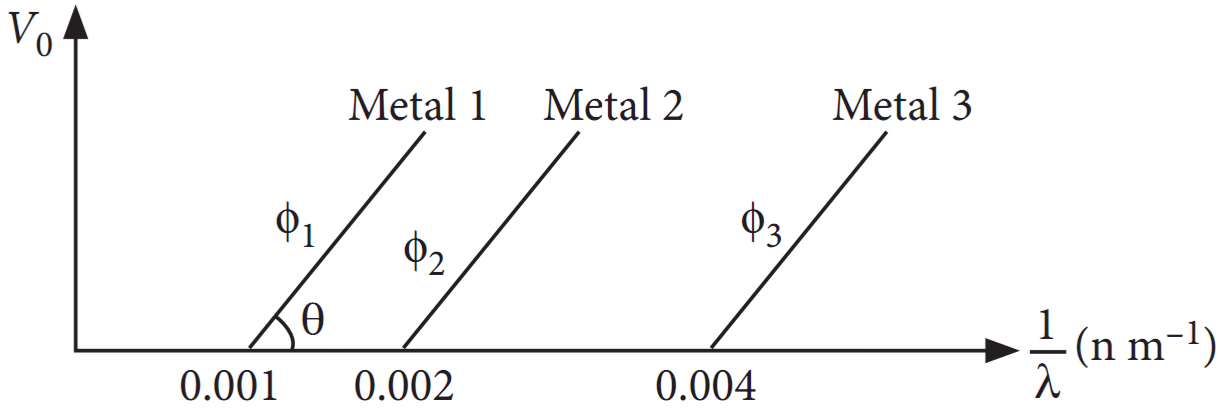
  1. The graph between the stopping potential (V0) and $\Big(\frac{1}{\lambda}\Big)$ is shown in the figure. $\phi_1,\phi_2,\phi_3$ are work function. Which of the following options is correct?

  1. $\phi_1:\phi_2:\phi_3=1:2:3$

  2. $\phi_1:\phi_2:\phi_3=4:2:1$

  3. $\phi_1:\phi_2:\phi_3=1:2:4$

  4. Ultraviolet tight can be used to emit photoelectrons from metal 2 and metal 3 only.
  1. Which of the following figures represent the variation of particle momentum and the associated de-Broglie wavelength?

In motor vehicles, a convex mirror is attached near the driver's seat to give him the view of the traffic behind. What is the special function of this convex mirror which a plane mirror can not do?
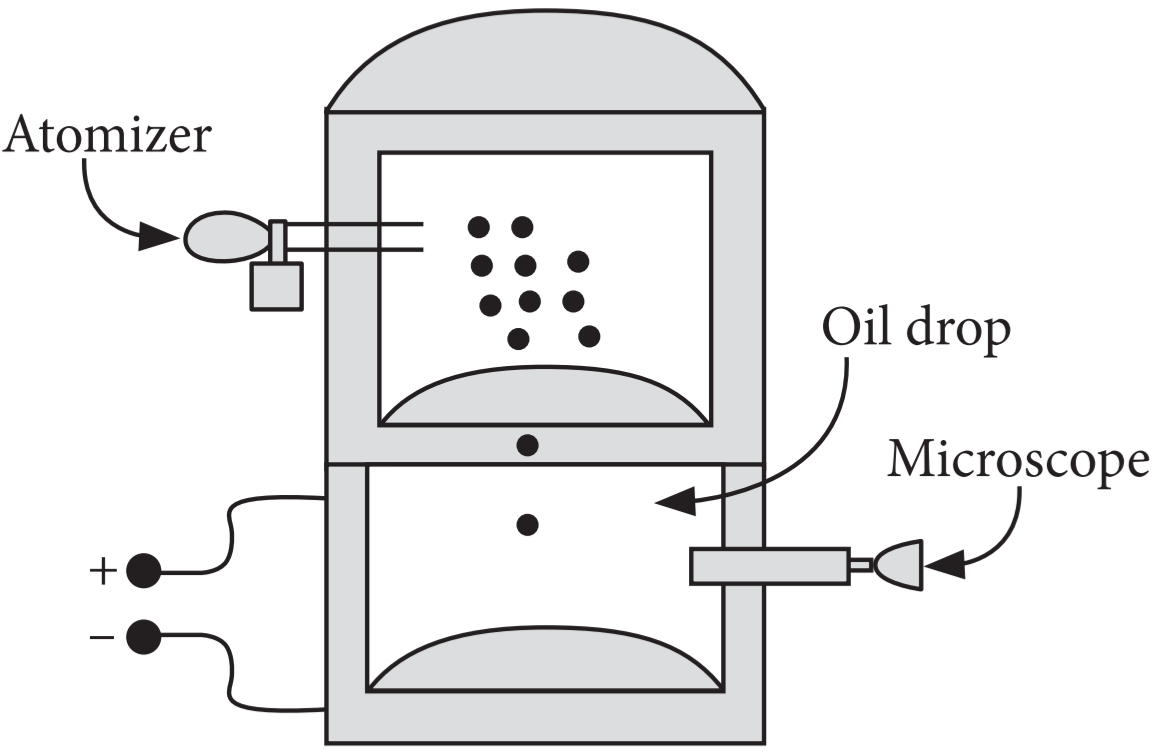
In 1909, Robert Millikan was the first to find the charge of an electron in his now-famous oil-drop experiment. In that experiment, tiny oil drops were sprayed into a uniform electric field between a horizontal pair of oppositely charged plates. The drops were observed with a magnifying eyepiece, and the electric field was adjusted so that the upward force on some negatively charged oil drops was just sufficient to balance the downward force of gravity. That is, when suspended, upward force qE just equaled Mg. Millikan accurately measured the charges on many oil drops and found the values to be whole number multiples of 1.6 × 10-19C the charge of the electron. For this, he won the Nobel Prize.

  1. If a drop of mass 1.08 × 10⁻¹⁴kg remains stationary in an electric field of 1.68 × 10⁵NC-1, then the charge of this drop is:
  1. 6.40 × 10-19C
  2. 3.2 × 10-19C
  3. 1.6 × 10-19C
  4. 4.8 × 10-19C
  1. Extra electrons on this particular oil drop (given the presently known charge of the electron) are:
  1. 4
  2. 3
  3. 5
  4. 8
  1. A negatively charged oil drop is prevented from falling under gravity by applying a vertical electric field 100V m-1. If the mass of the drop is 1.6 × 10-3g, the number of electrons carried by the drop is (g = 10m s-2)
  1. 1018
  2. 1015
  3. 1012
  4. 109
  1. The important conclusion given by Millikan's experiment about the charge is:
  1. Charge is never quantized.
  2. Charge has no definite value.
  3. Charge is quantized.
  4. Charge on oil drop always increases.
  1. If in Millikan's oil drop experiment, charges on drops are found to be $8\mu\text{C, }12\mu\text{C, }20\mu\text{C, }$ then quanta of charge is:
  1. $8\mu\text{C}$

  2. $20\mu\text{C}$

  3. $12\mu\text{C}$

  4. $4\mu\text{C}$

Two point charges +9e and +e are located at a distance of 16 cm apart from each other. Where should a charge q be placed between them so that there is no force on it?
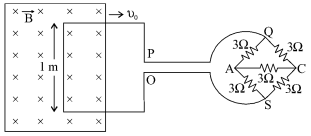
A square loop of a metallic wire of side 10 cm whose resistance is 1 ohm is moving with a constant velocity of as shown in the figure in a uniform magnetic field of $200 Wb / m ^2$. The magnetic field is normal to the plane of paper inwards. This loop is connected to a network of resistors of magnitude 3 ohms. Resistance of wire OS and PQ are negligible. What will be the magnitude of velocity, $v_0$ to flow one ampere of direct current in the loop? Also, what will be the direction of current?
Image
A child has near point at 10cm. What is the maximum angular magnification the child can have with a convex lens of focal length 10cm?
A moving-coil galvanometer has a 50-turn coil of size 2cm × 2cm. It is suspended between the magnetic poles producing a magnetic field of 0.5T. Find the torque on the coil due to the magnetic field when a current of 20mA passes through it.