Question types

Moving Charges and Magnetism question types

593 questions across 8 question groups — pick any mix to generate a Physics paper with step-by-step answer keys.

593
Questions
8
Question groups
5
Question types
Sample Questions

Moving Charges and Magnetism questions

One sample from each question group in this chapter. Select any group above to see the full set with answer keys.

Q 1M.C.Q [1M]1 Mark
Consider a wire carrying a steady current, I placed in a uniform magnetic field B perpendicular to its length. Consider the charges inside the wire. It is known that magnetic forces do no work. This implies that:
  • A
    Motion of charges inside the conductor is unaffected by B since they do not absorb energy.
  • B
    Some charges inside the wire move to the surface as a result of B.
  • C
    If the wire moves under the influence of B, no work is done by the force.
  • D
    If the wire moves under the influence of B, no work is done by the magnetic force on the ions, assumed fixed within the wire.
View full solution
Q 2M.C.Q [1M]1 Mark
A charged particle moves through a magnetic field perpendicular to its direction. Then:
  • A
    Kinetic energy changes, but the momentum is constant.
  • B
    The momentum changes, but the kinetic energy is constant.
  • C
    Both momentum and kinetic energy of the particle are not constant.
  • D
    Both momentum and kinetic energy of the particle are constant.
View full solution
Q 3M.C.Q [1M]1 Mark
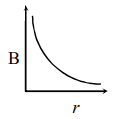
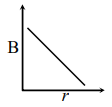
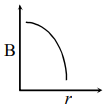
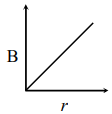
The graph shows the variation of magnetic field (B)with distance (r) from a long current carrying wire is-
  • A

    Image

  • Image
  • C

    Image
  • D

    Image

Answer: B.

View full solution
Q 4M.C.Q [1M]1 Mark
Let $\overrightarrow{\text{E}}$ and $\overrightarrow{\text{B}}$ denote electric and magnetic fields in a frame S and $\overrightarrow{\text{E}}$ and $\overrightarrow{\text{B}}$ in another frame S moving with respect to S at a velocity $\overrightarrow{\text{v}}.$ Two of the following equations are wrong. Identify them.
  • A
    $\text{B}_\text{y},=\text{B}_\text{y}+\frac{\text{vE}_\text{z}}{\text{c}^2}$
  • B
    $\text{E}_\text{y},=\text{E}_\text{y}+\frac{\text{vB}_\text{z}}{\text{c}^2}$
  • C
    $\text{B}'_\text{y}=\text{B}_\text{y}+\text{v}\text{E}_\text{z}$
  • D
    $\text{E}'_\text{y}=\text{E}_\text{y}+\text{vB}_\text{z}$
View full solution
Q 5M.C.Q [1M]1 Mark
A very long bar magnet is placed with its north pole coinciding with the centre of a circular loop carrying as electric current i. The magnetic field due to the magnet at a point on the periphery of the wire is B. The radius of the loop is a. The force on the wire is:
  • A
    Very nearly $2\pi\text{aiB}$ perpendicular to the plane of the wire.
  • B
    $2\pi\text{aiB}$ in the plane of the wire.
  • C
    $\pi\text{aiB}$ along the magnet.
  • D
    Zero.
View full solution
Two statements are given-one labelled Assertion (A) and the other labelled Reason (R). Select the correct answer to these questions from the codes (a), (b), (c) and (d) as given below.
  1. Both A and R are true and R is the correct explanation of A.
  2. Both A and R are true but R is NOT the correct explanation of A.
  3. A is true but R is false.
  4. A is false and R is also false.
Assertion (A): A charge, whether stationary or in motion produces a magnetic field around it.
Reason (R): Moving charges produce only electric field in the surrounding space.
View full solution
Two statements are given-one labelled Assertion (A) and the other labelled Reason (R). Select the correct answer to these questions from the codes (a), (b), (c) and (d) as given below.
  1. Both A and R are true and R is the correct explanation of A.
  2. Both A and R are true but R is NOT the correct explanation of A.
  3. A is true but R is false.
  4. A is false and R is also false.
Assertion (A): The magnetic field intensity at the centre of a circular coil carrying current changes, if the current through the coil is doubled.
Reason (R): The magnetic field intensity is dependent on current in conductor.
View full solution
Two statements are given-one labelled Assertion (A) and the other labelled Reason (R). Select the correct answer to these questions from the codes (a), (b), (c) and (d) as given below.
  1. Both A and R are true and R is the correct explanation of A.
  2. Both A and R are true but R is NOT the correct explanation of A.
  3. A is true but R is false.
  4. A is false and R is also false.
Assertion (A): In a conductor, free electrons keep on moving but no magnetic force acts on a conductor in a magnetic field.
Reason (R): Force on free electron due to magnetic field always acts perpendicular to its direction of motion.
View full solution
Two statements are given-one labelled Assertion (A) and the other labelled Reason (R). Select the correct answer to these questions from the codes (a), (b), (c) and (d) as given below.
  1. Both A and R are true and R is the correct explanation of A.
  2. Both A and R are true but R is NOT the correct explanation of A.
  3. A is true but R is false.
  4. A is false and R is also false.
Assertion (A): When a magnetic dipole is placed in a non uniform magnetic field, only a torque acts on the dipole.
Reason (R): Force would act on dipole if magnetic field is uniform.
View full solution
Two statements are given-one labelled Assertion (A) and the other labelled Reason (R). Select the correct answer to these questions from the codes (a), (b), (c) and (d) as given below.
  1. Both A and R are true and R is the correct explanation of A.
  2. Both A and R are true but R is NOT the correct explanation of A.
  3. A is true but R is false.
  4. A is false and R is also false.
Assertion (A): When two long parallel wires, hanging freely are connected in parallel to a battery, they come closer to each other.
Reason (R): Wires carrying current in opposite direction repel each other.
View full solution
Answer the following question:
An electron travelling west to east enters a chamber having a uniform electrostatic field in north to south direction. Specify the direction in which a uniform magnetic field should be set up to prevent the electron from deflecting from its straight line path.
View full solution
Answer the following question:
A charged particle enters an environment of a strong and non-uniform magnetic field varying from point to point both in magnitude and direction, and comes out of it following a complicated trajectory. Would its final speed equal the initial speed if it suffered no collisions with the environment?
View full solution
A straight horizontal conducting rod of length 0.45 m and mass 60 g is suspended by two vertical wires at its ends. A current of 5.0 A is set up in the rod through the wires.
  1. What magnetic field should be set up normal to the conductor in order that the tension in the wires is zero?
  2. What will be the total tension in the wires if the direction of current is reversed keeping the magnetic field same as before? (Ignore the mass of the wires.) g = 9.8 m s–2.
View full solution
Answer the following question:
A magnetic field that varies in magnitude from point to point but has a constant direction (east to west) is set up in a chamber. A charged particle enters the chamber and travels undeflected along a straight path with constant speed. What can you say about the initial velocity of the particle?
View full solution
Consider a tightly wound 100 turn coil of radius $10 cm$, carrying a current of $1 A$. What is the magnitude of the magnetic field at the centre of the coil?
View full solution
A magnetic field of 100 G (1 G = 10–4 T) is required which is uniform in a region of linear dimension about 10 cm and area of cross-section about 10–3 m2 . The maximum current-carrying capacity of a given coil of wire is 15 A and the number of turns per unit length that can be wound round a core is at most 1000 turns m–1. Suggest some appropriate design particulars of a solenoid for the required purpose. Assume the core is not ferromagnetic.
View full solution
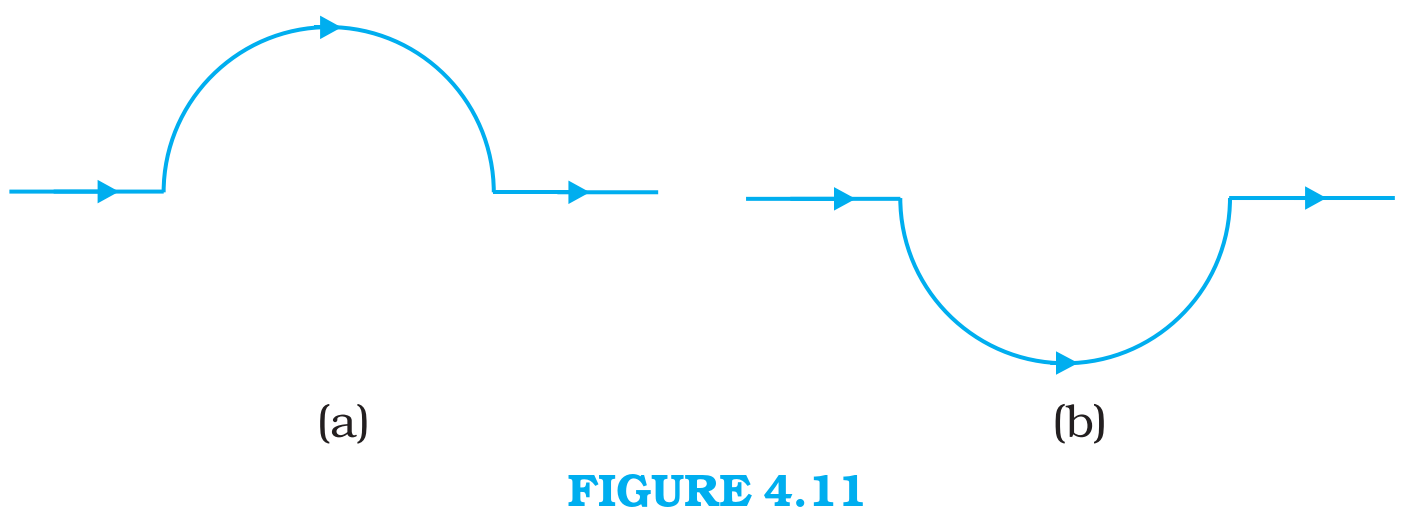
A straight wire carrying a current of $12 A$ is bent into a semi-circular arc of radius $2.0 cm$ as shown in Fig. 4.11 (a). Consider the magnetic field $B$ at the centre of the arc. (a) What is the magnetic field due to the straight segments? (b) In what way the contribution to $B$ from the semicircle differs from that of a circular loop and in what way does it resemble? (c) Would your answer be different if the wire were bent into a semi-circular arc of the same radius but in the opposite way as shown in Fig. 4.11(b)?
Image
View full solution
What is the radius of the path of an electron (mass $9 \times 10^{-31} kg$ and charge $1.6 \times 10^{-19} C$ ) moving at a speed of $3 \times 10^7 m / s$ in a magnetic field of $6 \times 10^{-4} T$ perpendicular to it? What is its frequency? Calculate its energy in $keV .\left(1 eV =1.6 \times 10^{-19} J \right)$.
View full solution
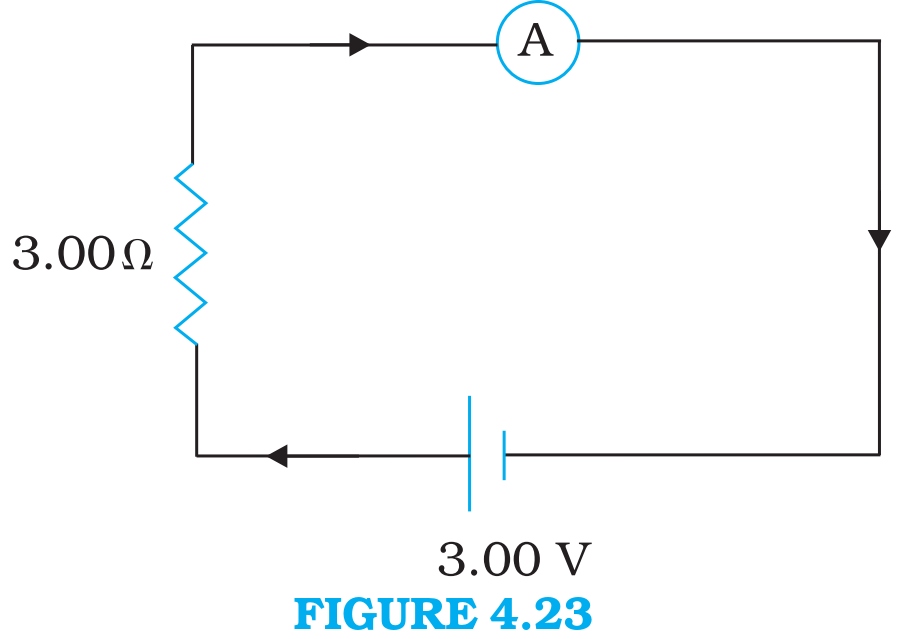
In the circuit (Fig. 4.23) the current is to be measured. What is the value of the current if the ammeter shown (a) is a galvanometer with a resistance $R_G=60.00 \Omega$; (b) is a galvanometer described in (a) but converted to an ammeter by a shunt resistance $r_s=0.02 \Omega$; (c) is an ideal ammeter with zero resistance?
Image
View full solution
Q 213 Marks Question3 Marks
  1. Obtain the expression for the cyclotron frequency.
  2. A deuteron and a proton are accelerated by the cyclotron. Can both be accelerated with the same oscillator frequency? Give reason to justify your answer.
View full solution
Q 223 Marks Question3 Marks
In a chamber, a uniform magnetic field of 6.5 G (1 G = 10–4 T) is maintained. An electron is shot into the field with a speed of 4.8 × 10⁶ m s–1 normal to the field. Explain why the path of the electron is a circle. Determine the radius of the circular orbit.
(e = 1.6 × 10–19 C, me = 9.1×10⁻³¹ kg)
View full solution
Q 233 Marks Question3 Marks
A circular coil of 20 turns and radius 10 cm is placed in a uniform magnetic field of 0.10 T normal to the plane of the coil. If the current in the coil is 5.0 A, what is the
  1. Total torque on the coil,
  2. Total force on the coil,
  3. Average force on each electron in the coil due to the magnetic field.
(The coil is made of copper wire of cross-sectional area 10–5 m2 , and the free electron density in copper is given to be about 1029 m–3).
View full solution
Q 243 Marks Question3 Marks
What is the magnitude of magnetic force per unit length on a wire carrying a current of 8 A and making an angle of 30º with the direction of a uniform magnetic field of 0.15 T?
View full solution
A magnetic field set up using Helmholtz coils (described in Exercise 4.16) is uniform in a small region and has a magnitude of 0.75 T. In the same region, a uniform electrostatic field is maintained in a direction normal to the common axis of the coils. A narrow beam of (single species) charged particles all accelerated through 15 kV enters this region in a direction perpendicular to both the axis of the coils and the electrostatic field. If the beam remains undeflected when the electrostatic field is 9.0 × 10–5 V m–1, make a simple guess as to what the beam contains. Why is the answer not unique?
View full solution
For a circular coil of radius R and N turns carrying current I, the magnitude of the magnetic field at a point on its axis at a distance x from its centre is given by,
$\text{B}=\frac{\mu_{0}\text{IR}^{2}\text{N}}{2(\text{x}^{2}+\text{R}^{2})^{\frac{3}{2}}}$
  1. Show that this reduces to the familiar result for field at the centre of the coil.
  2. Consider two parallel co-axial circular coils of equal radius R, and number of turns N, carrying equal currents in the same direction, and separated by a distance R. Show that the field on the axis around the mid-point between the coils is uniform over a distance that is small as compared to R, and is given by,$\text{B}=0.72\frac{\mu_{0}\text{NI}}{\text{R}}$, approximately.
[Such an arrangement to produce a nearly uniform magnetic field over a small region is known as Helmholtz coils.]
View full solution
A uniform magnetic field of 1.5 T exists in a cylindrical region of radius10.0 cm, its direction parallel to the axis along east to west. A wire carrying current of 7.0 A in the north to south direction passes through this region. What is the magnitude and direction of the force on the wire if,
  1. The wire intersects the axis,
  2. The wire is turned from N-S to northeast-northwest direction,
  3. The wire in the N-S direction is lowered from the axis by a distance of 6.0 cm?
View full solution
A solenoid 60 cm long and of radius 4.0 cm has 3 layers of windings of 300 turns each. A 2.0 cm long wire of mass 2.5 g lies inside the solenoid (near its centre) normal to its axis; both the wire and the axis of the solenoid are in the horizontal plane. The wire is connected through two leads parallel to the axis of the solenoid to an external battery which supplies a current of 6.0 A in the wire. What value of current (with appropriate sense of circulation) in the windings of the solenoid can support the weight of the wire? g = 9.8 m s–2.
View full solution
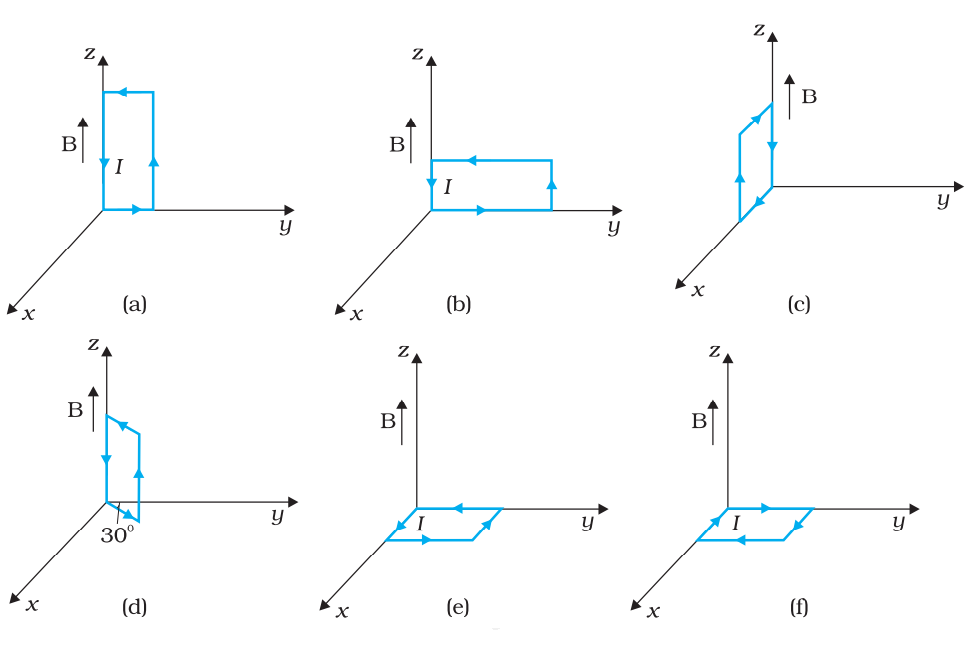
A uniform magnetic field of 3000 G is established along the positive z-direction. A rectangular loop of sides 10 cm and 5 cm carries a current of 12 A. What is the torque on the loop in the different cases shown in Fig.? What is the force on each case? Which case corresponds to stable equilibrium?

View full solution
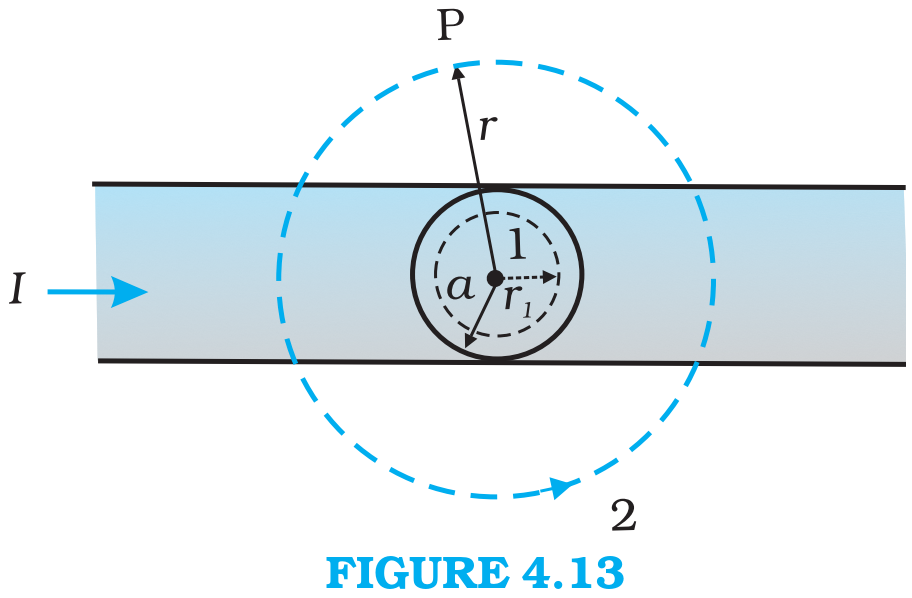
Figure 4.13 shows a long straight wire of a circular cross-section (radius a) carrying steady current $I$. The current $I$ is uniformly distributed across this cross-section. Calculate the magnetic field in the region $r<a$ and $r>a$.
Image
View full solution
A 100 turn closely wound circular coil of radius $10 cm$ carries a current of 3.2 A. (a) What is the field at the centre of the coil? (b) What is the magnetic moment of this coil?
The coil is placed in a vertical plane and is free to rotate about a horizontal axis which coincides with its diameter. A uniform magnetic field of $2 T$ in the horizontal direction exists such that initially the axis of the coil is in the direction of the field. The coil rotates through an angle of $90^{\circ}$ under the influence of the magnetic field. (c) What are the magnitudes of the torques on the coil in the initial and final position?
(d) What is the angular speed acquired by the coil when it has rotated by $90^{\circ}$ ? The moment of inertia of the coil is $0.1 kg m ^2$.
View full solution
  1. Deduce an expression for the frequency of revolution of a charged particle in a magnetic field and show that it is independent of velocity or energy of the particle.
  2. Draw a schematic sketch of a cyclotron. Explain, giving the essential details of its construction, how it is used to accelerate the charged particles.
View full solution
  1. Draw a labelled diagram of a moving coil galvanometer. Describe briefly its principle and working.
  2. Answer the following:
  1. Why is it necessary to introduce a cylindrical soft iron core inside the coil of a galvanometer?
  2. Increasing the current sensitivity of a galvanometer may not necessarily increase its voltage sensitivity. Explain, giving reason.
View full solution
  1. Using Biot-Savart’s law, derive the expression for the magnetic field in the vector form at a point on the axis of a circular current loop.
  2. What does a toroid consist of ? Find out the expression for the magnetic field inside a toroid for N turns of the coil having the average radius r and carrying a current I. Show that the magnetic field in the open space inside and exterior to the toroid is zero.
View full solution

Generate a Moving Charges and Magnetism paper free

Pick question groups from the list above, set marks and difficulty, and export a branded PDF with step-by-step answer keys. First 3 chapters free — no signup.

Download App