MCQ
A galvanometer together with an unknown resistance in series is connected to two identical batteries each of $1.5\, V$. When the batteries are connected in series, the  galvanometer records a current of $1\,A$, and when batteries are in parallel the current is $0.6\,A$.  What is the internal resistance of the battery ?
  • A
    $r = \frac{2}{3}\, \Omega$
  • B
    $r = \frac{2}{5}\, \Omega$
  • $r = \frac{1}{3} \,\Omega$
  • D
    $r = \frac{3}{2}\, \Omega$

Answer

Correct option: C.
$r = \frac{1}{3} \,\Omega$
c
Case $I$ $:-$  $I_{g}=\frac{E_{1}+E_{2}}{R_{g}+R+2 r} \Rightarrow 1=\frac{3}{R_{g}+R+\frac{r}{2}}$

$\Rightarrow \mathrm{R}_{\mathrm{g}}+\mathrm{R}+2 \mathrm{r}=3$           ............$(1)$

Case $II: - {E_{eq}} = E = 1.5{\rm{\,V}}$

$\mathrm{I}_{\mathrm{g}}=\frac{\mathrm{E}_{\mathrm{eq}}}{\mathrm{R}_{\mathrm{g}}+\mathrm{R}+\frac{\mathrm{r}}{2}} \quad \Rightarrow 0.6=\frac{1.5}{\mathrm{R}_{\mathrm{g}}+\mathrm{R}+\frac{\mathrm{r}}{2}}$

$\Rightarrow \mathrm{R}_{\mathrm{g}}+\mathrm{R}+\frac{\mathrm{r}}{2}=\frac{1.5}{0.6}=2.5$             .........$(2)$

from eq $(1)$ and $(2)$

$\frac{3 \mathrm{r}}{2}=0.5 \quad \Rightarrow \quad \mathrm{r}=\frac{1}{3}\, \Omega$

Need a full question paper?

Generate a complete, print-ready paper with questions like this in minutes — across 16+ boards, with answer keys.

Start Generating Free

Similar questions

In an a.c. curent the $e.m.f$ $(\varepsilon)$ and the current $(i)$ at any instant are given respectively by  $E=E_o sin\,\,\omega t$ ,$i=I_o sin$$\left( {\omega t - \phi } \right)$  The average power in the circuit over one cycle of $a.c.$ is
There are certain types of stars called visible stars which undergo periodic change in their light output. If such a star quadruple it's light output, how much does it's magnitude change
How many photons are emitted by a laser source of $5 \times 10^{-3} \,W$ operating at $632.2 \,nm$ in $2 \,s$ is .......$\times 10^{16}$ $\left(h=6.63 \times 10^{-34} \,Js \right)$
A TV tower has a height of 100 m. The average population density around the tower is 1000 per $km^2$. The radius of the earth is $6.4 \times {10^6}$m. the population covered by the tower is
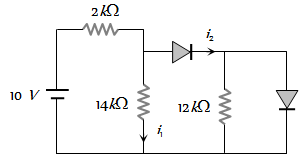
In the following circuit find $\mathrm{I}_1$ and $\mathrm{I}_2$
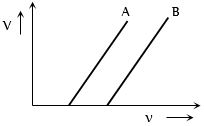
The stopping potential as a function of the frequency of the incident radiation is plotted for two different photoelectric surfaces $A$ and $B$. The graphs show that work function of $A$ is
In semiconductor the concentrations of electrons and holes are $8 × 10^{18}/m^3$ and $5 × 10^{18}/m$ respectively. If the mobilities of electrons and hole are  $2.3 m^{2}/volt-sec$ and $0.01\, m^{2}/volt-sec$ respectively, then semiconductor is
A simple microscope has:
The dipole moment of a short bar magnet is $1.25\, A-m^2$. The magnetic field on its axis at a distance of $0.5$ metre from the centre of the magnet is
In a uniform magnetic field of induction $B$ a wire in the form of semicircle of radius $r$ rotates about the diameter of the circle with angular frequency $\omega$. The axis of rotation is perpendicular to the field. If the total resistance of the circuit is $R$ the mean power generated per period of rotation is