MCQ
A geostationary satellite
  • Revolves about the polar axis
  • B
    Has a time period less than that of the near earth satellite
  • C
    Moves faster than a near earth satellite
  • D
    Is stationary in the space

Answer

Correct option: A.
Revolves about the polar axis
a
A geosynchronous satellite is a satellite whose orbital track on earth repeats regularly over points on the earth over time. If such a satellites orbit lies over the equator, it is called a geostationary satellite. Hence, geostationary satellite revolves about the polar axis.

Need a full question paper?

Generate a complete, print-ready paper with questions like this in minutes — across 16+ boards, with answer keys.

Start Generating Free

Similar questions

The angular velocity of a body is $\mathop \omega \limits^ \to   = 2\hat i + 3\hat j + 4\hat k$ and a torque $\mathop \tau \limits^ \to   = \hat i + 2\hat j + 3\hat k$ acts on it. The rotational power will be .......... $W$
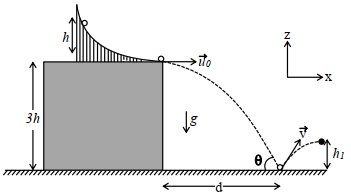
A slide with a frictionless curved surface, which becomes horizontal at its lower end,, is fixed on the terrace of a building of height $3 h$ from the ground, as shown in the figure. A spherical ball of mass $\mathrm{m}$ is released on the slide from rest at a height $h$ from the top of the terrace. The ball leaves the slide with a velocity $\vec{u}_0=u_0 \hat{x}$ and falls on the ground at a distance $d$ from the building making an angle $\theta$ with the horizontal. It bounces off with a velocity $\overrightarrow{\mathrm{v}}$ and reaches a maximum height $h_l$. The acceleration due to gravity is $g$ and the coefficient of restitution of the ground is $1 / \sqrt{3}$. Which of the following statement($s$) is(are) correct?

($AV$) $\vec{u}_0=\sqrt{2 g h} \hat{x}$ ($B$) $\vec{v}=\sqrt{2 g h}(\hat{x}-\hat{z})$  ($C$) $\theta=60^{\circ}$  ($D$) $d / h_1=2 \sqrt{3}$
A body starts from the origin and moves along the $X-$axis such that the velocity at any instant is given by $(4{t^3} - 2t)$, where $t$ is in sec and velocity in$m/s$. What is the acceleration of the particle, when it is $2\, m$ from the origin..........$m/{s^2}$
Venus looks brighter than other planets because
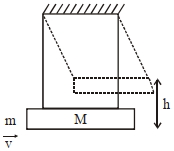
A large block of wood of mass $M =5.99\, kg$ is hanging from two long massless cords. A bullet of mass $m =10\, g$ is fired into the block and gets embedded in it. The (block $+$ bullet) then swing upwards, their centre of mass rising a vertical distance $h =9.8\,cm$ before the (block $+$ bullet) pendulum comes momentarily to rest at the end of its arc. The speed of the bullet just before collision is: (Take $g =9.8\, ms ^{-2}$ ) (in $m/s$)
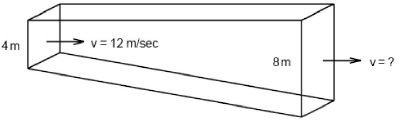
A river gradually deepens, from a depth of $4 \ m$ to a depth of $8\  m$ as shown. The width, $W$, of the river does not change. At the depth of $4 \ m$, the river's speed is $12\  m/sec.$ Its  elocity at the $8\  m$ depth is ......... $m/sec$
A solid homogenous sphere of mass $M$ and radius $r$ is moving on a rough horizontal surface, partly rolling and partly sliding. During this kind of motion of this sphere
$M$ grams of steam at $100^{\circ} \mathrm{C}$ is mixed with $200\; \mathrm{g}$ of ice at its melting point in a thermally insulated container. If it produces liquid water at $40^{\circ} \mathrm{C}$ [heat of vaporization of water is $540 \;cal/\mathrm{g}$ and heat of fusion of ice is $80 \;\text { cal/g }]$ the value of $\mathrm{M}$ is
If temperature of an object is $140°F$, then its temperature in centigrade is........ $^oC$
A tuning fork of frequency $340Hz$ is vibrated just above the tube of $120 cm$ height. Water is poured slowly in the tube. What is the minimum height of water necessary for the resonance .... $cm$ (speed of sound in the air $= 340 m/sec$)