A heater of $220\, V$ heats a volume of water in $5\,\min$ time. A heater of $110\, V$ heats the same volume of water in ............... $min$
Easy
Download our app for free and get started
Heat produced $ = \frac{{{V^2}}}{R}t$
i.e. when voltage is halved, heat produced becomes one-fourth. Hence time taken to heat the water becomes four times.

Download our appand get started for free
Experience the future of education. Simply download our apps or reach out to us for more information. Let's shape the future of learning together!No signup needed.*
Similar Questions
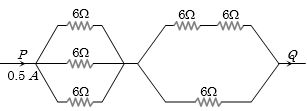
- 1Resistances of $6\, ohm$ each are connected in the manner shown in adjoining figure. With the current $0.5\,ampere$ as shown in figure, the potential difference ${V_P} - {V_Q}$ is .............. $V$View Solution
- 2$n$ identical cells each of $e.m.f.$ $E$ and internal resistance $r$ are connected in series. An external resistance $R$ is connected in series to this combination. The current through $R$ isView Solution
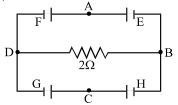
- 3In the circuit shown $E, F, G$ and $H$ are cells of $\mathrm{e.m.f.}$ $2\,V, 1\,V, 3\,V$ and $1\,V$ respectively and their internal resistances are $2\,\Omega , 1\,\Omega , 3\,\Omega$ and $1\,\Omega$ respectively.View Solution
- 4At what temperature will the resistance of a copper wire become three times its value at $0\,^oC$ ................. $^oC$ (Temperature coefficient of resistance for copper = $4 × 10^{-3} \,per\, \,^oC$ )View Solution
- 5In a potentiometer arrangement. $E_1$ is the cell establishing current in primary circuit. $E_2$ is the cell to be measured. $AB$ is the potentiometer wire and $G$ is a galvanometer. Which of the following are the essential condition for balance to be obtained.View Solution
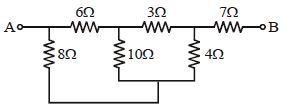
- 6The equivalent resistance between the points $A$ and $B$ is :-View Solution
- 7In the experiment of $Ohm's law,$ a potential difference of $5.0\, V$ is applied across the end of a conductor of length $10.0\, cm$ and diameter of $5.00\, mm .$ The measured current in the conductor is $2.00\, A$. The maximum permissible percentage error in the resistivity of the conductor isView Solution
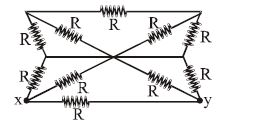
- 8What will be equivalent resistance of circuit between $x$ and $y$View Solution
- 9A fuse wire with radius $1\, mm$ blows at $1.5\, amp$. The radius of the fuse wire of the same material to blow at $3\,A$ will beView Solution
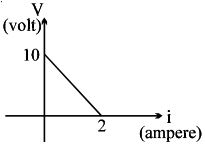
- 10$A$ battery of $\mathrm{emf}$ $E$ and internal resistance $r$ is connected across a resistance $R$. Resistance $R$ can be adjusted to any value greater than or equal to zero. Agraph is plotted between the current $(i)$ passing through the resistance and potential difference $(V) $ across it. Select the correct alternative $(s)$.View Solution