MCQ
A heavy brass sphere is hung from a spring and it executes vertical vibrations with period $T.$ The sphere is now immersed in a non$-$viscous liquid with a density $(\frac{1}{10})^\text{th}$ that of brass. When set into vertical vibrations with the sphere remaining inside liquid all the time, the time period will be:
  • A
    $\sqrt{\frac{9}{10\text{T}}}$
  • $\sqrt{\frac{10}{9\text{T}}}$
  • C
    $\sqrt{\Big(\frac{9}{10}}\Big)\text{T}$
  • D
    Unchanged

Answer

Correct option: B.
$\sqrt{\frac{10}{9\text{T}}}$

Need a full question paper?

Generate a complete, print-ready paper with questions like this in minutes — across 16+ boards, with answer keys.

Start Generating Free

Similar questions

A sound source is moving towards a stationary observer with $1/10$ of the speed of sound. The ratio of apparent to real frequency is
The fundamental frequency of a sonometer wire increases by $6$ $Hz$ if its tension is increased by $44\%$ keeping the length constant. The change in the fundamental frequency of the sonometer wire in $Hz$ when the length of the wire is increased by $20\%$, keeping the original tension in the wire will be :-
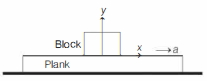
A plank is moving in a horizontal direction with a constant acceleration $\alpha \hat{ i }$. A uniform rough cubical block of side $l$ rests on the plank and is at rest relative to the plank. Let the centre of mass of the block be at $(0, l / 2)$ at a given instant. If $\alpha =g / 10$, then the normal reaction exerted by the plank on the block at that instant acts at
A ship $A$ is moving Westwards with a speed of $10\, km h^{-1}$ and a ship $B$ $100\;km$ South of $A$, is moving Northwards with a speed of $10\, km h^{-1}$ .The time after which the distance between them becomes shortest, is ........ $hr$
A transverse wave of frequency $500 \,Hz$ and speed $100 \,m / s$ is travelling in the positive $x$-direction on a long string. At time $t=0 \,s$, the displacements at $x=0.0 \,m$ and at $x=0.25 \,m$ are $0.0 \,m$ and $0.02 \,m$, respectively. The displacement at $x=0.2 \,m$ at $t=5 \times 10^{-4} s$ is ............ $m$
A tuning fork of known frequency $256\,Hz$ makes $5$ beats per second with the vibrating string of a guitar. The beat frequency decreases to $2$ beats per second when the tension in the guitar string slightly increased. The frequency of the guitar string before increasing the tension was ..... $Hz$
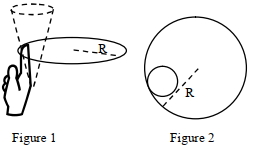
One twirls a circular ring (of mass $M$ and radius $R$ ) near the tip of one's finger as shown in Figure $1$ . In the process the finger never loses contact with the inner rim of the ring. The finger traces out the surface of a cone, shown by the dotted line. The radius of the path traced out by the point where the ring and the finger is in contact is $\mathrm{r}$. The finger rotates with an angular velocity $\omega_0$. The rotating ring rolls without slipping on the outside of a smaller circle described by the point where the ring and the finger is in contact (Figure $2$). The coefficient of friction between the ring and the finger is $\mu$ and the acceleration due to gravity is $g$.

(IMAGE)

($1$) The total kinetic energy of the ring is

$[A]$ $\mathrm{M} \omega_0^2 \mathrm{R}^2$   $[B]$ $\frac{1}{2} \mathrm{M} \omega_0^2(\mathrm{R}-\mathrm{r})^2$   $[C]$ $\mathrm{M \omega}_0^2(\mathrm{R}-\mathrm{r})^2$   $[D]$ $\frac{3}{2} \mathrm{M} \omega_0^2(\mathrm{R}-\mathrm{r})^2$

($2$) The minimum value of $\omega_0$ below which the ring will drop down is

$[A]$ $\sqrt{\frac{g}{\mu(R-r)}}$  $[B]$ $\sqrt{\frac{2 g}{\mu(R-r)}}$  $[C]$ $\sqrt{\frac{3 g}{2 \mu(R-r)}}$    $[D]$ $\sqrt{\frac{g}{2 \mu(R-r)}}$

Givin the answer quetion ($1$) and ($2$)

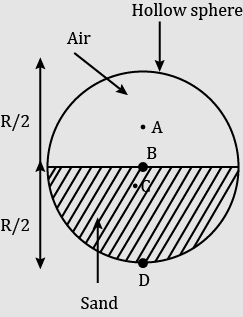
Which of the following points is the likely position of the centre of mass of the system shown in the figure ?
Image
Surface tension of soap solution is $ 2 ×10^{-2} N/m$. The work done in producing a soap bubble of radius $2 \,cm$ is
Hot water kept in a beaker placed in a room cools from ${70^o}C$ to $60°C$ in $4$ minutes. The time taken by it to cool from ${69^o}C$ to ${59^o}c$ will be