Question
A heavy nucleus breaks into comparatively lighter nuclei, which are more stable compared to the original heavy nucleus. When a heavy nucleus like uranium is bombarded by slow moving neutrons, it splits into two parts, releasing large amount of energy. The typical fission reaction of $_{92}\text{U}^{235}$.
$_{92}\text{U}^{235}+\ _0\text{n}^1\rightarrow\ _{56}\text{Ba}^{141}+\ _{36}\text{kr}^{92}+\ 3_0\text{n}^1+\ 200\text{ MeV}$
The fission of $_{92}\text{U}^{235}$ approximately released $200 MeV$ of energy.
  1. If $200 MeV$ energy is released in the fission of a single nucleus of $_{92}^{235}\text{U}$, the fissions which are required to produce a power of $1kW$ is.
  1. $3.125 \times 10^{13}$
  2. $1.52 \times 10^6$
  3. $3.125 \times 10^{12}$
  4. $3.125 \times 10^{14}$
  1. The release in energy in nuclear fission is consistent with the fact that uranium has
  1. More mass per nucleon than either of the two fragments.
  2. More mass per nucleon as the two fragment.
  3. Exactly the same mass per nucleon as the two fragments.
  4. Less mass per nucleon than either of two fragments.
  1. When $_{92}\text{U}^{235}$ undergoes fission, about $0.1\%$ of the original mass is converted into energy. The energy released when $1\ kg$ of $_{92}\text{U}^{235}$ undergoes fission is.
  1. $9 \times 10^{11}J$
  2. $9 \times 10^{13}J$
  3. $9 \times 10^{15}J$
  4. $9 \times 10^{18}J$
  1. A nuclear fission is said to be critical when multiplication factor or $K$.
  1. $K = 1$
  2. $K > 1$
  3. $K < 1$
  4. $K = 0$
  1. Einstein's mass-energy conversion relation $E = mc^2$ is illustrated by.
  1. Nuclear fission
  2. $\beta-$ decay
  3. Rocket propulsion
  4. Steam engine

Answer

  1. $(a)\ 3.125 \times 10^{13}$
  1. As only $0.1\%$ of the original mass is converted into energy, hence out of $1\ kg$ mass $1g$ is converted into energy.
    Energy released during fission $\text{E}=\triangle\text{mc}^2$
  2. $= 1g \times (3 \times 10^8 m s^{-1})^2 = 10^{-3} \times 9 \times 10^{16}J = 9 \times 10^{13}J$
  3. $(a)\ K = 1$
  4. $(a)$ Nuclear fission
  5. Let the number of fissions per second be $n$. Energy released per second
    $= n \times 200MeV = n \times 200 \times 1.6 \times 10^{-13}J$
    Energy required per second $=$ power $\times$ time
    $= 1kW \times Is = 1000J$
    $n \times 200 \times 1.6 \times 10^{-13} = 1000$ or
    $\text{n}=\frac{1000}{3.2\times10^{-11}}$
    $=\frac{10}{3.2}\times10^{13}=3.125\times10^{13}$
  6. $(a)$ More mass per nucleon than either of the two fragments.
  7. $(b) \ 9 \times 10^{13}J$

Need a full question paper?

Generate a complete, print-ready paper with questions like this in minutes — across 16+ boards, with answer keys.

Start Generating Free

Similar questions

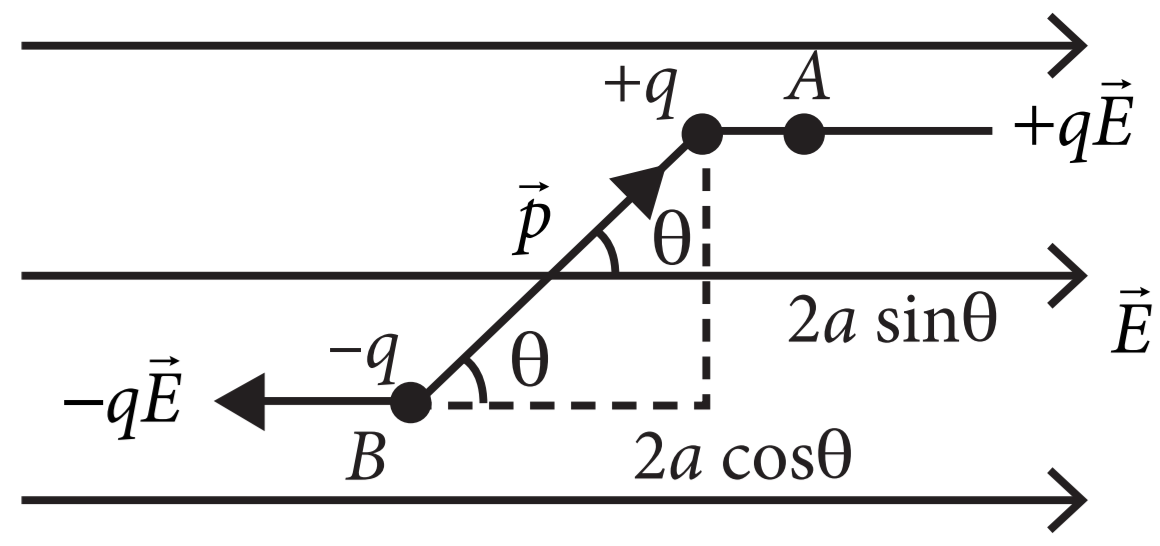
When electric dipole is placed in uniform electric field, its two charges experience equal and opposite forces, which cancel each other and hence net force on electric dipole in uniform electric field is zero. However, these forces are not collinear, so they give rise to some torque on the dipole. Since net force on electric dipole in uniform electric field is zero, so no work is done in moving the electric dipole in uniform electric field. However, some work is done in rotating the dipole against the torque acting on it.
  1. The dipole moment of a dipole in a uniform external field $\vec{\text{E}}$ is $\vec{\text{P}}.$ Then the torque $'i $ acting on the dipole is:
  1. $\text{pE}\sin\theta,-\text{pE}\cos\theta$
  2. $\text{pE}\sin\theta,-2\text{pE}\cos\theta$
  3. $\text{pE}\sin\theta,2\text{pE}\cos\theta$
  4. $\text{pE}\cos\theta,-2\text{pE}\sin\theta$
  5. An electric dipole of moment pis placed in an electric field of intensity $E.$ The dipole acquires a position such that the axis of the dipole makes an angle $\theta$ with the direction of the field. Assuming that the potential energy of the dipole to be zero when $\theta=90^\circ$ the torque and the potential energy of the dipole will respectively be:
  6. $\text{F}=0, \tau=0$
  7. $\text{F}\not=0, \tau\not=0$
  8. $\text{F}=0, \tau\not=0$
  9. $\text{F}\not=0, \tau=0$
  10. When an electric dipole is held at an angle in a uniform electric field, the net force $F$ and torque t on the dipole are:
  11. $0^\circ$
  12. $90^\circ$
  13. $180^\circ$
  14. Both $(a)$ and $(c)$
  15. Torque on a dipole in uniform electric field is minimum when $\theta$ is equal to:
  16. $0.2 \times 10^{-3}Nm$
  17. $1 \times 10^{-3}Nm$
  18. $2 \times 10^{-3}Nm$
  19. $4 \times 10^{-3}Nm$
  20. An electric dipole consists of two opposite charges, each of magnitude $1.0\mu\text{C}$ separated by a distance of $2.0\ cm$.
  21. The dipole is placed in an external field of $10^5N C^{-1}$.
  22. The maximum torque on the dipole is:
  23. $\vec{\tau}=\vec{\text{P}}\times\vec{\text{E}}$
  24. $\vec{\tau}=\vec{\text{P}}\cdot\vec{\text{E}}$
  25. $\vec{\tau}=2(\vec{\text{P}}+\vec{\text{E}})$
  26. $\vec{\tau}=(\vec{\text{P}}+\vec{\text{E}})$
There are materials which absorb photons of shorter wavelength and emit photons of longer wavelength. Can there be stable substances which absorb photons of larger wavelength and emit light of shorter wavelength.
If a mosquito is dipped into water and released, it is not able to fly till it is dry again. Explain.
Currents can be induced not only in conducting coils, but also in conducting sheets or blocks. Current is induced in solid metallic masses when the magnetic flux threading through them changes. Such currents flow in the from of irregularly shaped loops throughout the body of the metal. These currents look like eddies or whirlpools in water so they are known as eddy currents. Eddy currents have both undesirable effects and practically useful applications. For example it causes unnecessary heating and wastage of power in electric motors, dynamos and in the cores of transformers.
  1. The working of speedometers of trains is based on:
  1. Wattless currents.
  2. Eddy currents.
  3. alternating currents.
  4. pulsating currents.
  1. Identify the wrong statement.
  1. Eddy currents are produced in a steady magnetic field.
  2. Induction furnace uses eddy currents to produce heat.
  3. Eddy currents can be used to produce braking force in moving trains.
  4. Power meters work on the principle of eddy currents.
  1. Which of the following is the best method to reduce eddy currents?
  1. Laminating core.
  2. Using thick wires.
  3. By reducing hysteresis loss.
  4. None of these.
  1. The direction of eddy currents is given by:
  1. Fleming's left hand rule.
  2. Biot-Savart law.
  3. Lenz's law
  4. Ampere-circuital law.
  1. Eddy currents can be used to heat localised tissues of the human body. This branch of medical therapy is called:
  1. Hyperthermia.
  2. Diathermy.
  3. Inductothermy.
  4. None of these.
Refraction of light is the change in the path of light as it passes obliquely from one transparent medium to another medium. According to law of refraction $\frac{\sin\text{i}}{\sin\text{r}}=\ ^1\mu_2,$ where $^1\mu_2$ is called refractive index of second medium with respect to first medium. From refraction at a convex spherical surface, we have $\frac{\mu_2}{\text{v}}=\frac{\mu_1}{\text{u}}=\frac{\mu_2-\mu_1}{\text{R}}.$ Similarly from refraction at a concave spherical surface when object lies in the rarer medium, we have $\frac{\mu_2}{\text{v}}-\frac{\mu_1}{\text{u}}=\frac{\mu_2-\mu_1}{\text{R}}$ and when object lies in the denser medium, we have $\frac{\mu_1}{\text{v}}-\frac{\mu_2}{\text{u}}=\frac{\mu_1-\mu_2}{\text{R}}.$
  1. Refractive index of a medium depends upon:
  1. Nature of the medium.
  2. Wavelength of the tight used.
  3. Temperature.
  4. All of these.
  1. A ray of light of frequency $5 \times 10^{14}Hz$ is passed through a liquid. The wavelength of light measured inside the liquid is found to be $450 \times 10^{-9m.}$ The refractive index of the liquid is:
  1. $1.33$
  2. $2.52$
  3. $2.22$
  4. $0.75$
  1. A ray of light is incident at an angle of $60^\circ$ on one face of a rectangular glass slab of refractive index $1.5.$ The angle of refraction is:
  1. $\sin^-1 (0.95)$
  2. $\sin^-1 (0.58)$
  3. $\sin^-1 (0.79)$
  4. $\sin^-1 (0.86)$
  1. $A$
  2. point object is placed at the centre of a glass sphere of radius $6 \ cm$ and refractive index $1.5.$ The distance of the virtual image from the surface of sphere is:
  1. $2\ cm$
  2. $4\ cm$
  3. $6\ cm$
  4. $12\ cm$
  1. In refraction, light waves are bent on passing from one medium to the second medium because in the second medium:
  1. The frequency is different.
  2. The co$-$efficient of elasticity is different.
  3. The speed is different.
  4. The amplitude is smaller.
The magnetic field at a point, $10\ cm$ away from a magnetic dipole, is found to be $2.0 \times 10^{-4 }T.$ find the magnetic moment of the dipole if the point is.
  1. In end$-$on position of the dipole.
  2. In broadside$-$onposition of the dipole.
When the atomic dipoles are aligned partially or fully, there is a net magnetic moment in the direction of the field in any small volume of the material. The actual magnetic field inside material placed in magnetic field is the sum of the applied magnetic field and the magnetic field due to magnetisation. This field is called magnetic intensity $(H)$.
$\text{H}=\frac{\text{B}}{\mu_0}-\text{M}$
where Mis the magnetisation of the material, flo is the permittivity of vacuum and $B$ is the total magnetic field. The measure that tells us how a magnetic material responds to an external field is given by a dimensionless quantity is appropriately called the magnetic susceptibility: for a certain class of magnetic materials, intensity of magnetisation is directly proportional to the magnetic intensity.
  1. Magnetization of a sample is:
  1. Volume of sample per unit magnetic moment.
  2. Net magnetic moment per unit volume.
  3. Ratio of magnetic moment and pole strength.
  4. Ratio of pole strength to magnetic moment.
  1. Identify the wrongly matched quantity and unit pair.
  1. Pole strength $- Am$
  2. Magnetic susceptibility $-$ dimensionless number
  3. Intensity of magnetisation $- Am^{-1}$
  4. Magnetic permeability $-$ Henry $m$
  1. A closed surface $S$ encloses a magnetic dipole of magnetic moment $2\ ml$. The magnetic flux emerging from the surface is:
  1. $2 \times 10^5\ A/ m$
  2. $3 \times 10^5\ A/ m$
  3. $4 \times 10^5\ A/ m$
  4. $5 \times 10^5\ A/ m$
  1. A solenoid has core of a material with relative permeability $500$ and its windings carry a current of $1A$. The number of turns of the solenoid is $500$ per metre. The magnetization of the material is nearly,
  1. $2.5 \times 10^3Am^{-1}$
  2. $2.5 \times 10^5Am^{-1}$
  3. $2.0 \times 10^3Am^{-1}$
  4. $2.0 \times 10^5Am^{-1}$
  1. The relative penneability of iron is $6000$. Its magnetic susceptibility is:
  1. $5999$
  2. $6001$
  3. $6000 \times 10^{-7}$
  4. $6000 \times 10^7$
An ideal gas is pumped into a rigid container having diathermic walls so that the temperature remains constant. In a certain time interval, the pressure in the container is doubled. Is the internal energy of the contents of the container also doubled in the interval?
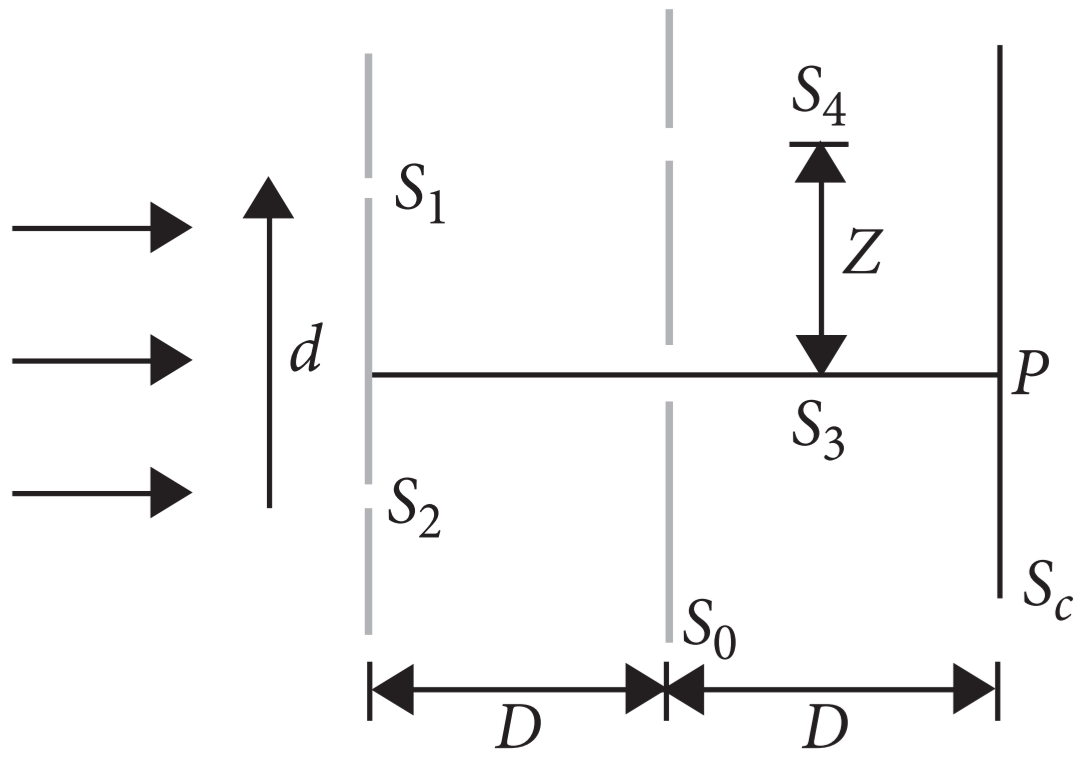
Consider the situation shown in figure. The two slits $S_1$ and $S_1$ placed symmetrically around the central line are illuminated by monochromatic light of wavelength $\lambda$. The separation between the slits is $d$. The light transmitted by the slits falls on a screen $S_0$ place at a distance $D$ from the slits. The slits $S_3$ is at the central line and the slit $S_4$ is at a distance from $S_3$. Another screen $S_c$ is placed a further distance $D$ away from $S_c$.
  1. Find the path difference if $\text{z}=\frac{\lambda\text{D}}{2\text{d}}$.
  1. $5A^2$
  2. $13A^2$
  3. $7A^2$
  4. $19A^2$
  5. Two monochromatic light waves of amplitudes $3_A$ and $2_A$ interfering at a point have a phase difference of $60^\circ$ .
  6. The intensity at that point will be proportional to:
  7. $\Big(\text{n}+\frac{1}{2}\Big)\lambda$
  8. $\text{n}\lambda$
  9. $\Big(\text{n}-\frac{1}{2}\Big)\lambda$
  10. $\frac{\lambda}{2}$
  11. ln the case of light waves from two coherent sources $S_1$ and $S_2,$ there will be constructive interference at an arbitrary point $P, $ if the path difference $\ce{S_1P - S_2P}$ is:
  12. Concentric circles.
  13. Points.
  14. Straight lines.
  15. Semi $-$ circles.
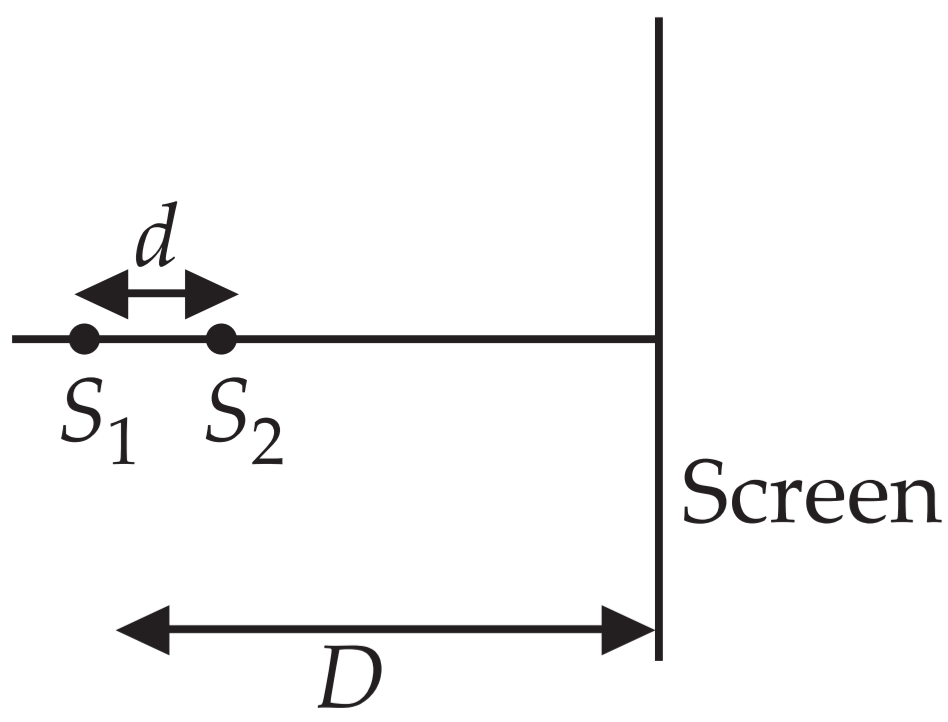
  16. Two coherent point sources $S_1$ and $S_2$ are separated by a small distanced as shown in figure. The fringes obtained on the screen will be:
  17. $4$
  18. $2$
  19. $\infty$
  20. $1$
  21. Find the ratio of the maximum to minimum intensity observed on $S_c$ if $\text{z}=\frac{\lambda\text{D}}{\text{d}}$
  22. $\lambda$
  23. $\frac{\lambda}{2}$
  24. $\frac{3}{2\lambda}$
  25. $2\lambda$
Explain the use of chock coil.