Question
When electric dipole is placed in uniform electric field, its two charges experience equal and opposite forces, which cancel each other and hence net force on electric dipole in uniform electric field is zero. However, these forces are not collinear, so they give rise to some torque on the dipole. Since net force on electric dipole in uniform electric field is zero, so no work is done in moving the electric dipole in uniform electric field. However, some work is done in rotating the dipole against the torque acting on it.
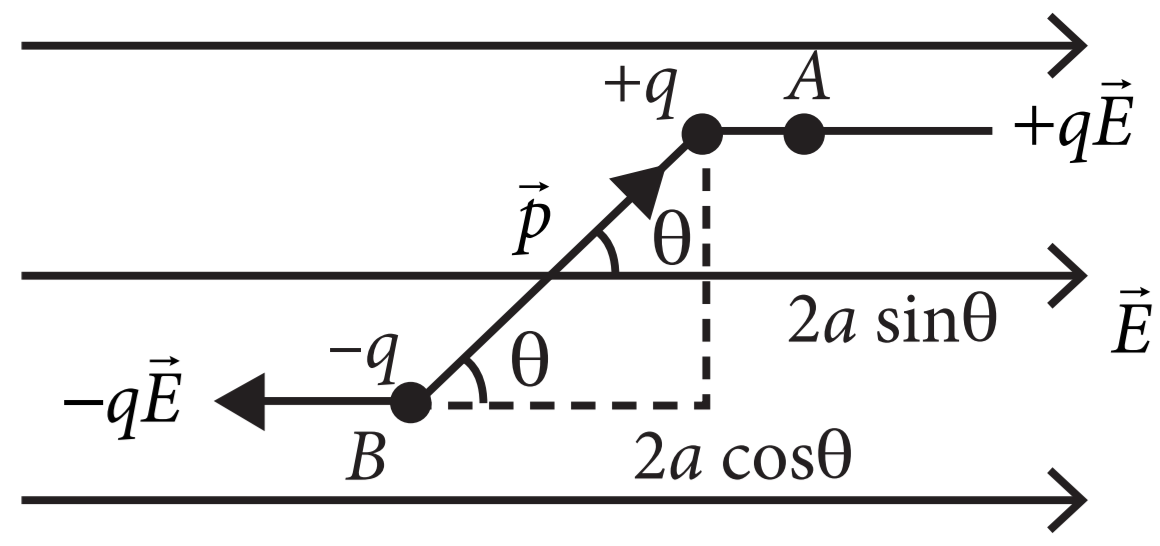
  1. The dipole moment of a dipole in a uniform external field $\vec{\text{E}}$ is $\vec{\text{P}}.$ Then the torque $'i $ acting on the dipole is:
  1. $\text{pE}\sin\theta,-\text{pE}\cos\theta$
  2. $\text{pE}\sin\theta,-2\text{pE}\cos\theta$
  3. $\text{pE}\sin\theta,2\text{pE}\cos\theta$
  4. $\text{pE}\cos\theta,-2\text{pE}\sin\theta$
  5. An electric dipole of moment pis placed in an electric field of intensity $E.$ The dipole acquires a position such that the axis of the dipole makes an angle $\theta$ with the direction of the field. Assuming that the potential energy of the dipole to be zero when $\theta=90^\circ$ the torque and the potential energy of the dipole will respectively be:
  6. $\text{F}=0, \tau=0$
  7. $\text{F}\not=0, \tau\not=0$
  8. $\text{F}=0, \tau\not=0$
  9. $\text{F}\not=0, \tau=0$
  10. When an electric dipole is held at an angle in a uniform electric field, the net force $F$ and torque t on the dipole are:
  11. $0^\circ$
  12. $90^\circ$
  13. $180^\circ$
  14. Both $(a)$ and $(c)$
  15. Torque on a dipole in uniform electric field is minimum when $\theta$ is equal to:
  16. $0.2 \times 10^{-3}Nm$
  17. $1 \times 10^{-3}Nm$
  18. $2 \times 10^{-3}Nm$
  19. $4 \times 10^{-3}Nm$
  20. An electric dipole consists of two opposite charges, each of magnitude $1.0\mu\text{C}$ separated by a distance of $2.0\ cm$.
  21. The dipole is placed in an external field of $10^5N C^{-1}$.
  22. The maximum torque on the dipole is:
  23. $\vec{\tau}=\vec{\text{P}}\times\vec{\text{E}}$
  24. $\vec{\tau}=\vec{\text{P}}\cdot\vec{\text{E}}$
  25. $\vec{\tau}=2(\vec{\text{P}}+\vec{\text{E}})$
  26. $\vec{\tau}=(\vec{\text{P}}+\vec{\text{E}})$
Answer

  1.  $\vec{\tau}=\vec{\text{P}}\times\vec{\text{E}}$
As $\tau=$ either force $\times$ perpendicular distance between the two forces.
$=\text{qaE}\sin\theta\text{ or }\tau=\text{PE}\sin\theta$
$(\because\text{qa}=\text{P})$
Or $\vec{\tau}=\vec{\text{P}}\times\vec{\text{E}}$
  1.  $2 \times 10^{-3}Nm$
The maximum torque on the dipole in an external electric field is given by
$\tau=\text{pE}=\text{q}(\text{2a})\times\text{E}$
Here, $\text{q}=1\mu\text{C}=10^{-6}\text{C,}$
$2a = 2\ cm = 2 \times 10^{-2}m,$
$E = 10^5N C^{-1},$
$\tau=?$
$\therefore\tau=10^{-6}\times2\times10^{-2}\times10^5$
$=2\times10^{-3}\text{Nm}$
  1.  Both $(a)$ and $(c)$
When $\theta$ is $0$ or $180^\circ ,$ the $\tau$ minimum, which means the dipole moment should be parallel to the direction of the uniform electric field.
  1.  $\text{F}=0, \tau\not=0$
Net force is zero and torque acts on the dipole, trying to align $p$ with $E$.
  1.  $\text{pE}\sin\theta,-\text{pE}\cos\theta$
Torque, $\tau=\text{pE}\sin\theta$ and potential energy, $\text{U}=-\text{pE}\cos\theta.$

Need a full question paper?

Generate a complete, print-ready paper with questions like this in minutes — across 16+ boards, with answer keys.

Start Generating Free

Similar questions

Ram is a  student of class X in a village school. His uncle gifted him a bicycle with a dynamo fitted in it. He was very excited to get it. While cycling during night, he could light the bulb and see the objects on the road. He however, did not know this device works. He asked this question to his teacher. the teacher considered it an opportunity to explain the working to the whole class.
Answer the following question:
  1. State the principle and working of a dynamo.
  2. Write two values each displayed by Ram and his school teacher.
Sunita and her friends visited an exhibition. The policeman asked them to pass through a metal detector. Sunita’s friends were initially scared of it. Sunita, however, explained to them the purpose and working of the metal detector.
Answer the following questions:
  1. On what principle does a metal detector work?
  2. Why does the detector emit sound when a person carrying any metallic object walks through it?
  3. State any two qualities which Sunita displayed while explaining the purpose of walking through the detector.
The lens maker's formula relates the focallength of a lens to the refractive index of the lens material and the radii of curvature of its two surfaces. This formula is called so because it is used by manufacturers to design lenses of required focal length from a glass of given refractive index.
If the object is placed at infinity, the image will be fanned at focus for both double convex lens and double concave lens.
Therefore, lens maker's formula is, $\frac{1}{\text{f}}=[\frac{\mu_2-\mu_1}{\mu_1}][\frac{1}{\text{R}_1}-\frac{1}{\text{R}_2}]$
When lens is placed in air, $\mu_1=1$ and $\mu_2=\mu.$ The lens maker formula takes the form, $\frac{1}{\text{f}}=(\mu-1)[\frac{1}{\text{R}_1}-\frac{1}{\text{R}_2}]$
  1. The radius of curvature of each face of biconcave lens with refractive index 1.5 is 30cm. The focal length of the lens in air is:
  1. 12cm
  2. 10cm
  3. 20cm
  4. 30cm
  1. The radii of curvature of the faces of a double convex lens are 10cm and 15cm. If focal length is 12cm, then refractive index of glass is:
  1. 1.5
  2. 1.78
  3. 2.0
  4. 2.52
  1. An under-water swinuner cannot see very clearly even in absolutely clear water because of:
  1. Absorption of light in water.
  2. Scattering of light in water.
  3. Reduction of speed of light in water.
  4. Change in the focal length of eye-lens.
  1. A thin lens of glass $(\mu=1.5)$ of focal length 10cm is immersed in water $(\mu=1.33).$ The new focal length is:
  1. 20cm
  2. 40cm
  3. 48cm
  4. 12cm
  1. An object is immersed in a fluid. In order that the object becomes invisible, it should,
  1. Behave as a perfect reflector.
  2. Absorb all light falling on it.
  3. I have refractive index one.
  4. Have refractive index exactly matching with that of the surrounding fluid.
Indian style of cooling drinking water is to keep it in a pitcher having porous walls. Water comes to the outer surface very slowly and evaporates. Most of energy needed for evaporation is taken from the water itself and the water is cooled down. Assume that a pitcher contains $10\ kg$ of water and $0.2g$ of water comes out per second. Assuming no backward heat transfer from the atmosphere to the water, calculate the time in which the temperature decrease by $5^\circ C$. Specific heat capacity of water $= 4200J \ kg^{-1^\circ} C^{-1}$ and latent heat of vaporization of water $= 2.27 \times 10^6 J \ kg^{-1}$.
A metallic loop is placed in a nonuniform magnetic field. Will an emf be induced in the loop?
The spectral series of hydrogen atom were accounted for by Bohr using the relation $\text{V}=\text{R}\Bigg(\frac{1}{\text{n}^2_1}-\frac{1}{\text{n}^2_2}\Bigg)$
where $R =$ Rydberg constant $= 1.097 \times 107m^{-1}$ Lyman series is obtained when an electron jumps to first orbit from any subsequent orbit. Similarly, Balmer series is obtained when an electron jumps to $2^{nd}$ orbit from any subsequent orbit, Paschen series is obtained when an electron jumps to $3^{rd}$ orbit from any subsequent orbit. Whereas Lyman series lies in $U.V$. region, Balmer series is in visible region and Pasch en series lies in infrared region. Series limit is obtained when $n_2 = \infty$
  1. The wavelength of first spectral line of Lyman series is.
  1. $1215.4A$
  2. $12154\ cm$
  3. $1215.4m$
  4. $1215.4mm$
  1. The wavelength limit of Lyman series is.
  1. $1215.4A$
  2. $511.9A$
  3. $951.6A$
  4. $911.6A$
  1. The frequency of first spectral line of Bahner series is.
  1. $1.097 \times 10^7Hz$
  2. $4.57 \times 10^{14}Hz$
  3. $4.57 \times 10^{15}Hz$
  4. $4.57 \times 10^{16}Hz$
  1. Which of the following transitions in hydrogen atoms emit photons of highest frequency?
  1. $n = 1$ to $ n = 2$
  2. $n = 2$ to $n = 6$
  3. $n = 6$ to $n = 2$
  4. $n = 2$ to $n = 1$
  1. The ratio of minimum to maximum wavelength in Balmer series is.
  1. $5 : 9$
  2. $5 : 36$
  3. $1 : 4$
  4. $3 : 4$
Maxwell showed that the speed of an electromagnetic wave depends on the permeability and permittivity of the medium through which it travels. The speed of an electromagnetic wave in free space is given by  $C=\frac{1}{\sqrt{\mu_0 \varepsilon_0}}$ The fact led Maxwell to predict that light is an electromagnetic wave. The emergence of the speed of light from purely electromagnetic considerations is the crowning achievement of Maxwell’s electromagnetic theory. The The fact led Maxwell to predict that light is an electromagnetic wave. The emergence of the speed of light from purely electromagnetic considerations is the crowning achievement of Maxwell’s electromagnetic theory. The speed of an electromagnetic wave in any medium of permeability $\mu$ and permittivity $\varepsilon$ will be$\frac{c}{\sqrt{K \mu_r}}$ where K is the dielectric constant of the medium and $\mu_r$ is the relative permeability.

(i) The dimensions of $\frac{1}{2} \varepsilon_0 E^2$ ( $\varepsilon_0$ : permittivity of free space; $E =$ electric field $)$ is
(a) $MLT ^{-1}$ (b) $ML ^{-1} T^{-2}$ (c) $ML ^2 T^{-2}$ (d) $ML ^2 T^{-1}$

(ii) Let $\left[\varepsilon_0\right]$ denote the dimensional formula of the permittivity of the vacuum. If $M =$ mass, $L =$ length, $T =$ time and $A =$ electric current, then
(a) $\left[\varepsilon_0\right]= ML ^2 T^{-1}$
(b) $\left[\varepsilon_0\right]= MLT ^{-2} A^{-2}$
(c) $\left[\varepsilon_0\right]= M ^{-1} L^{-3} T^4 A^2$
(d) $\left[\varepsilon_0\right]= M ^{-1} L^{-3} T^2 A$

(iii) An electromagnetic wave of frequency 3 MHz passes from vacuum into a dielectric medium with permittivity $\varepsilon=4$. Then
(a) wavelength is halved and the frequency remains unchanged.
(b) wavelength and frequency both remain unchanged
(c) wavelength is doubled and the frequency remains unchanged
(d) wavelength is doubled and the frequency becomes half

OR

The electromagnetic waves travel with
(a) the speed of light $c =3 \times 10^8 m s ^{-1}$ in
(b) the speed of light $c =3 \times 10 m s ^{-1}$ in fluid medium. solid medium
(c) the speed of light $c =3 \times 10^8 m s ^{-1}$ in
(d) the same speed in all media free space

(iv) Which of the following are not electromagnetic waves?
cosmic rays, $\gamma$-rays, $\beta$-rays, X-rays
(a) $\beta$-rays (b) X-rays (c) $\gamma$-rays (d) cosmic rays
Deduce the expression for the torque $\overrightarrow{\tau}$  acting on a planar loop of area $\overrightarrow{\text{A}}$ and carrying current I placed in a uniform magnetic field $\overrightarrow{\text{B}}.$ 
If the loop is free to rotate, what would be its orientation in stable equilibrium?
A magnetic dipole of magnetic moment $1.44A-m^2$ is placed horizontally with the north pole pointing towards north. Find the position of the neutral point if the horizontal component of the earth's magnetic field is $18 \mu\text{T}.$
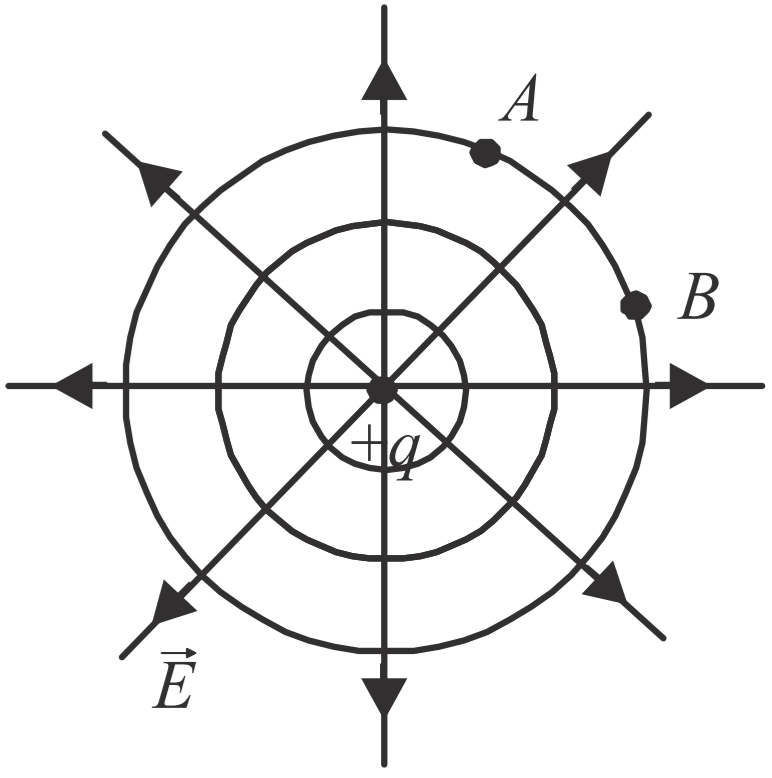
For the various charge systems, we represent equipotential surfaces by curves and line of force by full line curves. Between any two adjacent equipotential surfaces, we assume a constant potential difference the equipotential surfaces of a single point charge are concentric spherical shells with their centres at the point charge. As the tines of force point radially outwards, so they are perpendicular to the equipotential surfaces at all points.
  1. Identify the wrong statement.
  1. Equipotential surface due to a single point charge is spherical.
  2. Equipotential surface can be constructed for dipoles too.
  3. The electric field is normal to the equipotential surface through the point.
  4. The work done to move a test charge on the equipotential surface is positive.
  1. Nature of equipotential surface for a point charge is:
  1. Ellipsoid with charge at foci.
  2. Sphere with charge at the centre of the sphere.
  3. Sphere with charge on the surface of the sphere.
  4. Plane with charge on the surface.
  1. A spherical equipotential surface is not possible:
  1. Inside a uniformly charged sphere.
  2. For a dipole.
  3. Inside a spherical condenser.
  4. For a point charge.
  1. The work done in carrying a charge $q$ once round a circle of radius a with a charge $Q$ at its centre is:
  1. $\frac{\text{qQ}}{4\pi\epsilon_0\text{a}}$
  2. $\frac{\text{qQ}}{4\pi\epsilon_0\text{a}^2}$
  3. $\frac{\text{q}}{4\pi\epsilon_0\text{a}}$
  4. $\text{Zero}$
  1. The work done to move a unit charge along an equipotential surface from $P$ to $Q:$
  1. Must be defined as $-\int\limits_{\text{P}}^{\text{Q}}\vec{\text{E}}\cdot\text{d}\vec{\text{l}}.$
  2. Is zero.
  3. Can have a non$-$zero value.
  4. Both $(a)$ and $(b)$ are correct.