MCQ
A heavy solid sphere is thrown on a horizontal rough surface with initial velocity $u$ without rolling. What will be its speed, when it starts pure rolling motion?
  • A
    $\frac{3 u}{5}$
  • B
    $\frac{2 u}{5}$
  • $\frac{5 u}{7}$
  • D
    $\frac{2 u}{7}$

Answer

Correct option: C.
$\frac{5 u}{7}$
c
(c)

Using angular momentum conservation

$m u r=m v r+\frac{2}{5} m r^2\left(\frac{v}{r}\right)$

$u=7 \frac{v}{5}$

$v=\frac{5 u}{7}$

Need a full question paper?

Generate a complete, print-ready paper with questions like this in minutes — across 16+ boards, with answer keys.
Start Generating Free

Similar questions

A body is projected with a velocity $u$. It passes through a certain point above the ground after $t_1$ second. The time interval after which the body passes through the same point during the return journey is
In a simple harmonic motion, when the displacement is one-half the amplitude, what fraction of the total energy is kinetic?
When a mass $m$ is hung from the lower end of a spring of neglibgible mass, an extension $x$ is produced in the spring. The time period of oscillation is
What must be the lengths of steel and copper rods at $0^o C$ for the difference in their lengths to be $10\,cm$ at any common temperature? $(\alpha_{steel}=1.2 \times {10^{-5}} \;^o C^{-1})$ and $(\alpha_{copper} = 1.8 \times 10^{-5} \;^o C^{-1})$
An object is attached to the bottom of a light vertical spring and set vibrating. The maximum speed of the object is $15\, cm/sec$ and the period is $628$ milli-seconds. The amplitude of the motion in centimeters is
Two identical cylindrical vessels with their bases at same level, each contains a liquid of density $d$ . The height of the liquid in one vessel is $ h_1$ and that in the other vessel is $h_2$ . The area of either base is $A$ . The work done by gravity in equalizing the levels when the two vessels are connected is
A body is moving under the action of two forces ${\vec F_1} = 2\hat i - 5\hat j\,;\,{\vec F_2} = 3\hat i - 4\hat j$. Its velocity will become uniform under an additional third force ${\vec F_3}$ given by
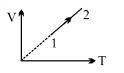
An ideal gas undergoes the process $1 \rightarrow 2$ as shown in the figure, the heat supplied and work done in the process is $\Delta \,\,Q$ and $\Delta \,\,W$ respectively. The ratio $\Delta \,\,Q :$ $\Delta \,\,W$ is
When $20\ \text{cal}$ of heat is supplied to a system, the increase in internal energy is $50J$. If the external work done is $35J$, the mechanical equivalent of heat is:
A mass is revolving in a circle, which is in the plane of the paper. The direction of angular acceleration if any, is: