MCQ
Two identical cylindrical vessels with their bases at same level, each contains a liquid of density $d$ . The height of the liquid in one vessel is $ h_1$ and that in the other vessel is $h_2$ . The area of either base is $A$ . The work done by gravity in equalizing the levels when the two vessels are connected is
  • A
    $(h_1 -h_2)gd$
  • B
    $(h_1 -h_2)gAd$
  • C
    $\frac {1}{2}(h_1 -h_2)^2gAd$
  • $\frac {1}{4}(h_1 -h_2)^2gAd$

Answer

Correct option: D.
$\frac {1}{4}(h_1 -h_2)^2gAd$
d
Work done = initial potential energy -final potential energy 

or $W{\text{ }} = {\text{ }}Adg\,\left[ {\frac{{h_1^2 + h_2^2}}{2} - {{\left( {\frac{{{h_1} + {h_2}}}{2}} \right)}^2}} \right]\, = \,\frac{{Adg}}{4}{({h_1} - {h_2})^2}$

Need a full question paper?

Generate a complete, print-ready paper with questions like this in minutes — across 16+ boards, with answer keys.

Start Generating Free

Similar questions

Two vectors $\overrightarrow A $ and $\overrightarrow B $ are at right angles to each other, when
$Assertion$ : The error in the measurement of radius of the sphere is $0.3\%$. The permissible error in its surface area is $0.6\%$

$Reason$ : The permissible error is calculated by the formula $\frac{{\Delta A}}{A} = \frac{{4\Delta r}}{r}$

Which of the following statement is incorrect regarding mass?
The following bodies,

$(1)$ a ring

$(2)$ a disc

$(3)$ a solid cylinder

$(4)$ a solid sphere,

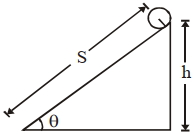
of same mass $m$ and radius $R$ are allowed to roll down without slipping simultaneously from the top of the inclined plane. The body which will reach first at the bottom of the inclined plane is ...........

[Mark the body as per their respective numbering given in the question]

The strain energy stored in a body of volume $V$ due to shear strain $\phi$ is (shear modulus is $\eta$ )
A thin uniform rod has moment of inertia l about an axis parallel to its length at a certain distance. If on heating its length increases by $20\%,$ then moment of inertia of rod will change by:
A ball is thrown with a velocity of $6\, m/s$ vertically downwards from a height $H = 3.2\, m$ above a horizontal floor. If it rebounds back to same height then coefficient of restitution $e$ is $[g = 10\, m/s^2]$
The mean free path of molecules ofa gas, (radius $r$) is inversely proportional to
The average acceleration vector for a particle having a uniform circular motion is
On a railway curve, the outside rail is laid higher than the inside one so that resultant force exerted on the wheels of the rail car by the tops of the rails will