Question
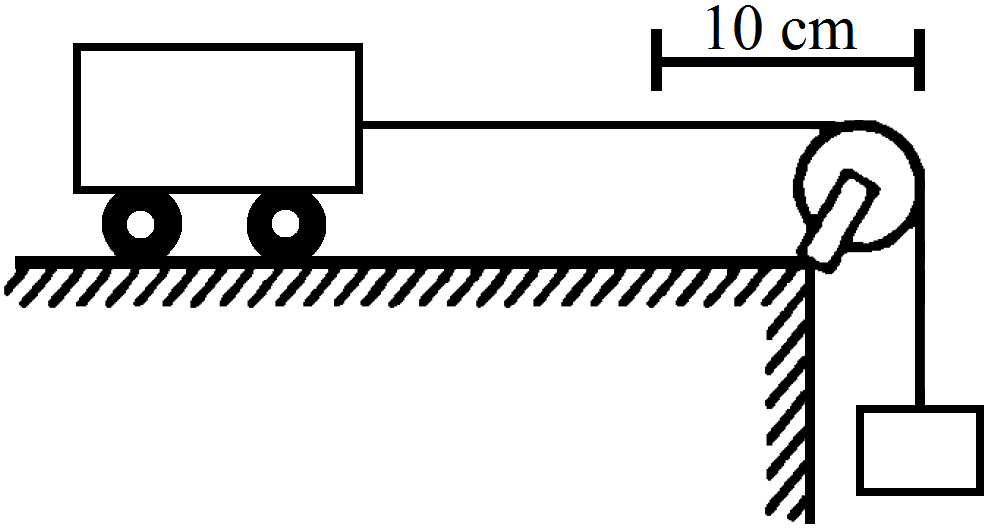
A heavy string is tied at one end to a movable support and to a light thread at the other end as shown in figure, The thread goes over a fixed pulley and supports a weight to produce a tension. The lowest frequency with which the heavy string resonates is 120Hz. If the movable support is pushed to the right by 10cm so that the joint is placed on the pulley, what will be the minimum frequency at which the heavy string can resonate?
Answer

Initially because the end A is free, an antinode will be formed.
So, $\text{l}=\frac{\text{Ql}_1}{4}$
Again, if the movable support is pushed to right by 10m, so that the joint is placed on the pulley, a node will be formed there.
So, $\text{l}=\frac{\lambda_2}{2}$
Since, the tension remains same in both the cases, velocity remains same.
As the wavelength is reduced by half, the frequency will become twice as that of 120Hz i.e. 240Hz.

Need a full question paper?

Generate a complete, print-ready paper with questions like this in minutes — across 16+ boards, with answer keys.

Start Generating Free

Similar questions

The voltage and current in a series AC circuit are given by, $\text{V}=\text{V}_0\cos\omega\text{t}$ and $\text{i}=\text{i}_0\sin\omega\text{t}.$ What is the power dissipated in the circuit?
Time period of a planet around the Sun is $11.6$ years. How far is the planet from the Sun? The distance between the Sun and the earth is $1.5 \times 10^8km$.
Precise measurements of physical quantities are a need of science. For example, to ascertain the speed of an aircraft, one must have an accurate method to find its positions at closely separated instants of time. This was the actual motivation behind the discovery of radar in World War II. Think of different examples in modern science where precise measurements of length, time, mass etc. are needed. Also, wherever you can, give a quantitative idea of the precision needed.
Explain the concepts of ideal gas.
A long, cylindrical tube of inner and outer radii $a$ and $b$ carries a current $i$ distributed uniformly over its cross section. Find the magnitude of the magnetic field at a point $(a)$ just inside the tube $(b)$ just outside the tube.
A person looks at different trees in an open space with the following details. Arrange the trees in decreasing order of their apparent sizes.
Tree Height(m) Distance form the eye(m)
A 2.8 50
B 2.5 80
C 1.8 70
D 2.8 100
The volume of air bubble increases $15$ times when it rises from bottom to the top of a lake. Calculate the depth of the lake if density of lake water is $1.02 \times 10^3 \mathrm{~kg} / \mathrm{m}^3$ and atmospheric pressure is $75$ cm of mercury.
Consider the situation of the previous problem. Suppose the production of the radioactive isotope starts at t = 0. Find the number of active nuclei at time t.
The length of a rod is exactly $1m$ when measured at rest. What will be its length when it moves at a speed of:
a. $3 \times 10^5 \mathrm{~m} / \mathrm{s}$.
b. $3 \times 10^6 \mathrm{~m} / \mathrm{s}$.
c. $3 \times 10^7 \mathrm{~m} / \mathrm{s}$.
Two particles are moving with common speed v such that they are always at a constant distance ‘d' apart and their velocities are always equal and opposite. After what time, they turn to their initial positions?