MCQ
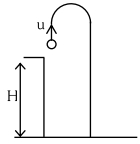
A horizontal bridge is built across a river. A student standing on the bridge throws a small ball vertically upwards with a velocity $4\,m s ^{-1}$. The ball strikes the water surface after $4\,s$. The height of bridge above water surface is $......\,m$ $\left(\right.$ Take $\left.g=10\,m s ^{-2}\right)$
  • A
    $68$
  • B
    $56$
  • C
    $60$
  • $64$

Answer

Correct option: D.
$64$
d
$S = ut +\frac{1}{2} a t^2$

$-H =4 \times 4-\frac{1}{2} \times 10 \times 4^2$

$-H =16-80$

$-H =-64$

$H =64\,m$

Need a full question paper?

Generate a complete, print-ready paper with questions like this in minutes — across 16+ boards, with answer keys.

Start Generating Free

Similar questions

A spherical body of radius $R$ consists of a fluid of constant density and is in equilibrium under its own gravity. If $P ( r )$ is the pressure at $r ( r < R )$, then the correct option$(s)$ is(are)

$(A)$ $P ( I =0)=0$ $(B)$ $\frac{ P ( r =3 R / 4)}{ P ( r =2 R / 3)}=\frac{63}{80}$

$(C)$ $\frac{ P ( r =3 R / 5)}{ P ( r =2 R / 5)}=\frac{16}{21}$ $(D)$ $\frac{ P ( r = R / 2)}{ P ( r = R / 3)}=\frac{20}{27}$

Range of a bullet fired at $45^o$ to horizontal is $980m$. If the bullet is fired at same  angle from a car travelling horizontally at $18\, km/hr$ towards target then range will be  increased by :-
The pressure and volume of an ideal gas are related as $\mathrm{PV}^{3 / 2}=\mathrm{K}$ (Constant). The work done when the gas is taken from state $A\left(P_1, V_1, T_1\right)$ to state $\mathrm{B}\left(\mathrm{P}_2, \mathrm{~V}_2, \mathrm{~T}_2\right)$ is :
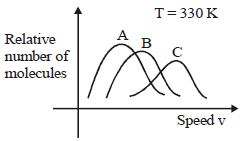
Maxwell distribution function is shown in figure for different gases, which of the following is correct matching?
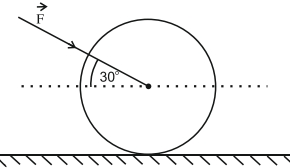
As shown in figure, a $70\,kg$ garden roller is pushed with a force of $\overrightarrow{ F }=200\,N$ at an angle of $30^{\circ}$ with horizontal. The normal reaction on the roller is $.......\,N$ $\left(\right.$ Given $\left.g =10\,m s ^{-2}\right)$
If the law of gravitation, instead of being inversesquare law, becomes an inversecube law.
  1. Planets will not have elliptic orbits.
  2. Circular orbits of planets is not possible.
  3. Projectile motion of a stone thrown by hand on the surface of the earth will be approximately parabolic.
  4. There will be no gravitational force inside a spherical shell of uniform density.
The dimension of $P = \frac{{{B^2}{l^2}}}{m}$ is 

where $B=$ magnetic field, $l=$ length, $m =$ mass

A uniform disc of radius $R$ lies in $x-y$ plane with its centre at origin. Its moment of inertia about $z$ -axis is equal to its moment of inertia about line $y = x + c$. The value of $c$ is :-
The maximum wavelength of radiations emitted at $900\,K$ is $4\mu m$. What will be the maximum wavelength of radiations emitted at $1200 \,K$ ......... $\mu m$
Two projectiles are projected at $30^{\circ}$ and $60^{\circ}$ with the horizontal with the same speed. The ratio of the maximum height attained by the two projectiles respectively is: