Question
A horizontal cesium plate ($\phi$ = l.9 eV) is moved vertically downward at a constant speed u in a room full of radiation of wavelength 250 run and above. What should be the minimum value of u so that the vertically upward component of velocity is nonpositive for each photoelectron?
Answer

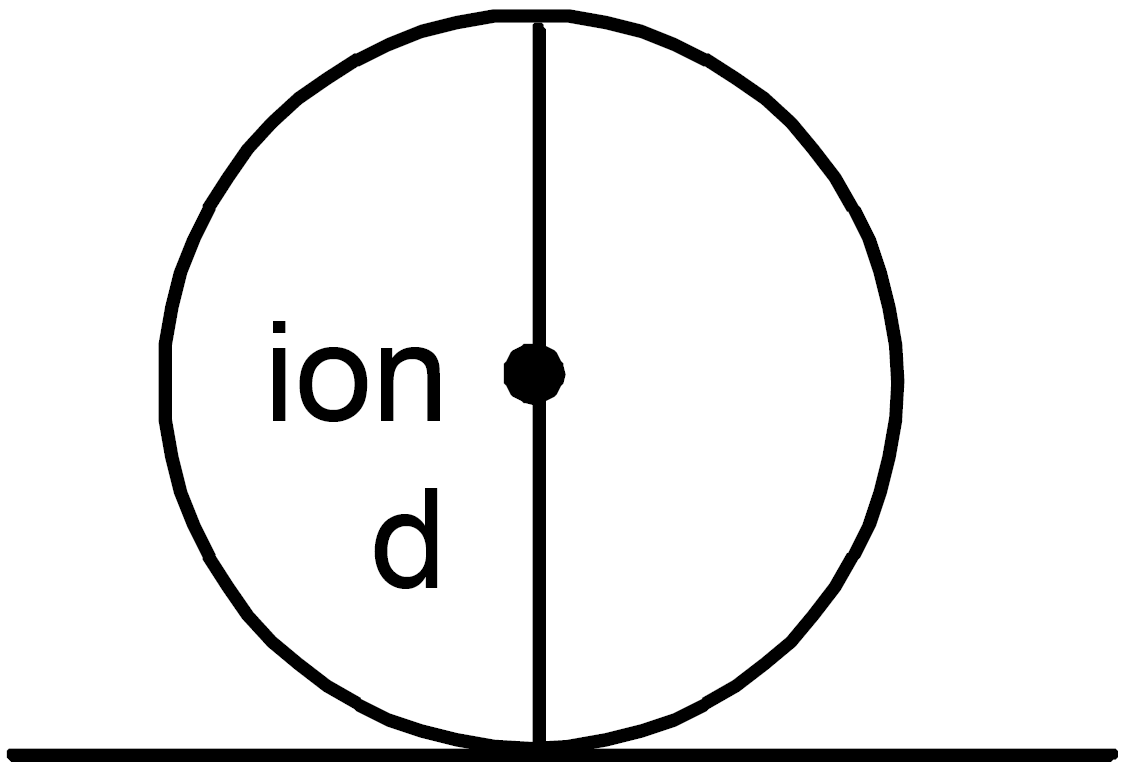
Work function $=\phi,$ distance = dThe particle will move in a circle
When the stopping potential is equal to the potential due to the singly charged ion at that point.
$\text{eV}_0=\frac{\text{hc}}{\lambda}-\phi$
$\Rightarrow\text{v}_0=\Big(\frac{\text{hv}}{\lambda}-\phi\Big)\frac{1}{\text{e}}$
$\Rightarrow\frac{\text{ke}}{2\text{d}}=\Big(\frac{\text{hc}}{\lambda}-\phi\Big)\frac{1}{\text{e}}$
$\Rightarrow\frac{\text{ke}}{\text{2d}}=\frac{\text{hc}}{\lambda}-\phi$
$\Rightarrow\frac{\text{hc}}{\lambda}=\frac{\text{ke}^2}{2\text{d}}+\phi=\frac{\text{ke}^2+2\text{d}\phi}{2\text{d}}$
$\Rightarrow\lambda=\frac{\text{hc 2d}}{\text{ke}^2+2\text{d}\phi}=\frac{2\text{hcd}}{\frac{1}{4\pi\omega_0\text{e}^2}2\text{d}\phi}=\frac{8\pi\omega_0\text{hcd}}{\text{e}^2+8\pi\omega_0\text{d}\phi}$

Need a full question paper?

Generate a complete, print-ready paper with questions like this in minutes — across 16+ boards, with answer keys.

Start Generating Free

Similar questions

An electron of kinetic energy 100eV circulates in a path of radius 10cm in a magnetic field. Find the magnetic field and the number of revolutions per second made by the electron.
  1. With the help of the circuit diagram explain the working principle of a transistor amplifier as an oscillator.
  2. Distinguish between a conductor, a semiconductor and an insulator on the basis of energy band diagrams.
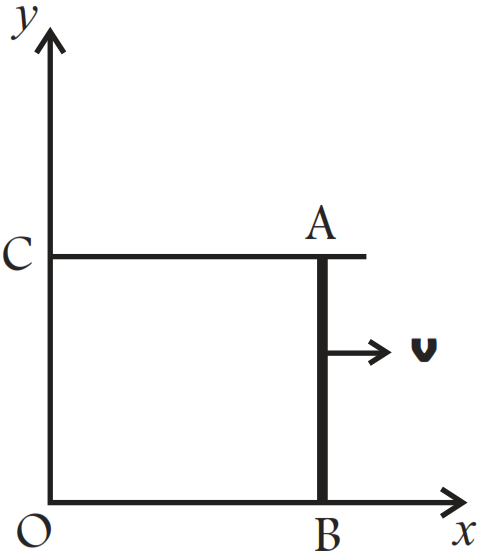
A magnetic field $\text{B}=\text{B}_0\sin(\omega\text{t})\hat{\text{k}}$ covers a large region where a wire AB slides smoothly over two parallel conductors separated by a distance d (Fig.). The wires are in the x-y plane. The wire AB (of length d) has resistance R and the parallel wires have negligible resistance. If AB is moving with velocity v, what is the current in the circuit. What is the force needed to keep the wire moving at constant velocity?
Consider a uniformly charged ring of radius R. Find the point on the axis where the electric field is maximum.
Two persons each of mass m are standing at the two extremes of a railroad car of mass M resting on a smooth track. The person on left jumps to the left with a horizontal speed u with respect to the state of the car before the jump. Thereafter, the other person jumps to the right, again with the same horizontal speed u with respect to the state of the car before his jump. Find the velocity of the car after both the persons have jumped off.
Consider the situation of the previous problem. A charges of $-2.0 \times 10^{-4}C$ is moved from the point $A$ to the point $B$. Find the change in electrical potential energy ${U_B - U_A}$ for the cases $(a), (b)$ and $(c).$
A parallel $-$ plate capacitor having plate area $20\ cm^2$ and separation between the plates $1.00\ mm$ is connected to a battery of $12.0V.$ The plates are pulled apart to increase the separation to $2.0\ mm.$
  1. Calculate the charge flown through the circuit during the process.
  2. How much energy is absorbed by the battery during the process?
  3. Calculate the stored energy in the electric field before and after the process.
  4. Using the expression for the force between the plates, find the work done by the person pulling the plates apart.
  5. Show and justify that no heat is produced during this transfer of charge as the separatio
  1. n is increased.
The separation between the objective and the eyepiece of a compound microscope can be adjusted between $9.8\ cm$ to $11.8\ cm$. If the focal lengths of the objective and the eyepiece are $1.0\ cm$ and $6\ cm$ respectively, find the range of the magnifying power if the image is always needed at $24\ cm$ from the eye.
If the outer coil of the previous problem is rotated through 90° about a diameter, what would be the magnitude of the magnetic field B at the centre?
In an experiment on photoelectric effect, the stopping potential is measured for monochromatic light beams corresponding to different wavelengths. The data collected are $11s$ follows:
wavelength (nm) $350$ $400$ $450$ $500$ $550$
stopping potential(V): $1.45$ $1.00$ $0.66$ $0.38$ $0.16$
Plot the stopping potential against inverse of wavelength $\big(\frac{1}{\lambda}\big) $ on a graph paper and find
  1. The Planck constant,
  2. The work function of the emitter and.
  3. The threshold wavelength.