Question
The separation between the objective and the eyepiece of a compound microscope can be adjusted between $9.8\ cm$ to $11.8\ cm$. If the focal lengths of the objective and the eyepiece are $1.0\ cm$ and $6\ cm$ respectively, find the range of the magnifying power if the image is always needed at $24\ cm$ from the eye.
Answer

For the given compound microscope $f_0 = 1\ cm, f_e = 6\ cm, D = 24\ cm$
For the eye piece$, v_e= -24\ cm, f_e = 6\ cm$
Now, $\frac{1}{\text{v}_\text{e}}-\frac{1}{\text{u}_\text{e}}=\frac{1}{\text{f}_\text{e}}$
$\Rightarrow\frac{1}{\text{u}_\text{e}}=\frac{1}{\text{v}_\text{e}}-\frac{1}{\text{f}_\text{e}}$
$\Rightarrow-\Big[\frac{1}{24}+\frac{1}{6}\Big]=-\frac{5}{24}$
$\Rightarrow \text{u}_\text{e}=-4.8\ \text{cm}$
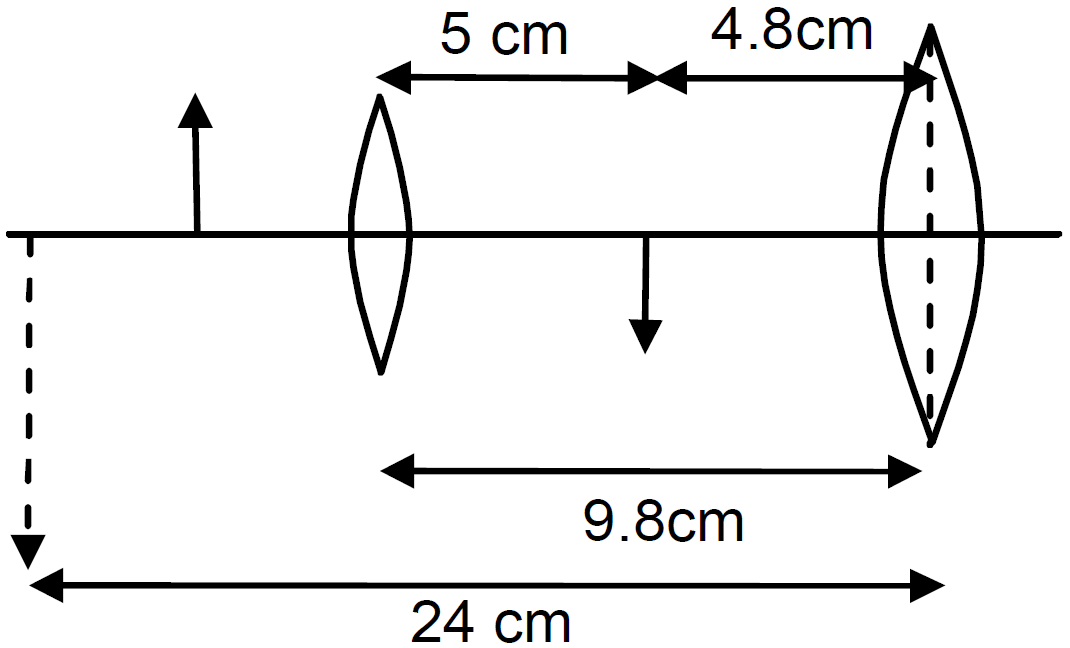
  1. When the separation between objective and eye piece is $9.8\ cm,$ the image distance for the objective lens must be $(9.8) - (4.8) = 5.0\ cm$
Now, $\frac{1}{\text{v}_0}-\frac{1}{\text{u}_0}=\frac{1}{\text{f}_0}$
$\Rightarrow\frac{1}{\text{u}_0}=\frac{1}{\text{v}_0}-\frac{1}{\text{f}_0}=\frac{1}{5}-\frac{1}{1}=-\frac{4}{5}$
$\Rightarrow\text{u}_0=-\frac{5}{4}=-1.25\text{cm}$
So, the magnifying power is given by,
$\text{m}=\frac{\text{v}_0}{\text{u}_\text{0}}\Big[1+\frac{\text{D}}{\text{f}}\Big]=\frac{-5}{-1.25}\Big[1+\frac{24}{6}\Big]=4\times5=20$
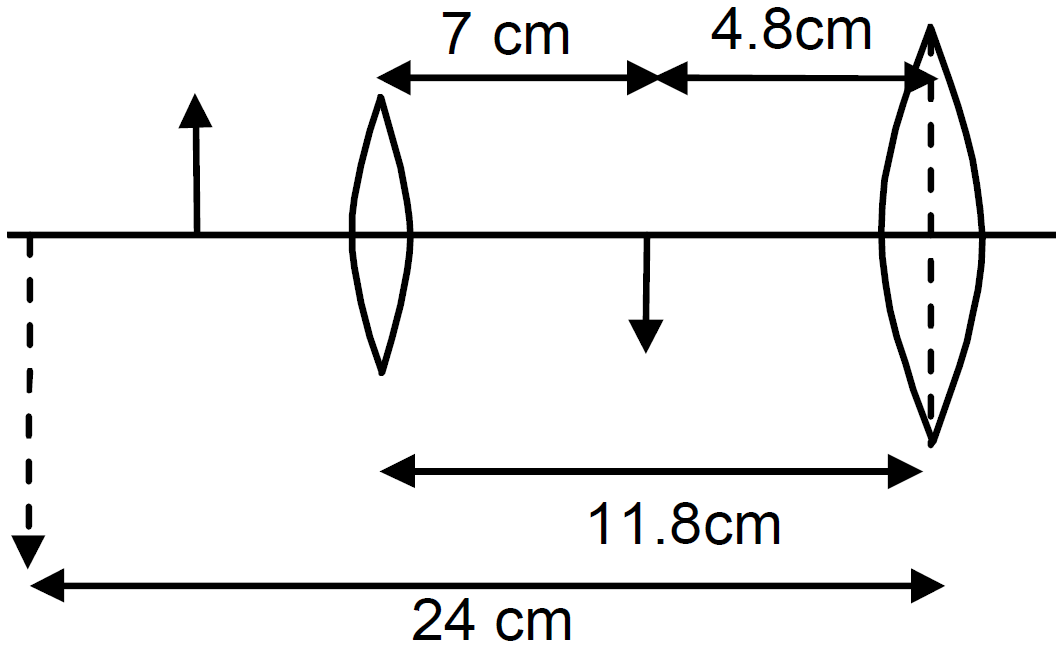
  1. When the separation is $11.8\ cm,$
$v_0 = 11.8 - 4.8 = 7.0\ cm, f_0 = 1\ cm$
$\Rightarrow\frac{1}{\text{u}_0}=\frac{1}{\text{v}_0}-\frac{1}{\text{f}_0}=\frac{1}{7}-\frac{1}{1}=-\frac{6}{7}$
So, $\text{m}=-\frac{\text{v}_0}{\text{u}_\text{o}}\Big[1+\frac{\text{D}}{\text{f}}\Big]$
$=\frac{-7}{-\Big(\frac{7}{6}\Big)}\Big[1+\frac{24}{6}\Big]=6\times5=30$
So, the range of magnifying power will be $20$ to $30.​​​​​​​$​​​​​​​

Need a full question paper?

Generate a complete, print-ready paper with questions like this in minutes — across 16+ boards, with answer keys.

Start Generating Free

Similar questions

A room has a window fitted with a single $1.0m \times 2.0m$ glass of thickness $2 \ mm.$
  1. Calculate the rate of heat flow through the closed window when the temperature inside the room is $32^\circ C$ and that outside is $40^\circ C.$
  2. The glass is now replaced by two glasspanes, each having a thickness of $1 \ mm$ and separated by a distance of $1 \ mm.$ Calculate the rate of heat flow under the same conditions of temperature. Thermal conductivity of window glass $= 1.0Js^{-1}m^{-1^\circ }C^{-1}$ and that of air $= 0.025Js^{-1}m^{-1^\circ }C^{-1}.$
Two large conducting plates are placed parallel to each other with a separation of $2.00\ cm$ between them. An electron starting from rest near one of the plates reaches the other plate in $2.00$ microseconds. Find the surface charge density on the inner surfaces.
In the previous problem, suppose $m_2 = 2.0\ kg$ and $m_3 = 3.0\ kg$. What should be the mass $m$ so that it remains at rest?
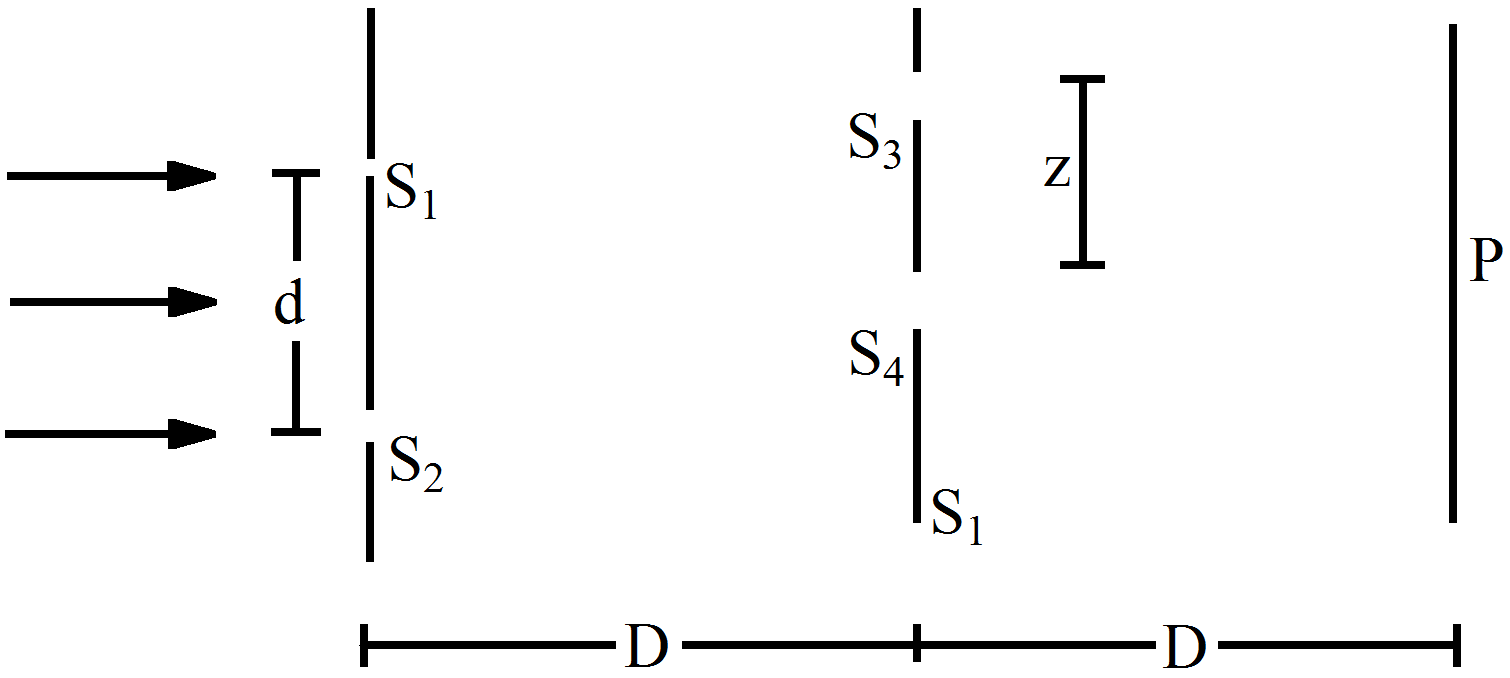
Consider the arrangement shown in figure. By some mechanism, the separation between the slits $S_3$ and $S_4$ can be changed. The intensity is measured at the point $P$ which is at the common perpendicular bisector

of $S_1,S_2$ and $S_3,S_4$.
When $\text{z}=\frac{\text{D}\lambda}{2\text{d}},$ intensity measured at $P$ is $I$.
​​​​​​​Find this intensity when $z$ is equal to:
  1. $\frac{\text{D}\lambda}{\text{d}}$
  2. $\frac{3\text{D}\lambda}{2\text{d}}$
  3. $\frac{2\text{D}\lambda}{\text{d}}$
An inductor of inductance 2.00H is joined in series with a resistor of resistance $200\Omega$ and a battery of emf 2.00V. At t = 10ms, find
  1. The current in the circuit.
  2. The power delivered by the battery.
  3. The power dissipated in heating the resistor.
  4. The rate at which energy is being stored in magnetic field.
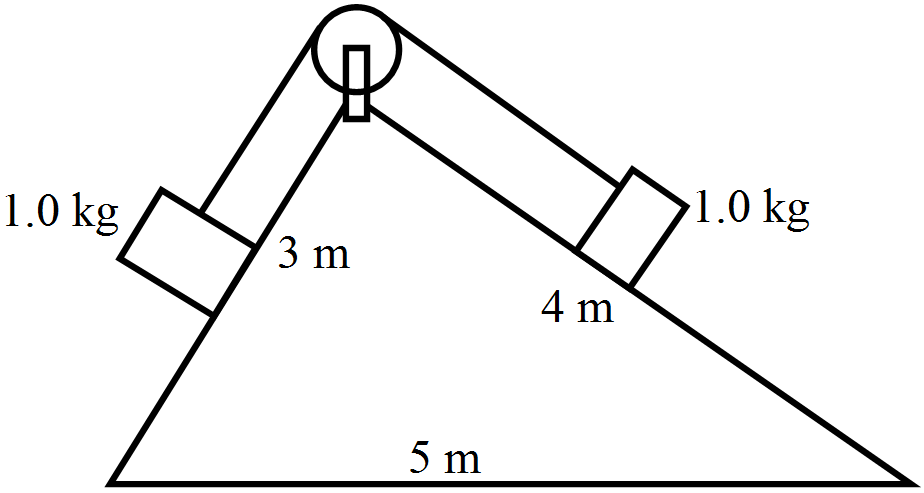
Consider the situation shown in figure. All the surfaces are frictionless and the string and the pulley are light. Find the magnitude of the acceleration of the two blocks.
Suppose we want to verify the analogy between electrostatic and magnetostatic by an explicit experiment. Consider the motion of (i) electric dipole p in an electrostatic field E and (ii) magnetic dipole m in a magnetic field B. Write down a set of conditions on E, B, p, m so that the two motions are verified to be identical. (Assume identical initial conditions.)
A wire of resistance $15.0\Omega$ is bent to form a regular hexagon ABCDEFA. Find the equivalent resistance of the loop between the points (a) A and B (b) A and C and (c) A and D.
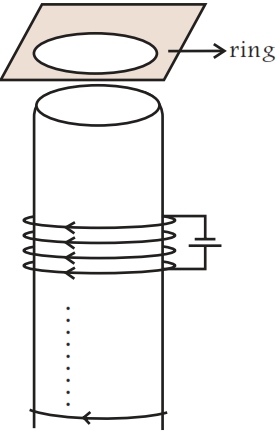
Consider a metal ring kept on top of a fixed solenoid (say on a carboard) (Fig). The centre of the ring coincides with the axis of the solenoid. If the current is suddenly switched on, the metal ring jumps up. Explain.
  1.  
  1. State the principle on which a potentiometer works. How can a given potentiometer be made more sensitive?
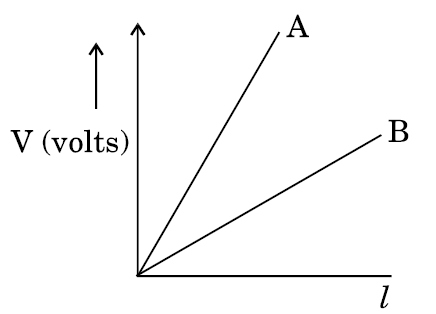
  2. In the graph shown below for two potentiometers, state with reason which of the two potentiometers$, A$ or $B,$ is more sensitive.
  1. Two metallic wires$, P_1$ and $P_2$ of the same material and same length but different cross$-$sectional areas$, A_1$ and $A_2$ are joined together and connected to a source of emf. Find the ratio of the drift velocities of free electrons in the two wires when they are connected $(i)$ in series, and $(ii)$ in parallel.