MCQ
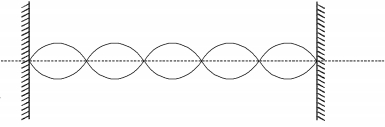
A horizontal stretched string, fixed at two ends, is vibrating in its fifth harmonic according to the equation, $y(x$, $t )=(0.01 \ m ) \sin \left[\left(62.8 \ m ^{-1}\right) x \right] \cos \left[\left(628 s ^{-1}\right) t \right]$. Assuming $\pi=3.14$, the correct statement$(s)$ is (are) :

$(A)$ The number of nodes is $5$ .

$(B)$ The length of the string is $0.25 \ m$.

$(C)$ The maximum displacement of the midpoint of the string its equilibrium position is $0.01 \ m$.

$(D)$ The fundamental frequency is $100 \ Hz$.

  • A
    $(B,D)$
  • $(B,C)$
  • C
    $(A,D)$
  • D
    $(C,D)$

Answer

Correct option: B.
$(B,C)$
b
$(A)$ There are $5$ complete loops.

Total number of nodes $=6$

$(B)$ $\omega=628 sec ^{-1}$

$k =62.8 m ^{-1}=\frac{2 \pi}{\lambda} \Rightarrow \lambda=\frac{1}{10} $

$v _{ w }=\frac{\omega}{ k }=\frac{628}{62.8}=10 ms ^{-1} $

$L=\frac{5 \lambda}{2}=0.25 $

$(C)$ $2 A =0.01=$ maximum amplitude of antinode

$(D)$ $f=\frac{v}{2 \ell}=\frac{10}{2 \times 0.25}=20 Hz$.

Need a full question paper?

Generate a complete, print-ready paper with questions like this in minutes — across 16+ boards, with answer keys.

Start Generating Free

Similar questions

Five persons $A, B, C, D$ and $E$ are pulling a cart of mass $100\, kg$ on a smooth surface and cart is moving with acceleration $3\, m/s^2$ in east direction. When person $'A'$ stops pulling, it moves with acceleration $1\,m/s^2$ in the west direction. When person $'B'$ stops pulling, it moves with acceleration $24\, m/s^2$ in the north direction. The magnitude of acceleration of the cart when only $A$ and $B$ pull the cart keeping their directions same as the old directions, is ............ $m/s^2$
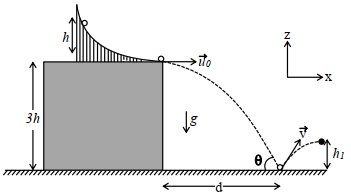
A slide with a frictionless curved surface, which becomes horizontal at its lower end,, is fixed on the terrace of a building of height $3 h$ from the ground, as shown in the figure. A spherical ball of mass $\mathrm{m}$ is released on the slide from rest at a height $h$ from the top of the terrace. The ball leaves the slide with a velocity $\vec{u}_0=u_0 \hat{x}$ and falls on the ground at a distance $d$ from the building making an angle $\theta$ with the horizontal. It bounces off with a velocity $\overrightarrow{\mathrm{v}}$ and reaches a maximum height $h_l$. The acceleration due to gravity is $g$ and the coefficient of restitution of the ground is $1 / \sqrt{3}$. Which of the following statement($s$) is(are) correct?

($AV$) $\vec{u}_0=\sqrt{2 g h} \hat{x}$ ($B$) $\vec{v}=\sqrt{2 g h}(\hat{x}-\hat{z})$  ($C$) $\theta=60^{\circ}$  ($D$) $d / h_1=2 \sqrt{3}$

The volume of a gas will be double of what it is at $0°C$ (pressure remaining constant) at
A rocket is fired upward from the earth's surface such that it creates an acceleration of $19.6 \,m/sec^2$. If after $5 \,sec$ its engine is switched off, the maximum height of the rocket from earth's surface would be.........$m$
From a 200m high tower, one ball is thrown upwards with speed of 10m/ s and another is thrown vertically downwards at the same speed simultaneously. The time difference of their reaching the ground will be nearest to:
A piece of marble is projected from earth's surface with velocity of $19.6 \sqrt{2}\,m / s$ at $45^{\circ}.$ $2\,s$ later its velocity makes an angle $\alpha$ with horizontal, where $\alpha$ is $..........$
In Newton's experiment of cooling, the water equivalent of two similar calorimeters is $10 $ gm each. They are filled with $350 gm$ of water and $300 gm$ of a liquid (equal volumes) separately. The time taken by water and liquid to cool from ${70^o}C$ to ${60^o}C$ is $3$ min and $95$ sec respectively. The specific heat of the liquid will be ...... $Cal/gm\,^oC$
An object is moving with variable speed, then
The distance between centre of the earth and moon is $384000\, km$. If the mass of the earth is $6 \times {10^{24}}kg$ and $G = 6.66 \times {10^{ - 11}}\,N{m^2}/k{g^2}$. The speed of the moon is nearly......... $km/sec$
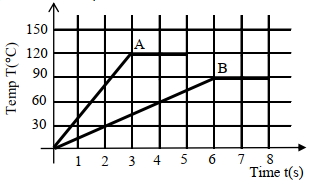
Two different metal bodies $A$ and $B$ of equal mass are heated at a uniform rate under similar conditions. The variation of temperature of the bodies is graphically represented as shown in the figure. The ratio of specific heat capacities is :