MCQ
A hydrogen atom (ionisation potential $ 13.6\, eV$) makes a transition from third excited state to first excited state. The energy of the photon emitted in the process is.......$eV$
  • A
    $1.89$
  • $2.55$
  • C
    $12.09 $
  • D
    $12.75$

Answer

Correct option: B.
$2.55$
b
(b) Energy released$ = 13.6\left[ {\frac{1}{{{{(2)}^2}}} - \frac{1}{{{{(4)}^2}}}} \right] = 2.55\,eV$

Need a full question paper?

Generate a complete, print-ready paper with questions like this in minutes — across 16+ boards, with answer keys.
Start Generating Free

Similar questions

Voltmeter reads potential difference across the terminals of an old battery as $1.2\,volt$ , while a potentiometer reads $1.4\,volt$ . The internal resistance of battery is $40\,\Omega $ , then voltmeter resistance is .............. $\Omega$
At temperature $0K,$ the germanium behaves as a/ an:
In $P-$type semiconductor, there is
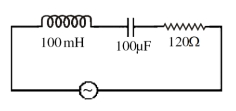
An $AC$ source is connected to an inductance of $100\,mH$ a capacitance of $100\,\mu F$ and a resistance of $120\,\Omega$ as shown in figure. The time in which the resistance having a thermal capacity $2\,J^{\circ } C$ will get heated by $16^{\circ} C$ is ..........$S$
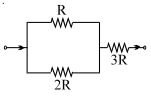
The ratio of powers dissipatted respectively in $R$ and $3R$, as shown is:
Liquid oxygen remains suspended between two pole faces of a magnet because it is
At two places $A$ and $B$ using vibration magnetometer, a magnet vibrates in a horizontal plane and its respective periodic time are $2$ sec and $3 \sec$ and at these places the earth's horizontal components are $H_A$ and $H_B$ respectively. Then the ratio between $H_A$ and $H_B$ will be
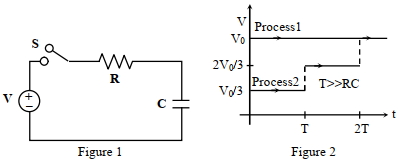
Consider a simple $RC$ circuit as shown in Figure $1$.

Process $1$: In the circuit the switch $S$ is closed at $t=0$ and the capacitor is fully charged to voltage $V_0$ (i.e. charging continues for time $T \gg R C$ ). In the process some dissipation ( $E_D$ ) occurs across the resistance $R$. The amount of energy finally stored in the fully charged capacitor is $EC$.

Process $2$: In a different process the voltage is first set to $\frac{V_0}{3}$ and maintained for a charging time $T \gg R C$. Then the voltage is raised to $\frac{2 \mathrm{~V}_0}{3}$ without discharging the capacitor and again maintained for time $\mathrm{T} \gg \mathrm{RC}$. The process is repeated one more time by raising the voltage to $V_0$ and the capacitor is charged to the same final

take $\mathrm{V}_0$ as voltage

These two processes are depicted in Figure $2$.

 ($1$) In Process $1$, the energy stored in the capacitor $E_C$ and heat dissipated across resistance $E_D$ are released by:

$[A]$ $E_C=E_D$ $[B]$ $E_C=E_D \ln 2$ $[C]$ $\mathrm{E}_{\mathrm{C}}=\frac{1}{2} \mathrm{E}_{\mathrm{D}}$ $[D]$ $E_C=2 E_D$

 ($2$) In Process $2$, total energy dissipated across the resistance $E_D$ is:

$[A]$ $\mathrm{E}_{\mathrm{D}}=\frac{1}{2} \mathrm{CV}_0^2$     $[B]$ $\mathrm{E}_{\mathrm{D}}=3\left(\frac{1}{2} \mathrm{CV}_0^2\right)$    $[C]$ $\mathrm{E}_{\mathrm{D}}=\frac{1}{3}\left(\frac{1}{2} \mathrm{CV}_0^2\right)$   $[D]$ $\mathrm{E}_{\mathrm{D}}=3 \mathrm{CV}_0^2$

Given the answer quetion  ($1$) and  ($2$)
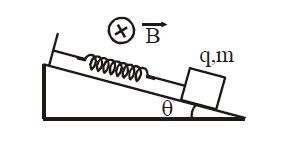
A small block of mass $m$, having charge $q$ is placed on frictionless inclined plane making an angle  $\theta$ with the horizontal. There exists a uniform magnetic field $B$ parallel to the inclined plane but  perpendicular to the length of spring. If $m$ is slightly pulled on the inclined in downward direction and released, the time period of oscillation will be (assume that the block does not leave contact with the plane)
Curie-Weiss law is obeyed by iron at a temperature ......