Question
A ladder rests against a wall at an angle $\alpha$ to the horizontal. Its foot is pulled away from the wall through a distance a, so that it slides a distance b down the wall making an angle $\beta$ with the horizontal. Show that, $\frac{\text{a}}{\text{b}}=\frac{\cos\alpha-\cos\beta}{\sin\beta-\sin\alpha}.$
Answer

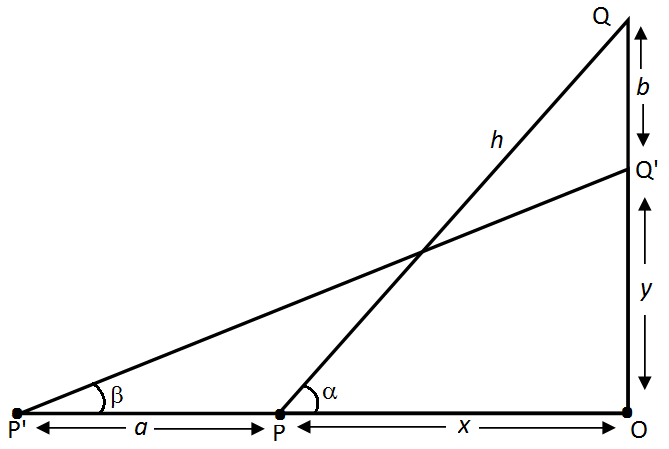
Let $PQ$ be the ladder such that its top $Q$ is on the wall $OQ$ and bottom $P$ is on the ground. The ladder is pulled away from the wall through a distance a, so that its top $Q$ slides and takes position $Q'$. So $PQ = P'Q'$
$\angle\text{OPQ}=\alpha$ and $\angle\text{OP}'\text{Q}'=\beta.$ Let $PQ = h$
We have to prove that,
$\frac{\text{a}}{\text{b}}=\frac{\cos\alpha-\cos\beta}{\sin\beta-\sin\alpha}$
We have the corresponding figure as follows,

We use trigonometric ratios.
In $\triangle\text{POQ}$
$\Rightarrow\ \sin\alpha=\frac{\text{OQ}}{\text{PQ}}$
$\Rightarrow\ \sin\alpha=\frac{\text{b}+\text{y}}{\text{h}}$
And,
$\Rightarrow\ \cos\alpha=\frac{\text{OP}}{\text{PQ}}$
$\Rightarrow\ \cos\alpha=\frac{\text{x}}{\text{h}}$
Again in $\triangle\text{P}'\text{OQ}'$
$\Rightarrow\ \sin\beta=\frac{\text{OQ}'}{\text{P}'\text{Q}'}$
$\Rightarrow\ \sin\beta=\frac{\text{y}}{\text{h}}$
And,
$\Rightarrow\ \cos\beta=\frac{\text{OP}'}{\text{P}'\text{Q}'}$
$\Rightarrow\ \cos\beta=\frac{\text{a}+\text{x}}{\text{h}}$
Now,
$\Rightarrow\ \sin\alpha-\sin\beta=\frac{\text{b}+\text{y}}{\text{h}}-\frac{\text{y}}{\text{h}}$
$\Rightarrow\ \sin\alpha-\sin\beta=\frac{\text{b}}{\text{h}}$
And,
$\Rightarrow\ \cos\beta-\cos\alpha=\frac{\text{a}+\text{x}}{\text{h}}-\frac{\text{x}}{\text{h}}$
$\Rightarrow\ \cos\beta-\cos\alpha=\frac{\text{a}}{\text{h}}$
So,
$\Rightarrow\ \frac{\sin\alpha-\sin\beta}{\cos\beta-\cos\alpha}=\frac{\text{b}}{\text{a}}$
$\Rightarrow\ \frac{\text{a}}{\text{b}}=\frac{\cos\beta-\cos\alpha}{\sin\alpha-\sin\beta}$
$\Rightarrow\ \frac{\text{a}}{\text{b}}=\frac{\cos\alpha-\cos\beta}{\sin\beta-\sin\alpha}$
Hence $\frac{\text{a}}{\text{b}}=\frac{\cos\alpha-\cos\beta}{\sin\beta-\sin\alpha}.$
Need a full question paper?

Generate a complete, print-ready paper with questions like this in minutes — across 16+ boards, with answer keys.

Start Generating Free

Similar questions

Solve graphically each of the following systems of linear equations. Also, find the coordinates of the points where the lines meet the axis of x in each system.
$x + 2y = 5,$
$2x - 3y = -4.$
An incomplete distribution is given as follows:
Variable $0-10$ $10-20$ $20-30$ $30-40$ $40-50$ $50-60$ $60-70$
Frequency $10$ $20$ $?$ $40$ $?$ $25$ $15$
You are given that the median value is $35$ and the sum of all the frequencies is $170.$ Using the median formula, fill up the missing frequencies.
Evaluate the following:
In the adjoining figure, $\triangle\text{ABC}$ is a right-angled at $B$ and $\angle\text{A}=45^\circ,$ If $\text{AC}=3\sqrt{2}\text{cm},$
Find:
  1. $BC.$
  2. $AB.$
The $10^{\text {th }}$ and $18^{\text {th }}$ terms of an $A.P.$ are $41$ and $73$ respectively. Find $26^{\text {th }}$ term.
Prove that $\sqrt{5}+\sqrt{3}$ is an irrational number.
In the given figure, $\triangle\text{ABC}$ is an obtuse triangle, obtuse-angled at B. If $\text{AD}\perp\text{CB}$ (produced) prove that $AC^2= AB^2+ BC^2+2BC.BD.$
The areas of two similar triangles are $81cm^2$ and $49cm^2$ respectively. If the altitudes of the first triangle is $6.3\ cm$, find the corresponding altitude of the other.
If $(\text{cosec}\theta+\cot\theta)=\text{m}$ and $(\text{cosec }\theta-\cot\theta)=\text{n},$ show that mn $= 1.$
Find the value of k for which the following equations have real and equal roots:
$\mathrm{k}^2 \mathrm{x}^2-2(2 \mathrm{k}-1) \mathrm{x}+4=0$
If three circles of radius a each, drawn such that each touches the other two, prove that the area included between included between them is equal to $\frac{4}{25}\text{a}^2.$ $\big[\text{Take } \sqrt{3}=1.73\text{ and}\ \pi=3.14\big]$