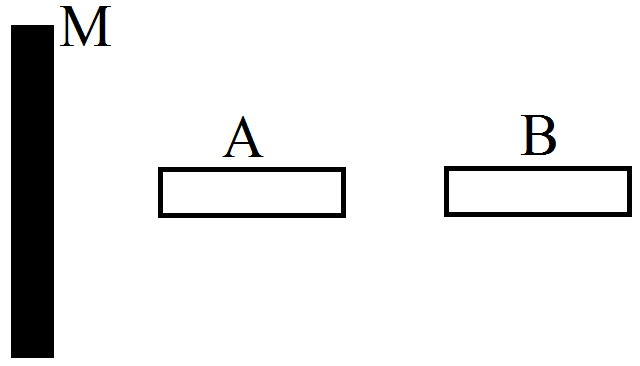
- M attracts A.
- M attracts B.
- A attracts B.
- B attracts A.
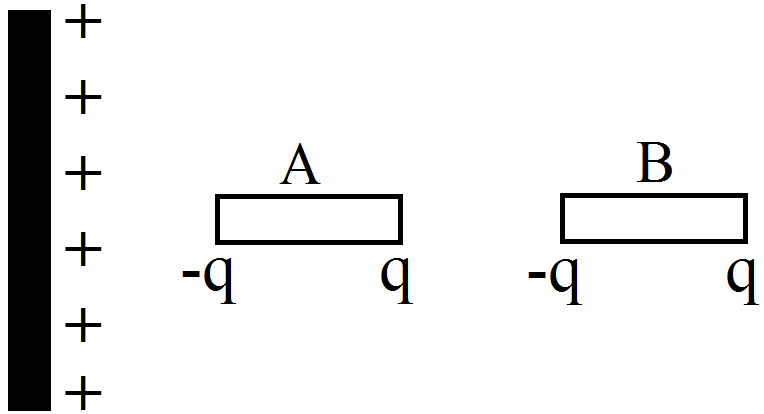

Explanation:

Charge distribution or M, A & B
So, we can say that M attracts A, M attracts B, A attracts B and 'B' attracts A.
Generate a complete, print-ready paper with questions like this in minutes — across 16+ boards, with answer keys.
It is not convenient to use a spherical Gaussian surface to find the electric field due to an electric dipole using Gauss’s theorem because
|
(a) Gauss’s law fails in this case |
|
(b) This problem does not have spherical symmetry |
|
(c) Coulomb’s law is more fundamental than Gauss’s law |
|
(d) Spherical Gaussian surface will alter the dipole moment |
The power rating of an electric motor which draws a current of 3.75 amperes when operated at 200 V is about
|
(a) 1 H.P. |
(b) 500 W |
(c) 54 W |
(d) 750 H.P. |
Young's experiment establishes that
|
(a) Light consists of waves |
|
(b) Light consists of particles |
|
(c) Light consists of neither particles nor waves |
|
(d) Light consists of both particles and waves |
When the number of turns in a coil is doubled without any change in the length of the coil, its self inductance becomes
|
(a) Four times |
(b) Doubled |
(c) Halved |
(d) Unchanged |
Outside a nucleus
|
(a) Neutron is stable |
|
(b) Proton and neutron both are stable |
|
(c) Neutron is unstable |
|
(d) Neither neutron nor proton is stable |