A linear harmonic oscillator of force constant $2 \times {10^6}N/m$ and amplitude $0.01\, m$ has a total mechanical energy of $160$ joules. Its
IIT 1989,AIPMT 1996, Medium


Download our appand get started for free
Experience the future of education. Simply download our apps or reach out to us for more information. Let's shape the future of learning together!No signup needed.*
Similar Questions
- 1The time period of a particle executing $S.H.M.$ is $8 \,s$. At $t=0$ it is at the mean position. The ratio of distance covered by the particle in $1^{\text {st }}$ second to the $2^{\text {nd }}$ second is .............. $s$View Solution
- 2A particle executes $S.H.M.$ of amplitude A along $x$-axis. At $t =0$, the position of the particle is $x=\frac{A}{2}$ and it moves along positive $x$-axis the displacement of particle in time $t$ is $x=A \sin (\omega t+\delta)$, then the value $\delta$ will beView Solution
- 3The amplitude of the vibrating particle due to superposition of two $SHMs,$View Solution
$y_1 = \sin \left( {\omega t + \frac{\pi }{3}} \right)$ and $y_2 = \sin \omega t$ is :
- 4The particle executing simple harmonic motion has a kinetic energy $K_0cos^2 \omega t$. The maximum values of the potential energy and the total energy are respectivelyView Solution
- 5Two springs of constant ${k_1}$and ${k_2}$are joined in series. The effective spring constant of the combination is given byView Solution
- 6View SolutionA simple pendulum hangs from the ceiling of a car. If the car accelerates with a uniform acceleration, the frequency of the simple pendulum will
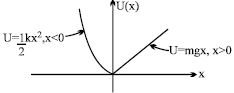
- 7A particle of mass $m$ moves in the potential energy $U$ shown above. The period of the motion when the particle has total energy $E$ isView Solution
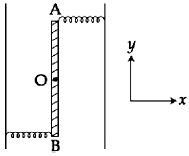
- 8Two light identical springs of spring constant $k$ are attached horizontally at the two ends of a uniform horizontal rod $AB$ of length $l$ and mass $m$. the rod is pivoted at its centre $‘O’$ and can rotate freely in horizontal plane. The other ends of the two springs are fixed to rigid supports as shown in figure. The rod is gently pushed through a small angle and released. The frequency of resulting oscillation isView Solution
- 9View SolutionResonance is an example of
- 10Four harmonic waves of equal frequencies and equal intensities $I_0$ have phase angles $0, \pi / 3,2 \pi / 3$ and $\pi$. When they are superposed, the intensity of the resulting wave is $nI _0$. The value of $n$ isView Solution