MCQ
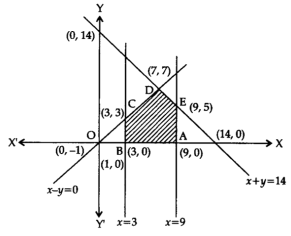
A Linear Programming Problem is as follows:
Minimize Z = 2x + y
Subject to the constraints $x \geq 3, x \leq 9, y \geq 0$
$x-y \geq 0, x+y \leq 14$
The feasible region has
  • A
    5 corner points including (0, 0) and (9, 5)
  • B
    5 corner points including (7, 7) and (3, 3)
  • C
    5 corner points including (3, 6) and (9, 5)
  • D
    5 corner points including (14, 0) and (9, 0)
Need a full question paper?

Generate a complete, print-ready paper with questions like this in minutes — across 16+ boards, with answer keys.

Start Generating Free

Similar questions

If $\cos^{-1}\frac{\text{x}}{3}+\cos^{-1}\frac{\text{y}}{2}=\frac{\theta}{2},$ then, $4\text{x}^2-12\text{xy}\cos^2\frac{\theta}{2}+9\text{y}^2=$
If $\left| {\begin{array}{*{20}{c}}
  {{a^2}}&{{b^2}}&{{c^2}} \\ 
  {{{(a + \lambda )}^2}}&{{{(b + \lambda )}^2}}&{{{(c + \lambda )}^2}} \\ 
  {{{(a - \lambda )}^2}}&{{{(b - \lambda )}^2}}&{{{(c - \lambda )}^2}} 
\end{array}} \right|$ $ = \,k\lambda \,\,\left| {{\mkern 1mu} {\mkern 1mu} \begin{array}{*{20}{c}}
  {{a^2}}&{{b^2}}&{{c^2}} \\
  a&b&c \\
  1&1&1
\end{array}} \right|,\lambda \, \ne \,0$ then $k$ is equal to
Let the set of all positive values of $\lambda$, for which the point of local minimum of the function $\left(1+x\left(\lambda^2-x^2\right)\right)$ satisfies $\frac{x^2+x+2}{x^2+5 x+6}<0$, be $(\alpha, \beta)$. Then $\alpha^2+\beta^2$ is equal to........
If $[.]$ represents the greatest integer function, then the value of $\int_{0}^{\sqrt{\pi / 2}}\left(\left[ x ^{2}\right]+[-\cos x ]\right) d x$ is.............
Let $\vec{a}=6 \hat{i}+9 \hat{j}+12 \hat{k}, \vec{b}=\alpha \hat{i}+11 \hat{j}-2 \hat{k}$ and $\vec{c}$ be vectors such that $\vec{a} \times \vec{c}=\vec{a} \times \vec{b}$. If $\vec{a} \cdot \vec{c}=-12$, $\vec{c} .(\hat{i}-2 \hat{j}+\hat{k})=5$, then $\vec{c} \cdot(\hat{i}+\hat{j}+\hat{k})$ is equal to $.............$.
If $\frac{{{d^2}y}}{{d{x^2}}} = 0,$ then
Let $A=\{a, b, c\}$ and $B=\{1,2,3,4\}$ Then the number of elements in the set $C =\{ f : A \rightarrow B \mid 2 \in f ( A )$ and $f$ is not one-one $\}$ is
$\int {\frac{{dx}}{{{{\sin }^6}x + {{\cos }^6}x}} = } $
$\left| {\begin{array}{*{20}{c}}0&a&{ - b}\\{ - a}&0&c\\b&{ - c}&0\end{array}} \right| = $
The solution of $\log \,\left( {\frac{{dy}}{{dx}}} \right) = ax + by$ is