MCQ
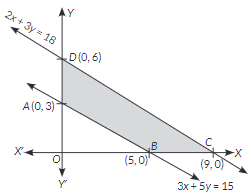
A linear programming problem is as follows:
Minimize $Z=30 x+50 y$
Subject to the constraints,
$\begin{array}{l}3 x+5 y \geq 15 \\ 2 x+3 y \leq 18 \\ x \geq 0, y \geq 0\end{array}$
In the feasible region, the minimum value of $Z$ occurs at
  • A
    a unique point
  • B
    no point
  • C
    infinitely many points
  • D
    two points only

Need a full question paper?

Generate a complete, print-ready paper with questions like this in minutes — across 16+ boards, with answer keys.

Start Generating Free

Similar questions

Evaluate: $\int_0^{\pi / 4} \tan ^3 x d x$
A line OP where O = (0, 0, 0) makes equal angles with ox, oy, oz. The point on OP, which is at a distance of 6 units from O is:

  1. $\Big(\frac{6}{\sqrt{3}},\frac{6}{\sqrt{3}},\frac{6}{\sqrt{3}}\Big)$

  2. $\big(2\sqrt{3},-2\sqrt{3},2\sqrt{3}\big)$

  3. $-\big(2\sqrt{3},-2\sqrt{3},2\sqrt{3}\big)$

  4. $-\big(6\sqrt{3},-6\sqrt{3},6\sqrt{3}\big)$

The element in the first row and third column of the inverse of the matrix $\left[ {\begin{array}{*{20}{c}}1&2&{ - 3}\\0&1&2\\0&0&1\end{array}} \right]$ is
Corner points of the feasible region for an LPP are $(0,2),(3,0)$, $(6,0),(6,8)$ and $(0,5)$.
Let $F=4 x+6 y$ be the objective function.
Maximum of $F$ - Minimum of $F=$
Let R be the relation in the set N given by $R =\{(a, b): a=b-2, b>6\}$. Then choose the correct option from the following.
If $\left| {\begin{array}{*{20}{c}}
{a - b - c}&{2a}&{2a}\\
{2b}&{b - c - a}&{2b}\\
{2c}&{2c}&{c - a - b}
\end{array}} \right|$ $ = \left( {a + b + c} \right)\,{\left( {x + a + b + c} \right)^2}$ , $x   \ne 0$ and $a + b + c \ne 0$, then $x$ is equal to
Choose the correct answer from the given four options.
Suppose a random variable X follows the binomial distribution with parameters n and p, where 0 < p < 1. If $\frac{\text{P}(\text{x}=\text{r})}{\text{P}(\text{x}=\text{n}–\text{r})}$ is independent of n and r, then p equals:
Direction ratios of the normal to the plane passing through the points $(0, 1, 1), (1, 1, 2)$ and $(-1, 2, -2)$ are
Choose the correct answers from the given four options:
If $\text{y}=\sqrt{\sin\text{x}+\text{y}},$ then $\frac{\text{dy}}{\text{dx}}$ is equal to:
  1. $\frac{\cos\text{x}}{2\text{y}-1}$
  2. $\frac{\cos\text{x}}{1-2\text{y}}$
  3. $\frac{\sin\text{x}}{1-2\text{y}}$
  4. $\frac{\sin\text{x}}{2\text{y}-1}$
Let f : R → R be given by $\text{f(x)}=\tan\text{x}.$ Then, f-1(1) is:
  1. $\frac{\pi}{4}$
  2. $\big\{\text{n}\pi+\frac{\pi}{4}:\text{n}\in\text{Z}\big\}$
  3. Does not exist.
  4. None of these.