- A$a+b=0$
- B$a=b$
- C$3 a=b$
- D$a=3 b$
$\therefore \quad 3 a+4 b=4 a+3 b \Rightarrow a=b$
50 questions · timed · auto-graded


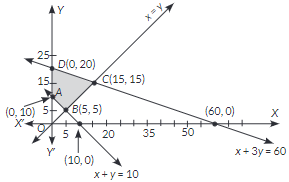
| Corner points | Value of Z=3x+9y |
| A(0,10) | 3xx0+9xx10=90 |
| B(5,5) | 3xx5+9xx5=60 |
| C(15,15) | 3xx15+9xx15=180 (Maximum) |
| D(0,20) | 3xx0+9xx20=180 (Maximum) |


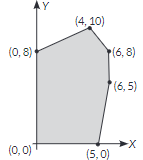
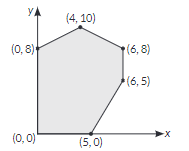
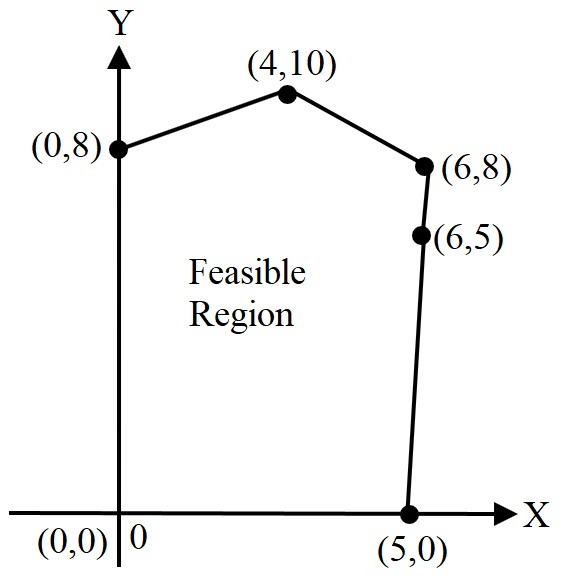
| Corner points | Value of Z=2x-3y |
| (0,0) | 2xx0-3xx0=0 |
| (0,8) | 2xx0-3xx8=-24 (Minimum) |
| (4,10) | 2xx4-3xx10=-22 |
| (6,8) | 2xx6-3xx8=-12 |
| (6,5) | 2xx6-3xx5=-3 |
| (5,0) | 2xx5-3xx0=10 |


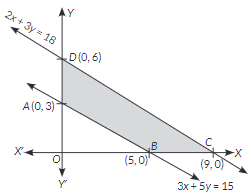
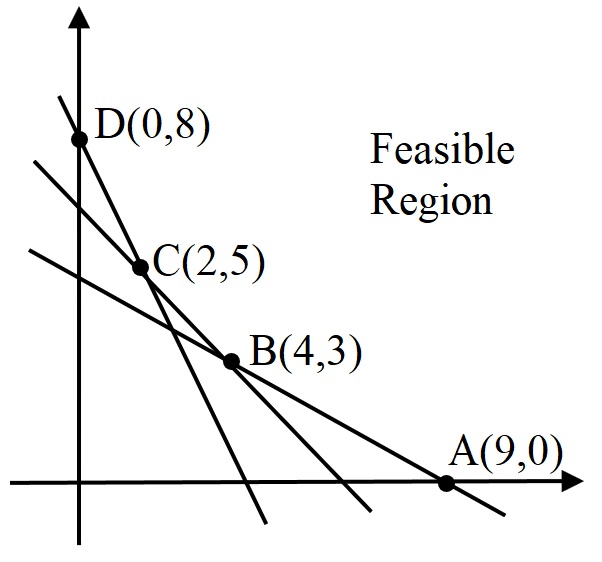
| Corner points | Value of Z=30 x+50 y |
| A(0,3) | 30 xx0+50 xx3=150 (Minimum) |
| B(5,0) | 30 xx5+50 xx0=150quad (Minimum) |
| C(9,0) | 30 xx9+50 xx0=270 |
| D(0,6) | 30 xx0+50 xx6=300 |

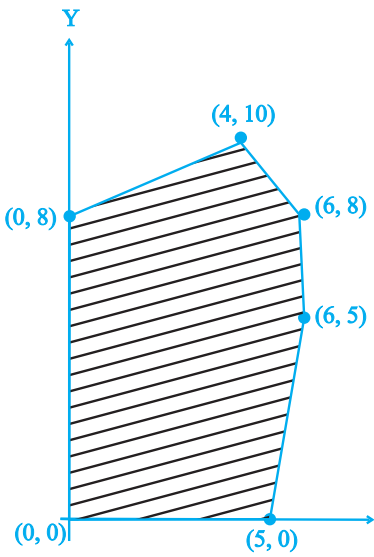
| Corner points | Value of z=3x-4y |
| (0,0) | 0 |
| (5,0) | 15 |
| (6,5) | -2 |
| (6,8) | -14 |
| (4,10) | -28 |
| (0,8) | -32 larr Minimum |
Solution:
4a + 0b = 2a + 4b
4a = 2a + 4b
4a - 2a = 4b
2a = 4b
a = 2b

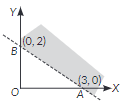
| Corner point | Value of Z=px+qy;p,q > 0 |
| (0,3) | p xx0+q xx3=3q |
| (1,1) | p xx1+q xx1=p+q |
| (3,0) | p xx3+q xx0=3p |


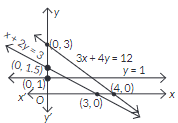
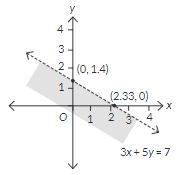
| x | 0 | 2.33 |
| y | 1.4 | 0 |

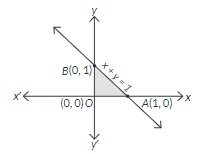
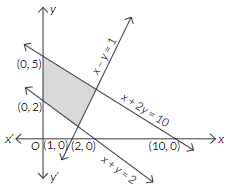
| x | 0 | 1 |
| y | 0 | 1 |
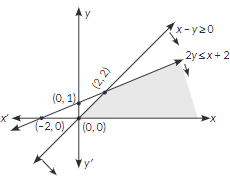
| x | 0 | -2 |
| y | 1 | 0 |


Solution:
The feasibe solution of a inear programming probem (LP) is a solution that must satisfy all of the problems constraints simultaniously.
Solution:
Formula used:
a3 + b3 = (a + b)(a2 - ab + b2)
$\frac{0.76\times0.76\times0.76+0.24\times0.24\times0.24}{0.76\times0.76-0.76\times0.24+ 0.24+0.24}$
$\frac{(0.76)^{3}+(0.24)^{3}}{0.76\times0.76-0.76\times0.24+0.24+0.24}$
$=\frac{(0.76+0.24)(0.76\times0.76-0.76\times0.24+0.24\times0.24)}{0.76\times0.76-0.76\times0.24+0.24\times0.24}$
$=(0.76+0.24)=1$
none of these
Solution:
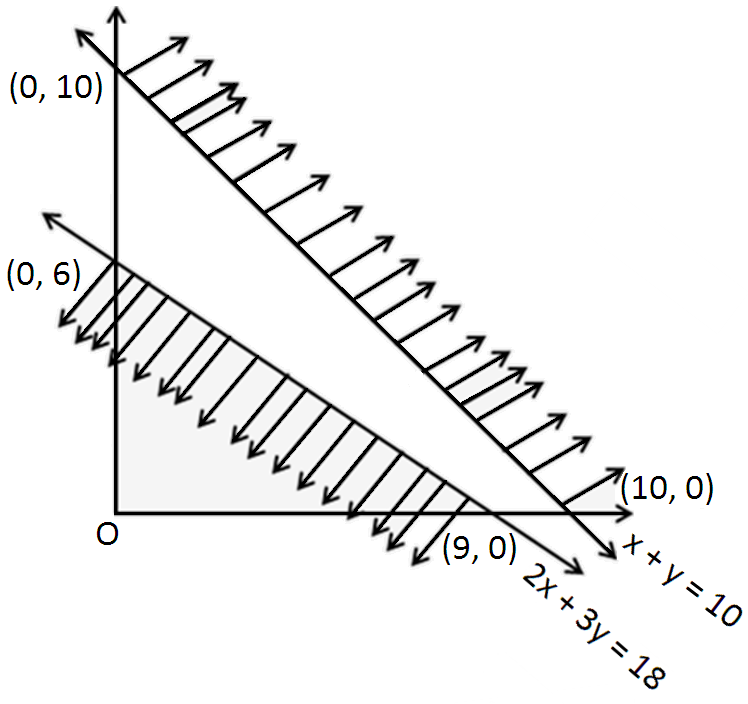
Consider, 2x + 3y = 18
| x | y | (x, y) |
| 0 | 6 | (0, 6) |
| 9 | 0 | (9, 0) |
Consider, x + y = 10
| x | y | (x, y) |
| 0 | 10 | (0, 10) |
| 10 | 0 | (10, 0) |

From the graph we conclude that no feasible region exist.
Solution:
We need to maximize the function Z = 4x + 3y
Converting the given inequations into equations, we obtain
3x + 2y = 160, 5x + 2y = 200, x + 2y = 80, x = 0 and y = 0
Region represented by 3x + 2y ≥ 160:
The line 3x + 2y = 160 meets the coordinate axes at A1603,0 and B(0, 80) respectively.
By joining these points we obtain the line 3x + 2y = 160.
Clearly (0, 0) does not satisfies the inequation 3x + 2y ≥ 160.
So, the region in xy plane which does not contain the origin represents the solution set of the inequation 3x + 2y ≥ 160.
Region represented by 5x +2y ≥ 200:
The line 5x + 2y = 200 meets the coordinate axes at C(40, 0) and D(0, 100) respectively.
By joining these points we obtain the line 5x + 2y = 200.
Clearly (0, 0) does not satisfies the inequation 5x +2y ≥ 200.
So, the region which does not contain the origin represents the solution set of the inequation 5x +2y ≥ 200.
Region represented by x +2y ≥ 80:
The line x + 2y = 80 meets the coordinate axes at E(80, 0) and F(0, 40) respectively.
By joining these points we obtain the line x + 2y = 80.
Clearly (0, 0) does not satisfies the inequation x + 2y ≥ 80.
So, the region which does not contain the origin represents the solution set of the inequation x + 2y ≥ 80.
Region represented by x ≥ 0 and y ≥ 0:
Since, every point in the first quadrant satisfies these inequations.
So, the first quadrant is the region represented by the inequations x ≥ 0, and y ≥ 0.
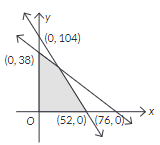
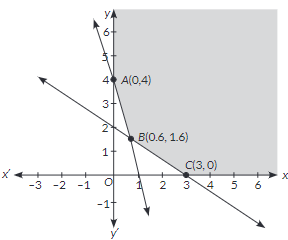
The feasible region determined by the system of constraints 3x + 2y ≥ 160,5x+2y ≥ 200, x +2y ≥ 80, x ≥ 0, and y ≥ 0 are as follows.
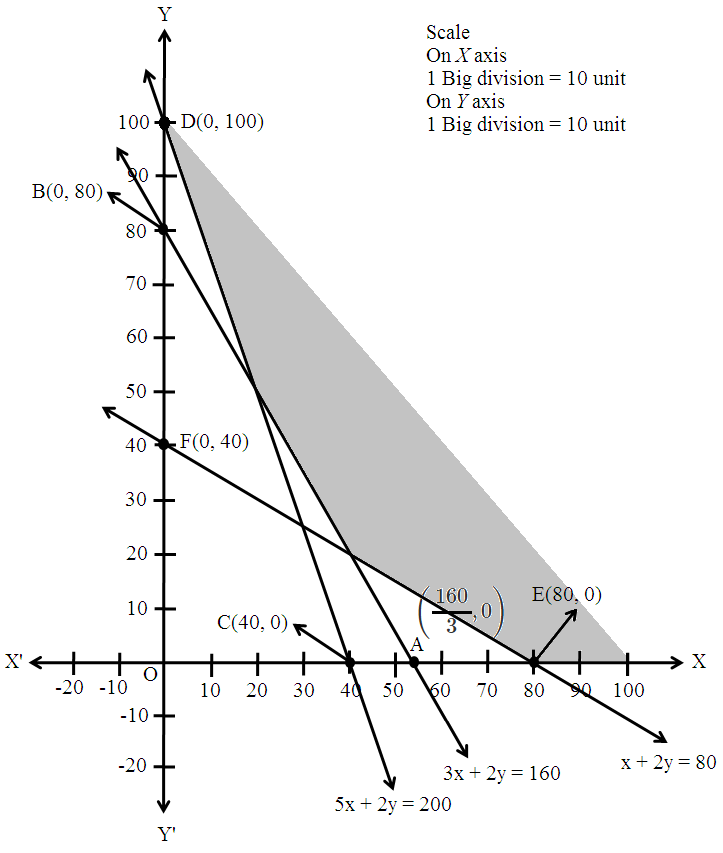
Here, we see that the feasible region is unbounded.
Therefore,maximum value is infinity.
Solution:
There are different methods to solve an linear programming problem.
Such as Graphical method, Simplex method, Ellipsoid method, Interior point methods.
q = 3p.
Explanation:
The maximum value of Z is unique.
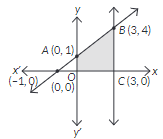
It is given that the maximum value of Z occurs at two points, (3, 4) and (0, 5).
$\therefore$ Value of z at (3, 4) = Value of z at (0, 5)
⇒ p(3) + q(4) = p(0) + q(5)
⇒ 3p + 4q = 5q
⇒ q = 3p
Hence, the correct answer is D.

Solution:
| Corner points | Corresponding value of Z = 3x - 4y |
| (0, 0) (5, 0) (6, 5) (6, 8) (4, 10) (0, 8) | 0 15 (Maximum) -2 -14 -28 -32 (Minimum) |
Here, maximum value of Z + minimum value of Z = 15 - 32 = -17.
Solution:
Constraints will be
x11 + x21 + ..... + xm1 = b1
x12 + x22 + ..... + xm2 = b2
x1n + x2n + ..... + xmn = bn
x11 + x12 + ..... + x1n = b1
x21 + x22 + ..... + x2n = b2
xm1 + xm2 + ..... + xmn = bn
So the total number of constraints = m + n